Posted by: James Wapotich | July 21, 2014

Trail Quest: Orpet and Franceschi Parks

On the Santa Barbara Riviera are two parks named for men who made significant contributions to landscapes and gardens of Santa Barbara.

The two parks can be connected with a fun urban hike of about four miles round trip that makes use of several “hidden” stairways and offers a chance to explore some of the Riviera.

The hike can be started at the end of East Pedregosa Street, where Pedregosa Street meets Grand Avenue. Here, you can find a set of stairs on the left hand side of the noticeable sandstone wall.
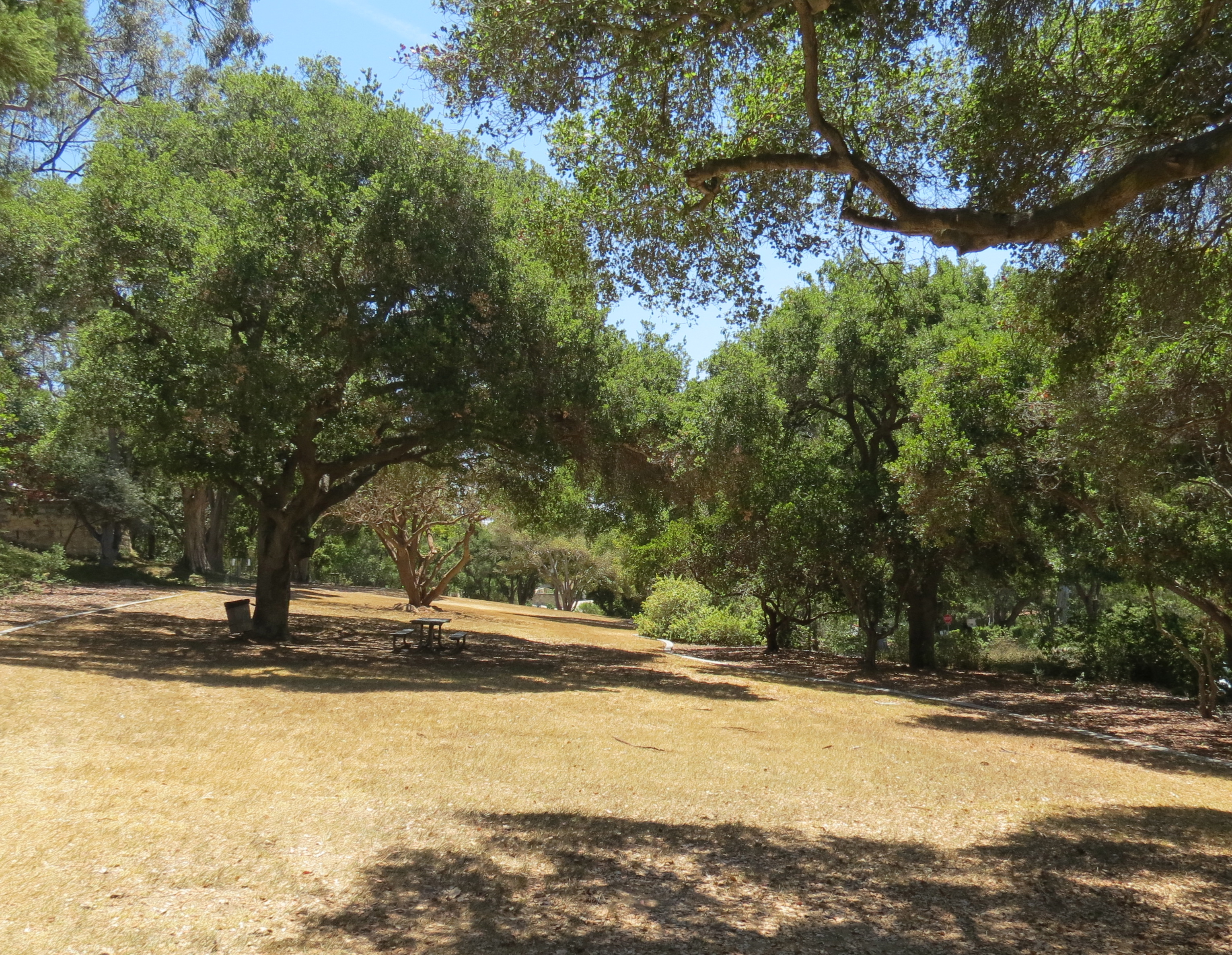
Orpet Park Riviera Santa Barbara hike

North Orpet Park

Pedregosa Street is one block south of Mission Street, which can be reached from Highway 101 by taking the Mission Street exit and continuing north towards the Santa Barbara Mission. From Mission Street turn right onto Garden Street to reach Pedregosa Street, and continue to the end of Pedregosa Street. Parking can be found along the residential streets.

As with any urban hike please be respectful of private property and help preserve the quiet enjoyed by the residents of the neighborhoods that you pass through.

The shaded stairway climbs up towards and crosses an extension of Loma Street where you can find a second, shorter set of stairs that takes you up to the last little section of East Pedregosa Street, just below Alameda Padre Serra.
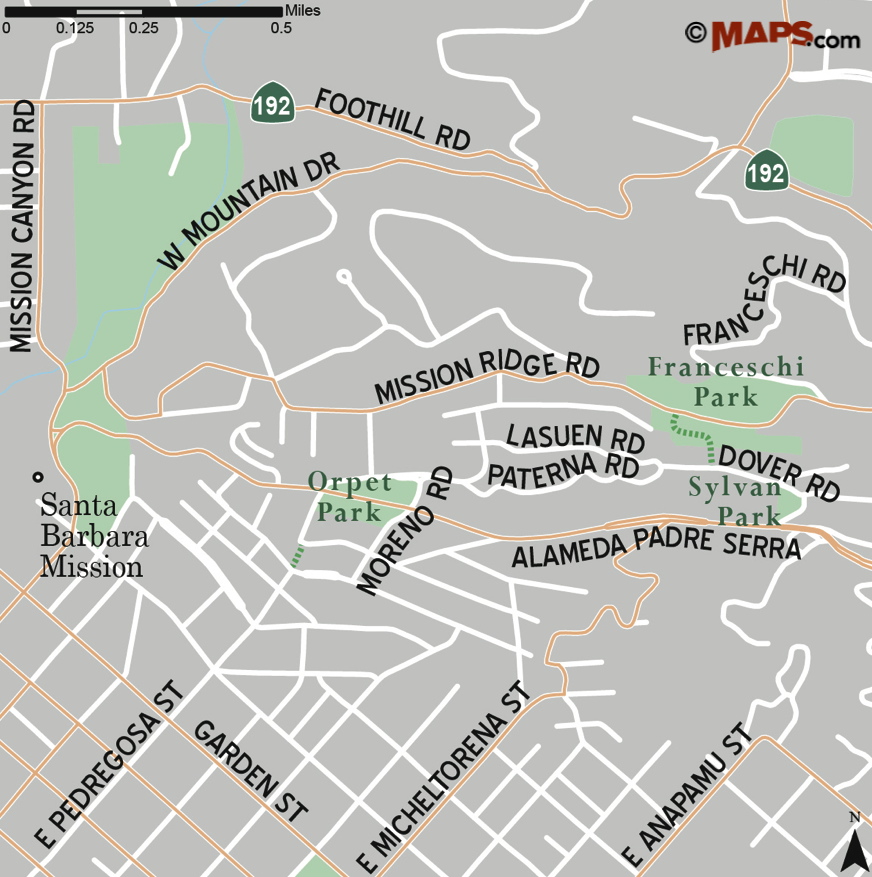
map orpet franceschi park santa barbara urban hike trail

Map courtesy Maps.com

On your right is the western end of Orpet Park. From here, one can follow one of the paths that leads east through the southern half of the park and either continue to Moreno Road or turn north and cross Alameda Padre Serra and explore the northern half of the park. The park is open from sunrise to 10:00 p.m. and includes open grassy areas and picnic tables in both the halves of the park.

Originally called Hillside Park, Orpet Park was named for Edward Owen Orpet, who served as Superintendent of Parks for the City of Santa Barbara from 1921-1930 and established the 4-acre park to showcase plants that could be used for landscaping in our area.

Among his accomplishments, Orpet popularized the use of aloes in landscaping locally, encouraged the California Highway Department to use iceplant along roadways for erosion control, and successfully got plants to grow on the barren island in the middle of the Andrea Clark Bird Refuge.

In 1963, the park that he helped plant was renamed in his honor.

From Orpet Park, to continue towards Franceschi Park, follow Moreno Road north from Alameda Padre Serra to Lasuen Road. Turn right onto Lasuen Road and follow it a short way to Paterna Road, then continue east along Paterna Road.
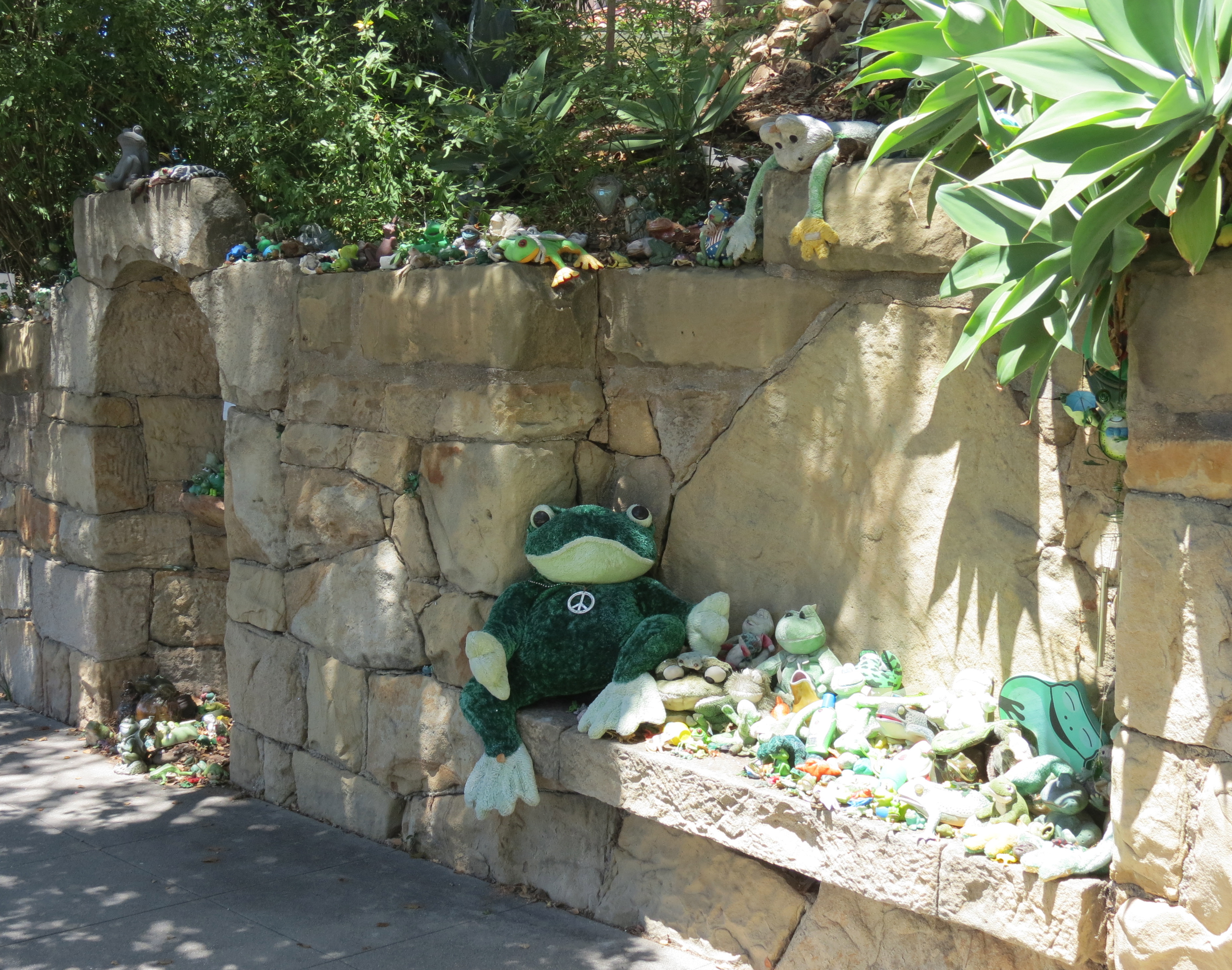
Frog Shrine Riviera Santa Barbara

Frog Shrine

This route leads you past what’s known as the Frog Shrine on the left hand side of the road. It’s said that the first frog appeared here in 1989, and over the years, visitors have added their own figurines, stuffed animals and other tributes to frogs bringing the count of memorabilia well into the hundreds.

Continuing past the shrine, Paterna Road arrives at the intersection of Lasuen and Dover Roads. From here, continue a short way east along Dover Road and look for a set of stairs on your left.

These stairs lead through the lower half of Franceschi Park. There are a number of terraced paths through this part of the park, but by generally taking the steeper of any two routes you’ll find your way up to Mission Ridge Road.
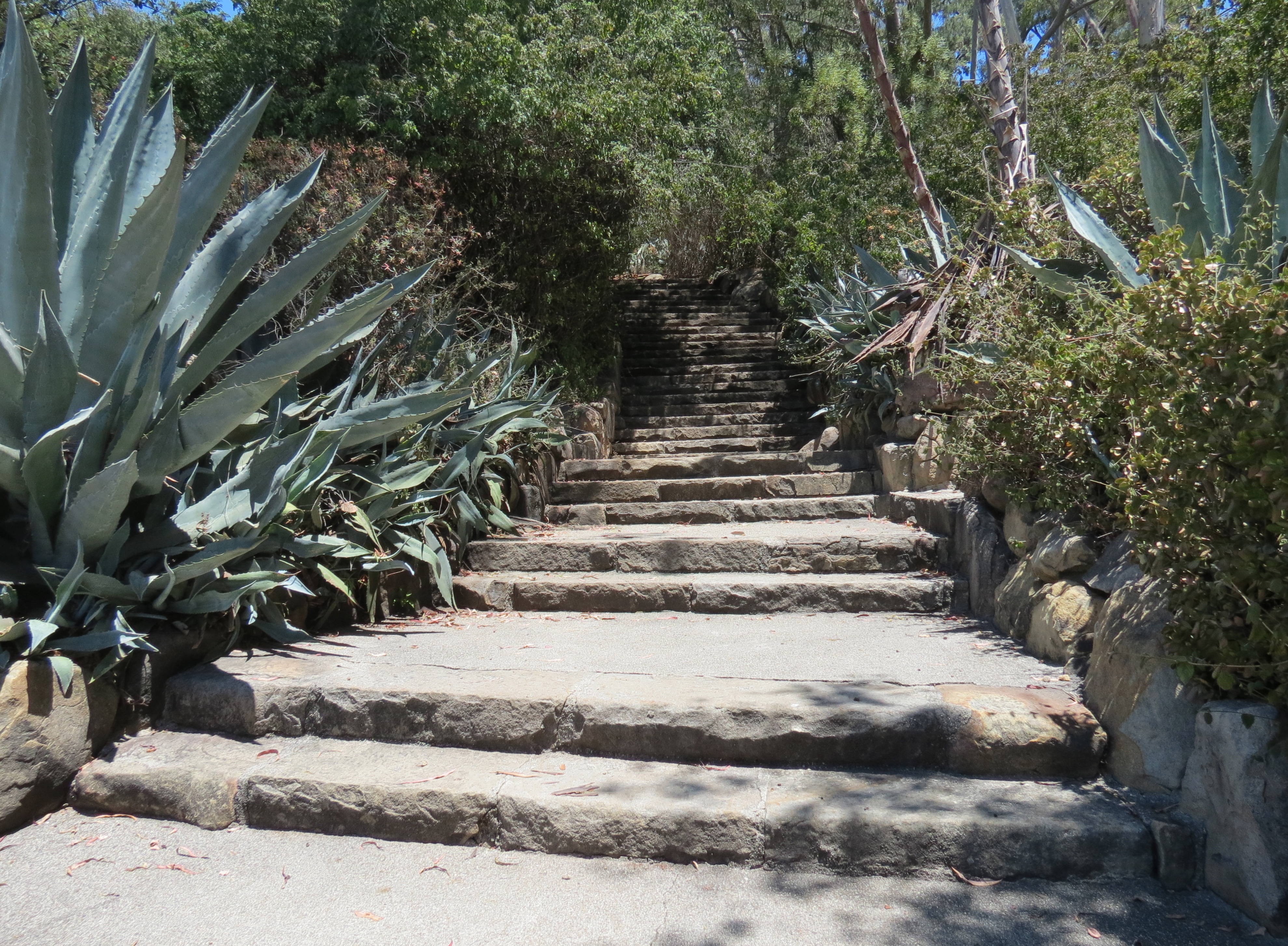
Franceschi Park hidden secret stairway Riviera Santa Barbara hike

“Hidden” stairway along Dover Road

Continue east along Mission Ridge Road to Franceschi Road. From Franceschi Road, one can follow the access road that leads west to the main house, near the center of the park, or take one of the footpaths that parallel the road.

At the end of the access road one can find exceptional views out across the city of Santa Barbara and out towards the Channel Islands. Just below the access road are two picnic tables and a drinking fountain. Nearby are public restrooms, and to the left of the picnic area, overlooking the city, is what’s left of Franceschi House. The park is open from sunrise to a half hour after sunset.

The 15-acre park is named for Francesco Franceschi, who was a well known horticulturist and is credited with introducing hundreds of plants to our area for landscaping and cultivation, and was considered an early advocate of using drought tolerant plants.

Born in Florence, Italy in 1843 with the given name of Emanuele Orazio Fenzi, Franceschi moved to the United States in 1891 following an economic downturn it Italy, and changed his name to Francesco Franceschi.
Franceschi Park Riviera urban hike trail Santa Barbara

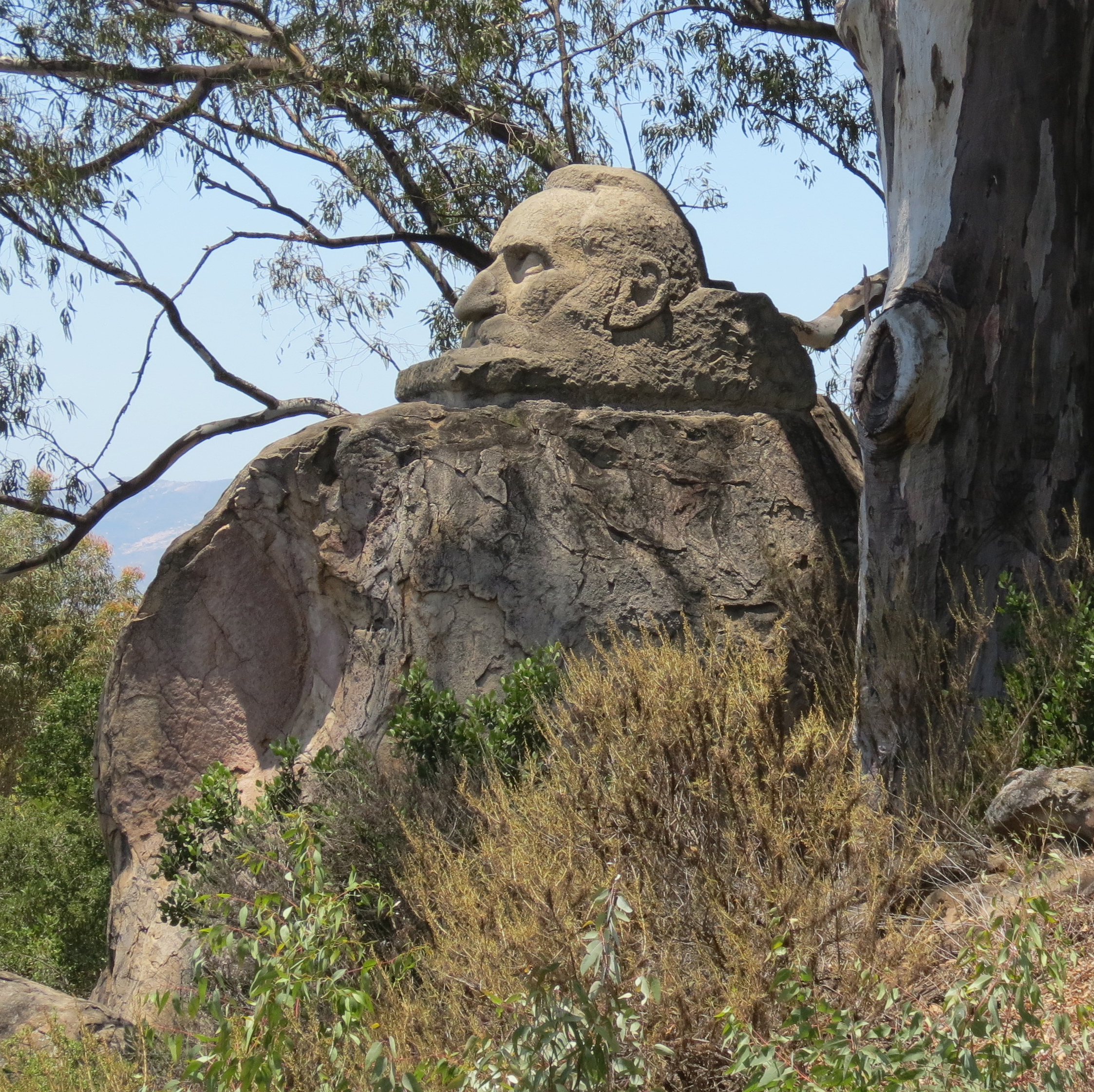
The carved sandstone head of Francesco Franceschi overlooks the city at Franceschi Park

In 1893, already passionate about plants, he moved to Santa Barbara and started an acclimatizing garden where he could study which plants from around the world could best be adapted to our Mediterranean climate, and how to cultivate and propagate them so they could be used commercially for landscaping and gardens.

In 1903, Franceschi’s wife, Cristina, purchased 40 acres of land along Mission Ridge Road in what is now known as the Riviera. On the property they built a two-story Craftsman style redwood house and named the site Montarioso, Italian for airy mountain. Here, Franceschi cultivated 10 acres with a variety of plants in order to continue his studies and showcase those plants that could best be adapted to our local environment.

In 1913, Franceschi accepted a job from the King of Italy to help introduce agricultural and ornamental plants in what was then the Italian colony of Libya, while other members of his family stayed behind to manage the Santa Barbara property. During this time portions of the 40-acre property were sold to offset operating expenses. Franceschi passed away in Libya in 1924.

In 1927, Alden Freeman purchased the house and two surrounding acres with the intent of creating a park to memorialize Franceschi and his work. He also bought back other parts of the property that had been previously sold. Freeman also added to the property the area below Mission Ridge Road with a larger vision of creating an open space with trails that would reach down to Milpas Street.

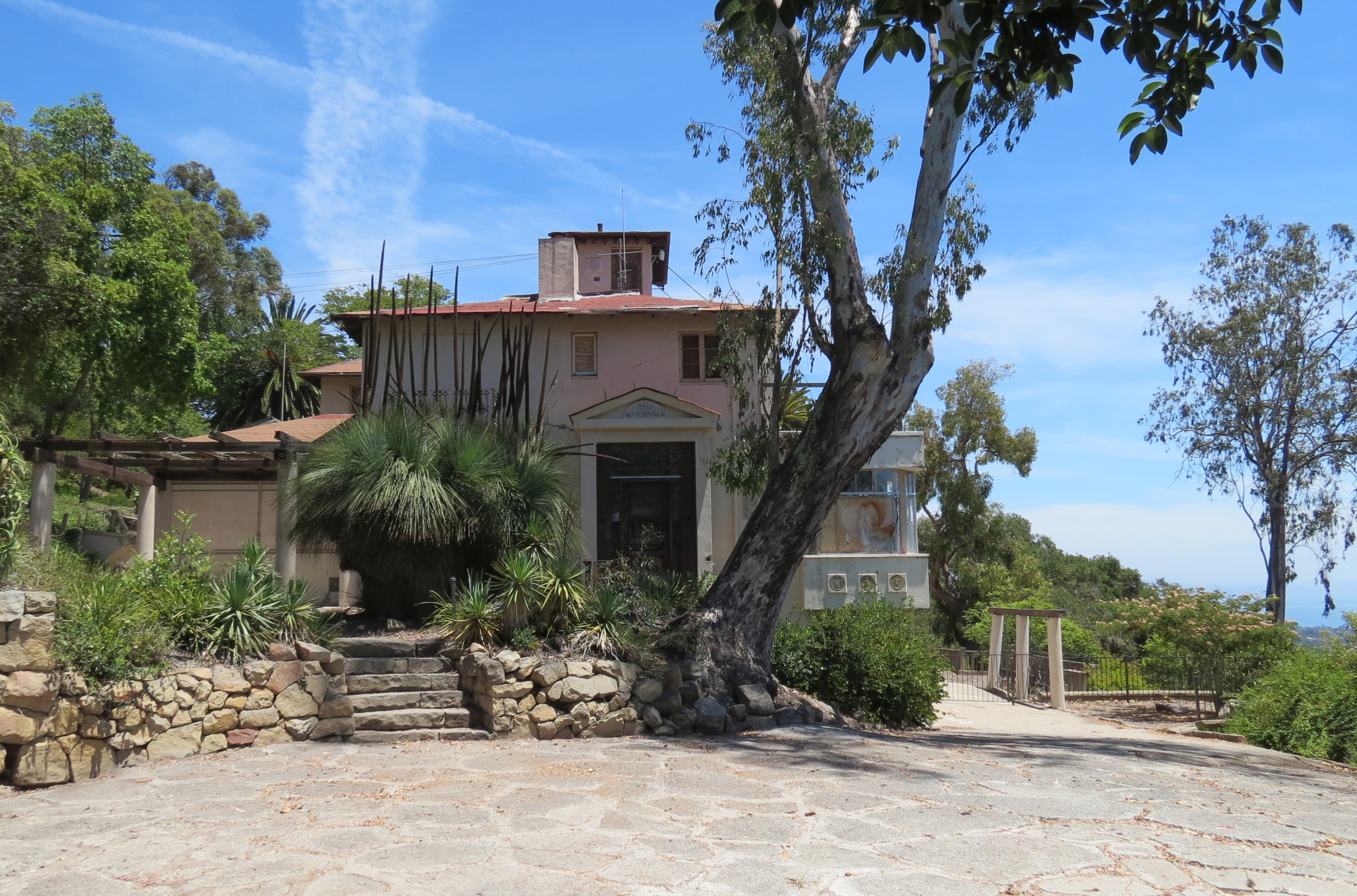
Freeman remodeled the house and covered the outside with plaques and medallions commemorating Franceschi, selected historical events, and other notable individuals. Freeman also commissioned a large carved sandstone head of Franceschi. The sculpture can still be found by starting from the end of the main access road and continuing west through the less developed part of the park.
Franceschi House Park Riviera Santa Barbara hike

Franceschi House

In 1931, Freeman gave the property to the city of Santa Barbara for use as a park. Pathways were added throughout the park during the 1930s as part of a Works Project Administration (WPA) program.

And for a period of time, Franceschi House was used to teach classes on horticulture. However, over the years the house has fallen into disuse and is in need of repair. There have been various plans to renovate the building and turn it into an interpretive center, but lack of funding has left it in its current state, and closed to the public.

Nevertheless, Franceschi’s legacy endures, today many of the plants he planted can still be found in the eastern end of the park. And with some hunting around, one can find examples of rare palms, two specimens of grass tree from Australia, as well as pines from around the world including a chir pine from the Himalayas.

In addition to introducing plants to our area, Franceschi also helped introduce plants from our area to the rest of the world. He was the first to cultivate Santa Cruz ironwood on the mainland by bringing a sample from the island and learning how to propagate it for commercial use.

In many ways, both Orpet and Franceschi Parks offer an opportunity to reflect on the legacies and contributions of each of these men.

This article originally appeared in section A of the July 21st, 2014 edition of Santa Barbara News-Press.

Lagniappe

The inspiration for this article came from a Sierra Club hike I did that more or less followed this same route. But what moved it up on my list as something to write about was when I learned both parks were named after people who were interested in learning which plants from around the world could be successfully grown here and that the parks also served as demonstration gardens. The Santa Barbara Historical Museum proved to be an invaluable resource for digging deeper into the history of these two men and the histories of the parks.

A third, nearby park in the area I wasn’t able to weave into the article is Sylvan Park. This one-acre piece of land was also purchased in 1927 by Freeman and donated to the city. The park is located at the eastern end of Dover Road where it meets Alameda Padre Serra, and to quote the Santa Barbara Parks and Recreation website, is “a small neighborhood park overlooking the city and a good place for some quiet reading, an informal picnic, or a quick walk with a dog.”

My photo of Franceschi house was featured in the Spring 2017 issue of the National Trust for Historic Preservation’s Preservation Magazinehttps://savingplaces.org/stories/santa-barbara-debates-franceschi-houses-future

Posted by: James Wapotich | July 7, 2014

Trail Quest: Cedar Creek

Although the trails associated with the upper reaches of Piru Creek are a bit of drive from Santa Barbara, the area offers some unique scenery that can make the visit worthwhile.

Piru Creek is one of the main tributaries of Santa Clara River. Its headwaters are located on the north side of Pine Mountain Ridge in Sespe Wilderness, and much of the creek’s course travels through Los Padres National Forest.

And while one can find pine forests in various parts of our local backcountry, more often than not they’re confined to ridges and mountain tops. Here, along both the upper stretches of Piru and Cedar Creeks one can find small, flat valleys dotted with pines and Great Basin sagebrush, making for scenery distinct from the chaparral more commonly found in our backcountry.

Piru Creek Sespe Wilderness Ojai Fishbowls Trail hike camp Grade Valley Lockwood

Willow flourishing along Piru Creek

The two main trails through the area are Fishbowls Trail and Cedar Creek Trail. Both of which feature campsites situated along a creek that can make for good backpacking destinations.

The trails can be accessed from Grade Valley Road near Lockwood Valley. And because the two trailheads are just 1.5 miles apart, one can easily make a loop hike employing both trails and thereby getting to see more of the area. The full loop is about 12 miles and both camps generally have water.

To get to the trailhead from Santa Barbara, make your way to Ojai and take State Route 33 north towards Cuyama. The road crests Pine Mountain summit before descending down towards the Cuyama Valley. As it reaches the valley floor it arrives at the intersection with Lockwood Valley Road. Turn right and continue east on Lockwood Valley Road to Grade Valley Road.

Grade Valley Road can also be reached from Interstate 5, and is roughly halfway between Interstate 5 and State Route 33. For this route, continue east from Ventura along State Route 126 to Interstate 5. Head north on Interstate 5 just past Gorman to Frazier Mountain Park Road. Follow Frazier Mountain Park Road west to Lockwood Valley Road and the turnoff for Grade Valley Road. And although this route is slightly longer, the roads used are mostly freeway and less winding, and so the amount of actual drive time is comparable.

map cedar creek fishbowls sespe wilderness grade valley road piru creek los padres national forest

Map courtesy Maps.com

Grade Valley Road is the name given to main road, as well as several turnoffs that lead to various trailheads and campgrounds. The main route is designated by the Forest Service as 7N03, while the side roads are given designations such as 7N03A and 7N03B. Each of the turnoffs is well marked.

To reach the Fishbowls Trailhead continue south along the main road. The road is paved for the first 1.5 miles, but quickly becomes unpaved. The road is in generally in good shape and suitable for most vehicles heading to the first trailhead, although a high clearance vehicle will make it easier to visit the other campgrounds and trailheads in the area. The road is seasonally closed from December to May, and it’s good to check with the Forest Service regarding current conditions before any trip.

Grade Valley is a long, open meadow dotted with sagebrush and is an impressive sight in and of itself.

At about the 7-mile mark from Lockwood Valley Road, Grade Valley Road arrives at Fishbowls Trailhead, where one can find parking and an outhouse. Total drive time from Santa Barbara is about 2.5 hours. An adventure pass is not required to park at the trailheads.

From the Fishbowls Trailhead, Fishbowls Trail climbs over a small rise before making its descent down towards Piru Creek. Here, the trail follows an old road cut which makes for generally easy hiking. The trail follows Piru Creek upstream and leads through some rich scenery of mostly pines and Great Basin sagebrush, offset by willow growing along the creek.

At about the 3.5-mile mark, the trail enters Sespe Wilderness and continues upstream. As the canyon begins to narrows one starts to see more cedar trees mixed in with the pines, and depending on the season one can find snow plant, or sarcodes, with their bright red bloom growing amongst the pine duff.

At about the 5.5-mile mark, the trail arrives at the first two campsites associated with Fishbowls Camp. On the north side of the creek one can find a campsite with a grated stove under the cedars tucked up against a rock outcropping, and then on the back side of the rock a second improvised site.

Fishbowls Trail continues across the creek where the trail branches. Here, a side trail continues upstream along the south side of the creek, passing three more campsites, each with a metal fire ring. Past the last of these three sites is a social trail that continues up the creek to the first of several sandstone pools that gives the camp its name.

Fishbowls cedar creek trail Los Padres National Forest hike trail sespe wilderness

Silt has filled in the pools at Fishbowls along Piru Creek

Normally these pools would make for inviting swim holes, however this year’s one substantial storm has filled the pools with silt. Nonetheless the creek can make for some fun exploring.

Continuing past Fishbowls Camp, Fishbowls Trail climbs up a side drainage, moving away from Piru Creek as it makes its way towards Cedar Creek Trail. As Fishbowls Trail climbs up onto the ridge separating the Piru and Cedar Creek drainages it offers some expansive views of the surrounding area including Mt. Pinos and Grade Valley to the north.

About 1.5 miles from Fishbowls Camp, the trail arrives at the intersection with Cedar Creek Trail. To the left, Cedar Creek Trail continues another 1.5 miles down to Cedar Creek Camp. And to the right, Cedar Creek Trail continues roughly 2.5 miles over towards Gene-Marshal Piedra Blanca Trail and Pine Mountain Lodge Camp.

Gene Marshall-Piedra Blanca Trial represents an alternate way to visit Fishbowls and Cedar Creek Camps as part of a longer backpacking or shuttle trip, by starting at either Piedra Blanca to the south or Reyes Creek Campground to the north. Cedar Creek Trail is in generally good shape and water can often be found in Piedra Blanca Creek near Pine Mountain Lodge Camp.

From the intersection with Fishbowls Trail, Cedar Creek Trail continues towards Cedar Creek Camp. Here, the views extend east out towards San Rafael and Frazier Mountains, and to the south towards Thorn Point, where with some luck one can spot Thorn Point Lookout.

Piru Creek Fishbowls Los Padres National Forest Sespe Wilderness hike campground Grade Valley

Pines along Piru Creek

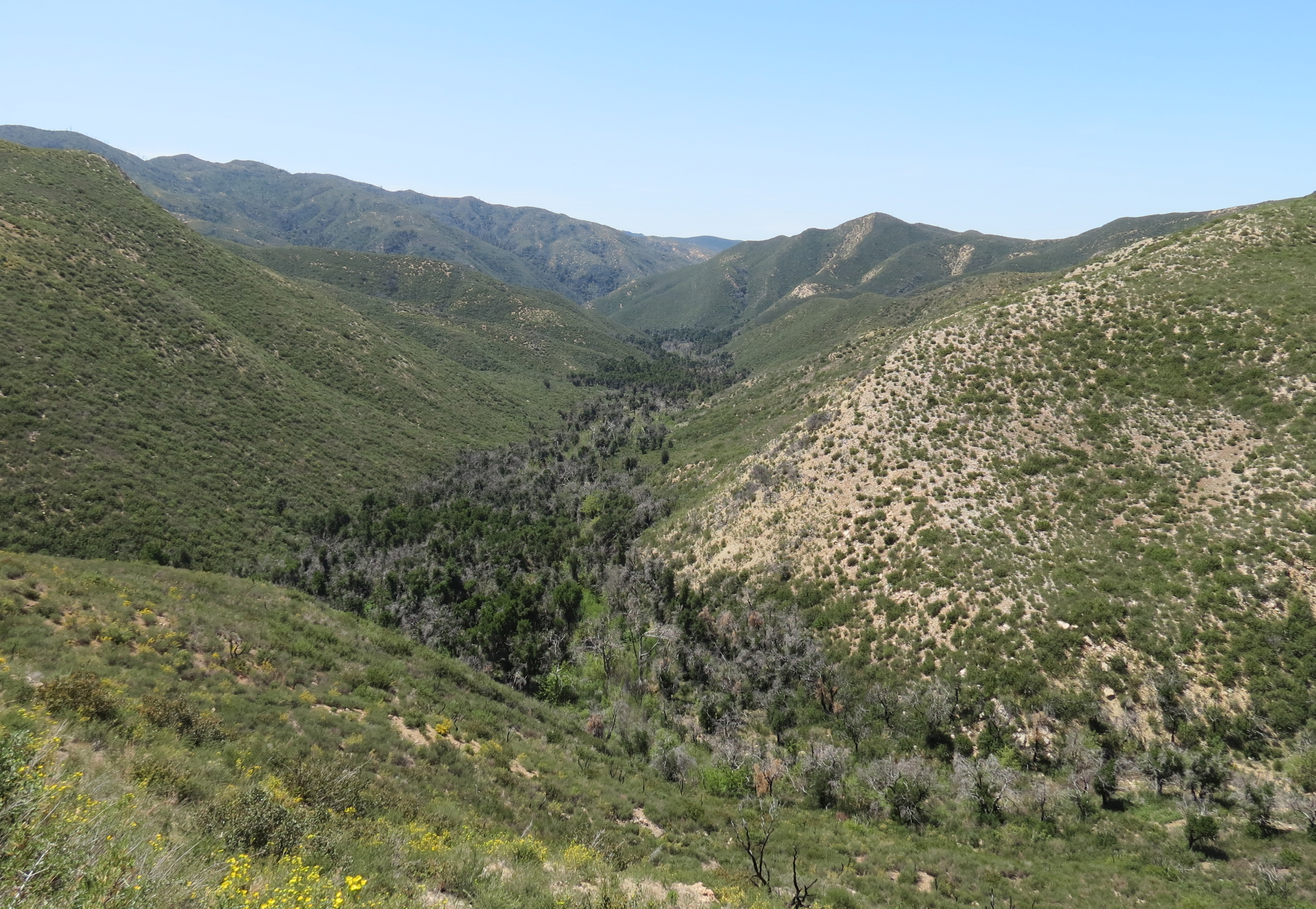
Cedar Creek Camp has three campsites each with a fire ring tucked under the pines and cedars. The camp is situated near the confluence of South Fork Cedar Creek and an unnamed side creek. The area was not burned in the 2006 Day Fire.

The camp and creek are named for the California incense cedars that grow in the area.

From Cedar Creek Camp, Cedar Creek Trail continues downstream along South Fork Cedar Creek through scenery similar to Piru Creek and Fishbowls Trail. About 2.5 miles from Cedar Creek Camp the trail arrives at the Cedar Creek Trailhead and Forest Service Road 7N03B, also referred to as Grade Valley Road, and perhaps more easily identifiable as the road to Thorn Meadows.

From here, to return to Fishbowls Trailhead, turn left, and continue along the road. About a mile later the road arrives at the intersection with the main route of Grade Valley Road, near the confluence of Cedar and Piru Creeks. From here, stay to the left and continue another half mile north to Fishbowls Trailhead.

If you’re hiking the route in reverse route and starting from Cedar Creek Trailhead, parking is found along the road at Cedar Creek Trailhead. About a mile past the trailhead, the road dead ends at Thorn Meadows Campground, where can also find the beginning of the trail that leads to Thorn Point.

Regardless of how far you hike you’ll get to see a unique corner of our local backcountry.

This article originally appeared in section A of the July 7th, 2014 edition of Santa Barbara News-Press. Thanks again to Maps.com for creating maps for the articles.

Posted by: James Wapotich | July 2, 2014

Trail Quest: Santa Barbara 100

While marathon running can bring to mind images of the original marathon run across the hillsides of Greece, ultra-marathon running or ultra-running, with its longer distances, can be more evocative of the feats accomplished by the Tarahumara Indians in Mexico or Incas in the Andes of South America.

An ultra-marathon is essentially any race longer than the traditional 26.2-mile marathon. Some of the more well known endurance races that take place in the mountains are Hard Rock 100 in Colorado and Western States Endurance Run in Squaw Valley, California.

Santa Barbara 100, formerly called DRTE 100, for Dirt Roads Trails Endurance and pronounced “Dirty 100”, takes place on the trails in Los Padres National Forest.

Santa Barbara trail run runners  los padres national forest

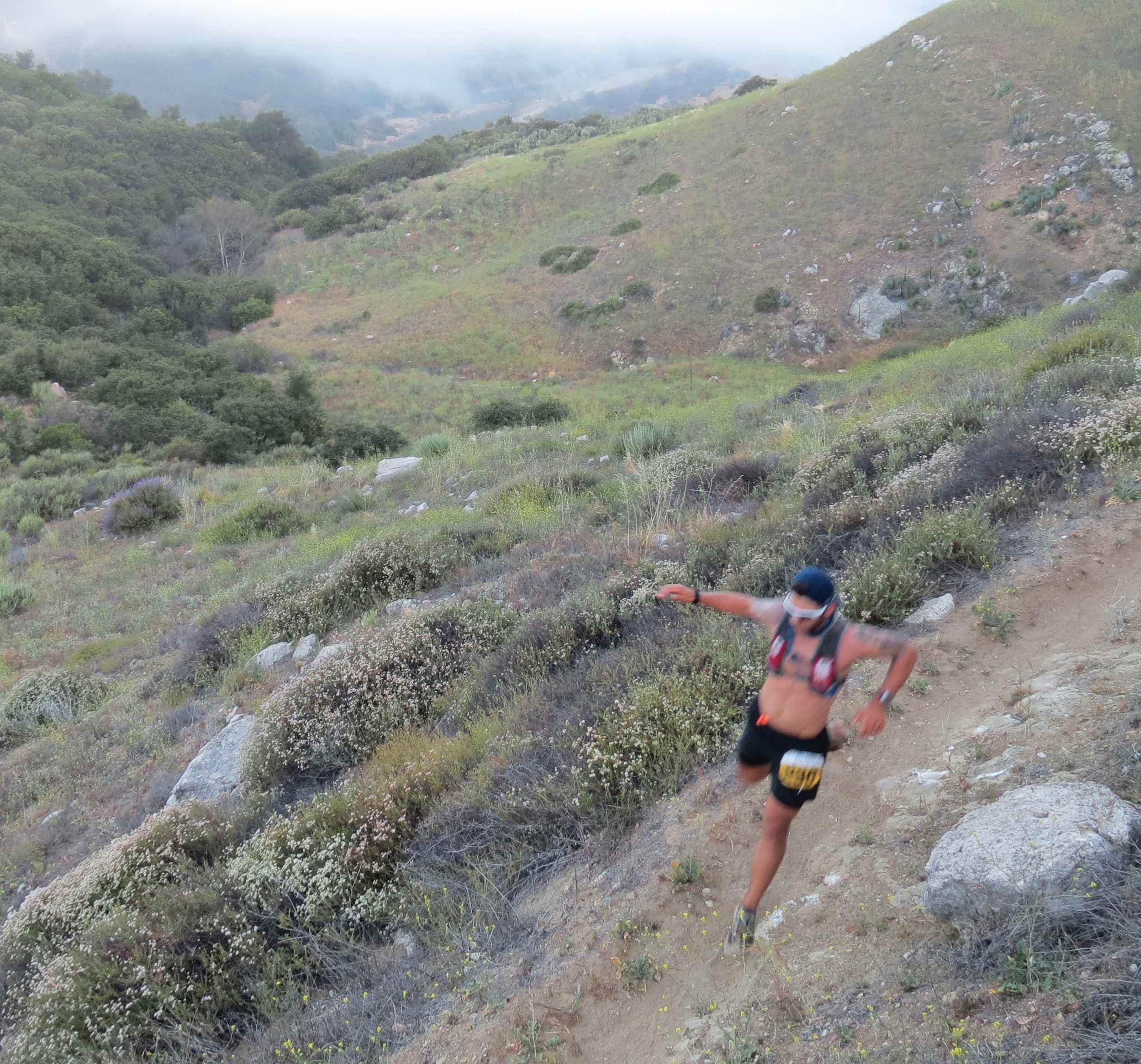
A runner in flight coming down Camuesa Connector Trail

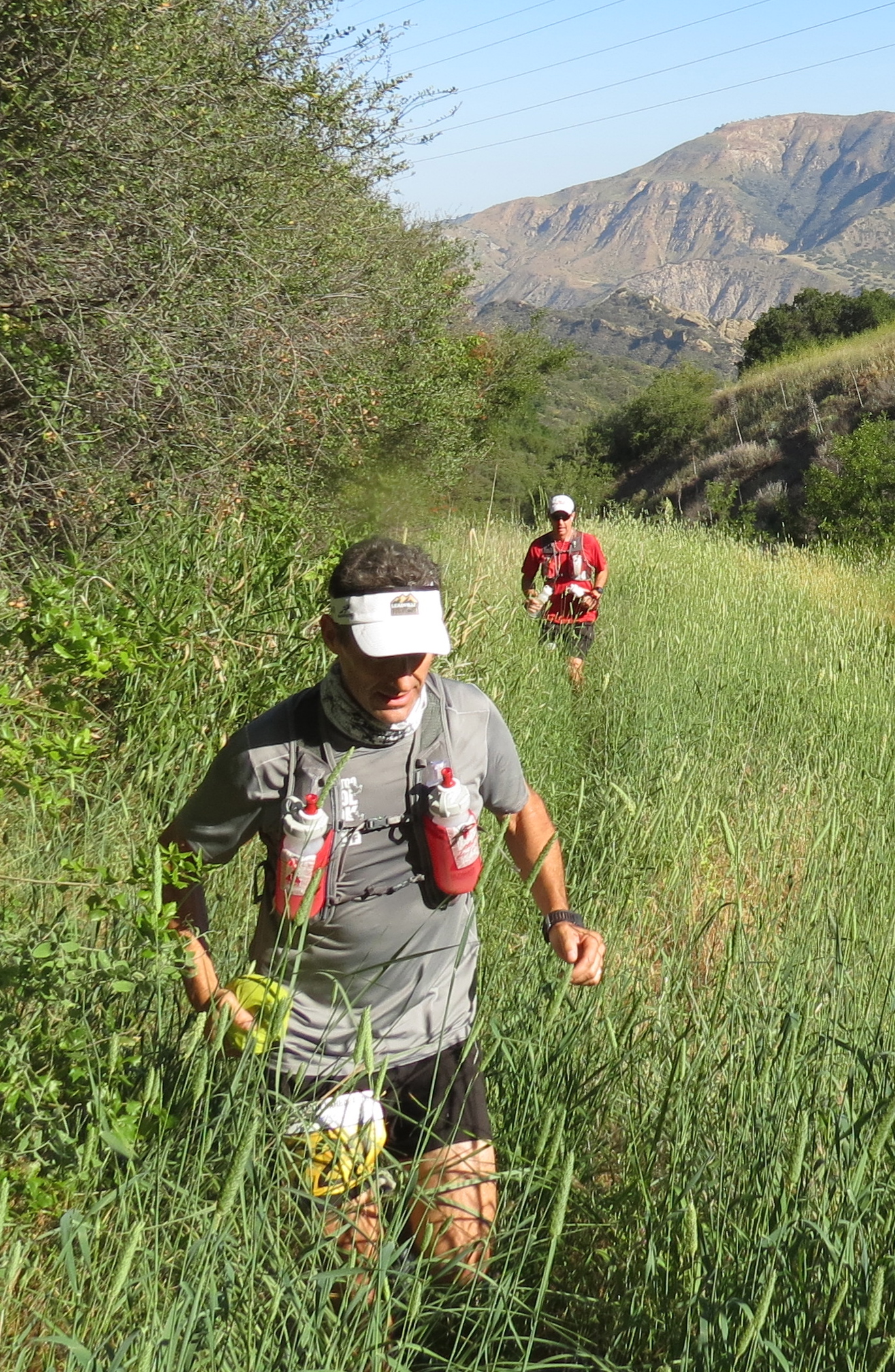
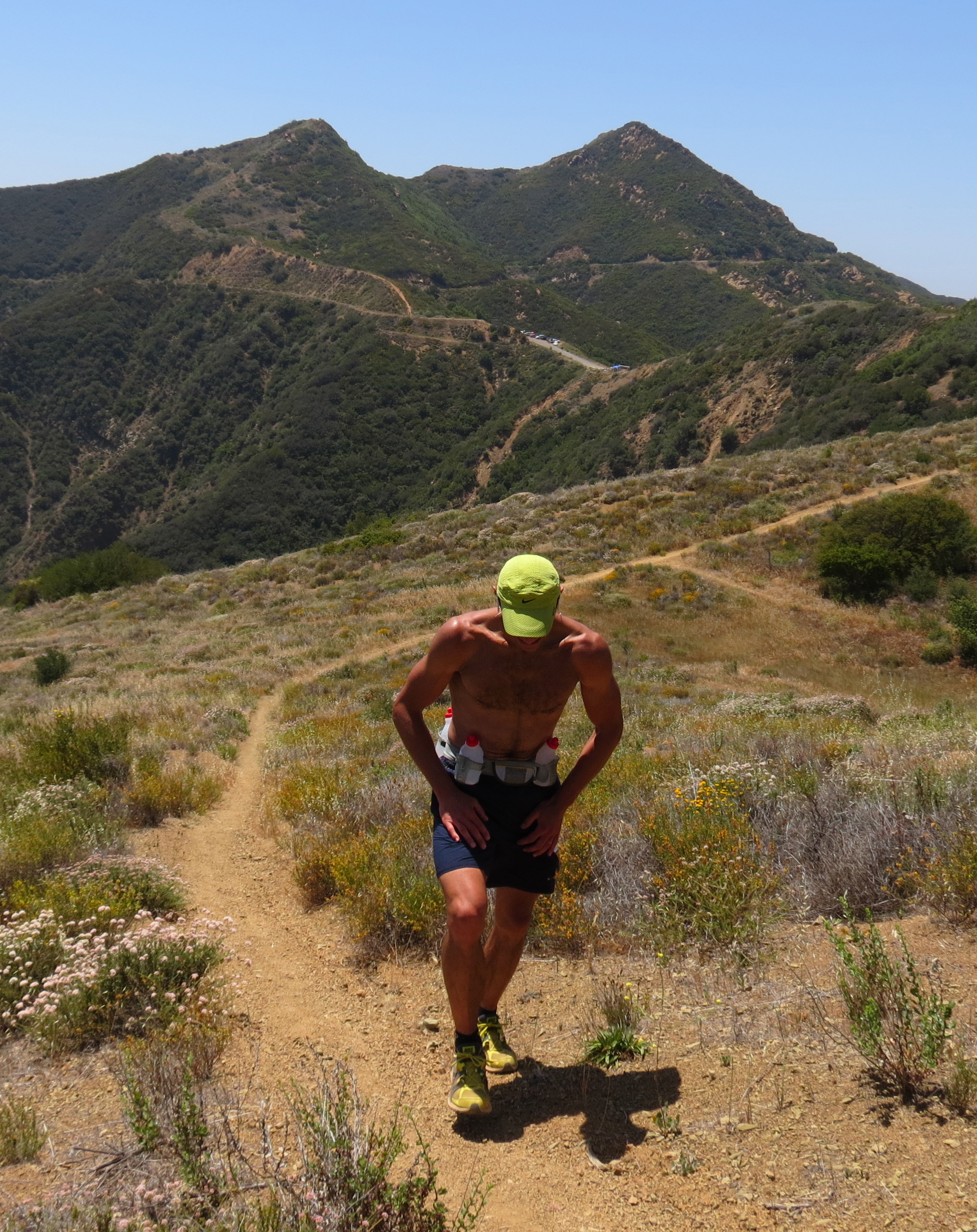
Now in its fourth year, Santa Barbara 100 is one of the tougher endurance races around with close to 21,000 feet of elevation gain and loss. The route covers a surprising amount of single track trail, around 70 miles, and can be quite technical and demanding at times. The course also follows about 24 miles of unpaved road with just a handful of miles along paved road, making for a good wilderness experience.

The route leads through some incredibly rich scenery, starting along the Santa Ynez River and eventually making its way to the top of the Santa Ynez Mountains, dipping down into the Santa Barbara front country, before continuing along the top of the Santa Ynez Mountains.

This year, along the route runners were treated to late blooming wildflowers; from the top of the Santa Ynez Mountains views extending out across the city towards the Channel Islands; and, to the north, out across the expansive Santa Barbara backcountry.

Santa Barbara 100 endurance race trail run running 100K 100 miles miler DRTE

Santa Barbara 100 route

The race began at 5:00AM Saturday morning at Lower Oso Day Use Area, along Paradise Road, with about 70 runners hitting the trails in the pre-dawn hours.

The group was evenly split between those running the 100 mile race and those running the 100K race, about 62 miles. The 100 mile runners were also given the option to drop down to the 100K race at Cold Spring Saddle.

The course led runners along the road from Lower Oso to Upper Oso Campground, and from there along Buckhorn Road to Santa Cruz Trail. Here, the 100K participants continued up Buckhorn Road to the first aid station at the top of Camuesa Connector Trail. While the 100 mile runners continued along Santa Cruz Trail to Nineteen Oaks and then followed what’s sometimes called Mine Trail from Nineteen Oaks up to Buckhorn Road.

Both groups then continued down Camuesa Connector Trail towards Paradise Road, then west along the road to the next aid station. From there they followed a trail along the river to Arroyo Burro Road and followed Arroyo Burro Road to Matias Trail.

Santa Barbara 100 miler miler 100K endurance running ultra marathon DRTE

runners along Matias Trail

The route then continued east along Matias Trail, over to Matias Connector Trail and back down to Paradise Road. There runners continued east past the third aid station to Red Rock Trailhead. From there, they continued along the access road that leads to Gibraltar Dam. Near the dam, runners joined Gibraltar Trail, following it along the south side of the reservoir, past the fourth aid station, to Cold Springs Trail.

Along Cold Springs Trail, the route became more challenging, gaining 1,800 feet over the next three miles as it climbed to Cold Spring Saddle and the top of the Santa Ynez Mountains.

At the Cold Spring Saddle Aid Station, the 100K runners continued east along East Camino Cielo to Romero Saddle and the halfway mark of their race. While the 100 mile runners continued just a short way east along East Camino Cielo to the top of San Ysidro Trail.

Here, the 100 mile route brought those runners down into the Santa Barbara front country. The route followed San Ysidro Trail down to Edison Catway, then east along Edison Catway through Buena Vista Canyon and over to Romero Canyon arriving at the sixth aid station. From there, the 100 mile route continued along Old Romero Road up to Romero Saddle and the seventh aid station.

Endurance Running Ultra Marathon 100K 100 miles miler Santa Barbara DRTE

A runner approaching Ocean View Trail from Romero Saddle

From Romero Saddle, the 100 mile runners continued east along Ocean View Trail to Divide Peak OHV Road, and then followed the road along the top of the Santa Ynez Mountains to the eighth aid station, before arriving at the halfway point and ninth aid station. Here, runners began their return, retracing the same route they had just run.

The route can take, on average, anywhere from 24 to 36 hours to complete, and so a portion of route is run at night, with runners using headlights.

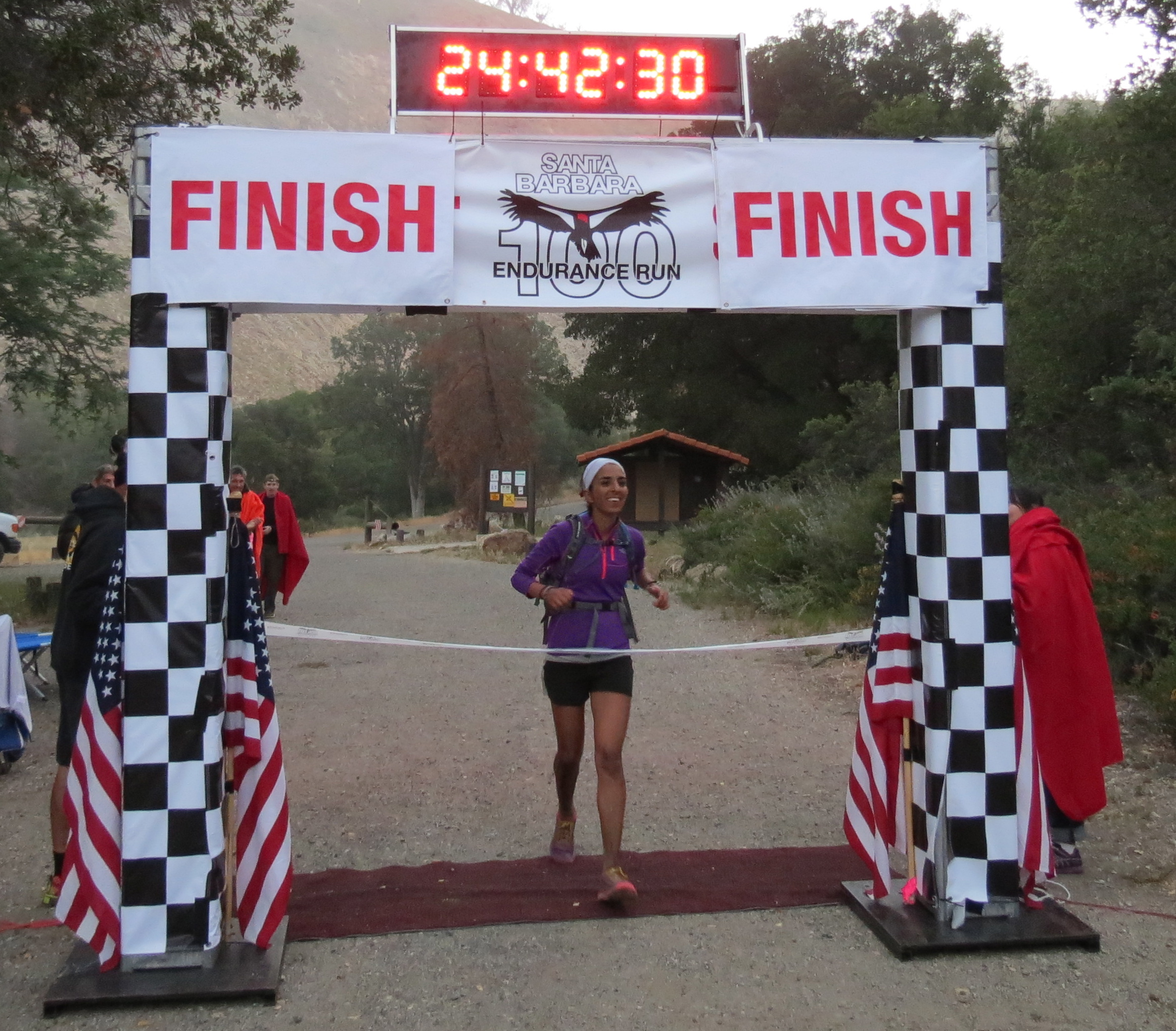
This year’s winner was Ginna Dhaliwal-Schneider, 30, from Toronto, Canada, who crossed the finish line at 5:42 AM on Sunday, completing the race in just over 24 hours. Originally from India, Ms. Dhaliwal-Schneider moved to Canada when she was 19. When not working, she spends her free time either running or climbing mountains.

“Combining those two sports together has always been a dream of mine.” Ms. Dhaliwal-Schneider told the News-Press, adding that in Toronto the trails are mostly flat, where she typically runs three hours a day.

“There were moments when I was so overwhelmed with the joy of being able to fulfill that dream, that I thought even if I don’t finish the race I’m just happy to be here.” Ms. Dhaliwal-Schneider shared after completing and winning her first race in the mountains.

Santa Barbara ultra marathon trail run runners los padres national forest

Race winner Ginna Dhaliwal-Schneider is seen crossing the finish line in the morning at Lower Oso

She had previously only run two other 100 mile races, both on more level terrain, winning the women’s division for each.

In many ways, the idea for Santa Barbara 100 began out on the trails. In 2006, after going through a challenging period in his life, Race Founder and Co-Director Robert Gilcrest took a backpacking trip into Sespe Wilderness which cemented his resolve to move his life forward in a new direction. Mr. Gilcrest, who started running in high school, decided to return to trail running.

“It’s very therapeutic doing a long run, you get into this place where everything just goes quiet, and all that thinking process just shuts down.” Mr. Gilcrest, told the News-Press.

“I like the trail system we have, and was seeing how our regional trails are not getting enough usage or repair.” Mr. Gilcrest added. And it was those experiences, out on the trails, that inspired Mr. Gilcrest to set about building a course and hosting a race that would showcase our local trails and help draw attention to the need to support them.

In 2007, Mr. Gilcrest began the permitting process with the Forest Service to host the event and develop a list of approved trails that could be used for the race.

The course has gone through several iterations and has faced a number of challenges along the way. In 2012, the race was canceled because of rain, and last year the race course had to be adjusted just a few weeks before race because of the 2013 White Fire, which burned part of the intended route.

This year’s route, with its mix of trails on both sides of the mountains, looks to be the official route going forward.

Mr. Gilcrest is supported by Race Co-Director Jakob Herrmann, who ran and completed each of the previous races. They’re in turn are supported by a number of other people associated with managing the event.

The race also sees over 40 volunteers who help staff the aid stations. As well as members from Santa Barbara Amateur Radio Club, who provide a crucial service of connecting the aid stations together with volunteer ham radio operators at each station. Santa Barbara 100 is also indebted to the Santa Barbara Ranger District for their support.

The next Santa Barbara 100 will be held July 11-12, 2015. For more information regarding the race go to www.santabarbara100.com.

This article originally appeared in section A of the June 30th, 2014 edition of Santa Barbara News-Press.

Posted by: James Wapotich | June 28, 2014

Mid-Summer Dream Quest

Lucid Dreaming Workshop Santa Barbara

*

Revelation Dreamwork: Mid-Summer Dream Quest

Friday, July 25th, 7:00pm-10:00pm
Saturday, July 26th, 9:30am-5:30pm
Ayni Gallery, Santa Barbara

For many of us, since childhood, summer has represented a break from the ordinary, a chance for rest, play, and even journeying to different places…sounds a lot like dreaming! Here then is a season for settling into our dreams, a season ready to hold our bold imagineering, and freely move with and entertain the magic that awaits us in these many realms.

Through this 2-day workshop we will explore dreaming, lucid dreaming, and lucid living. A sacred circle format will provide opportunities for interactivity and group discussion.

Participants will learn a variety of conceptual approaches and practical techniques for dream questing including:

* Dream recall
* Interpreting dream messages
* Cultivating heightened awareness within dreams
* Incorporating dream insights back into waking life
* Creating a “Dream Council”

Facilitators

Maya Shaw Gale, MA, Transformational Life Coach, Expressive Arts Therapist, Poet/Writer – mayashawgale@verizon.net (805) 882-1893

James Wapotich, leads Lucid Dreaming/Lucid Living and Wilderness Dreamquest workshops; writer and visual artist – jwapotich@yahoo.com (805) 729-4250

Workshop is $115 per person ($95 with early registration by 7/14) *bring a friend and both 20% off.

To sign up or for more info please contact us.

Posted by: James Wapotich | June 5, 2014

Trail Quest: Grapevine Trail

Gazing north from State Route 154 towards the San Rafael Mountains it can be hard to picture all different canyons hidden there, particularly those tucked away between Little Pine and West Big Pine Mountains. And yet, it’s here that one finds the headwaters of Santa Cruz Creek, and traversing a number of these little canyons, Grapevine Trail.

The 5.5-mile long trail runs west to east through San Rafael Wilderness and connects Santa Cruz Trail to Buckhorn Road and Bluff Camp. Amidst the rich scenery along the trail are several interesting historical sites that one can explore.

The area is best visited as part of a multi-day backpacking trip. The more commonly used routes involve starting at either Cachuma Saddle, and making use of Mission Pine Trail to reach either Santa Cruz Trail or Buckhorn Road, both of which connect to Grapevine Trail; or by starting at Upper Oso Campground and hiking in along Santa Cruz Trail to Grapevine Trail.

Los Padres National Forest Pelch Grapevine San Rafael Wilderness Santa Barbara hiking trial

West Big Pine is seen from Grapevine Trail

The eastern end of Grapevine Trail starts from Buckhorn Road, near Bluff Camp, and descends down into the Santa Cruz Creek drainage. The trail follows an unnamed canyon through mostly chaparral that leads down to East Fork Santa Cruz Creek. The trail is in generally good condition, and there is currently water flowing in the creek.

From here, Grapevine Trail continues west, upstream along East Fork Santa Cruz Creek, passing through a healthy variety of riparian plants. The trail then climbs out of the creek, and over to the next canyon.

As the trail descends down towards a small creek, it offers views out across the canyon to where the grapevine once grew that gives the trail, as well as the creek further downstream its name. The trail crosses the small creek and continues on the opposite side of the canyon, arriving at a spring. The spring is more of a trickle of water, but it is noticeable by the wild blackberry and roses that grow there in contrast to the surrounding oak and chaparral.

map grapevine trail hike pelch camp hiking backpacking Santa Barbara Los Padres National Forest San Rafael Wilderness

Map courtesy Maps.com

Continuing a short way past the spring, the trail crosses a small side creek, and it’s here, on the left or downhill side of the trail, that the grapevine was once located.

The grapevine’s origins to this day remain a mystery. One of the more more fanciful stories involve the infamous bandit Joaquin Murieta. It’s said that while he was attending a party in Montecito at the site of the famous Parra Grande, another large grapevine, that he was tipped off that the sheriff was coming to arrest him. Making a hasty retreat Murieta fashioned a horse whip from the Parra Grande vine, and fled into the backcountry. When he arrived at his hideout, located somewhere in the upper reaches of the Santa Cruz Creek drainage, he is said to have taken the whip and planted it in the ground near a spring, where it grew and flourished.

Other accounts suggest that it may have been planted there by one of the early homesteaders in the area. Nevertheless, the vine is said to date back to mid 1800’s and covered close to an acre, draping from the oaks and growing on top of other plants.

In a 1954 report to the Forest Service, Dick Smith described the site as “…a narrow spring-laden mountain slope almost directly underneath West Big Pine Mountain”.

There is still a fair amount of water seeping from the hillside, supporting a number of riparian plants in addition to the oaks. However, the grapevine appears to have died out.

A Forest Service report, written in 2010, indicated that the vine may have dried out during a period of drought, and that any remaining evidence of the vine was burned in the 2007 Zaca Fire. Currently the site is covered in a thick layer of native plants, including ferns and wild blackberry.

Grapevine Trail hike backpacking santa barbara Los Padres national forest san rafael wilderness

Grapevine Creek near Pelch Camp is seen from Grapevine Trail

Continuing west, past the grapevine site, Grapevine Trail climbs out of the canyon and over a small ridge before descending down toward Grapevine Creek and the turnoff to Pelch Camp.

The turnoff to the camp is about a half-mile west of the grapevine site, and about four miles from Bluff Camp. The intersection is marked with an old Forest Service sign that points back towards “Murieta Grapevine” and Bluff Camp.

From the turnoff, it’s a relatively short hike to Pelch Camp. The trail is somewhat overgrown and follows Grapevine Creek downstream to a small, open area surrounded by oaks, where one can find a picnic table. Nearby, one can find the remains of the old hunting camp situated above the confluence of Grapevine Creek and one of its tributaries.

Pelch Pinkham Camp P-P Grapevine Trail Los Padres National Forest San Rafael Wilderness

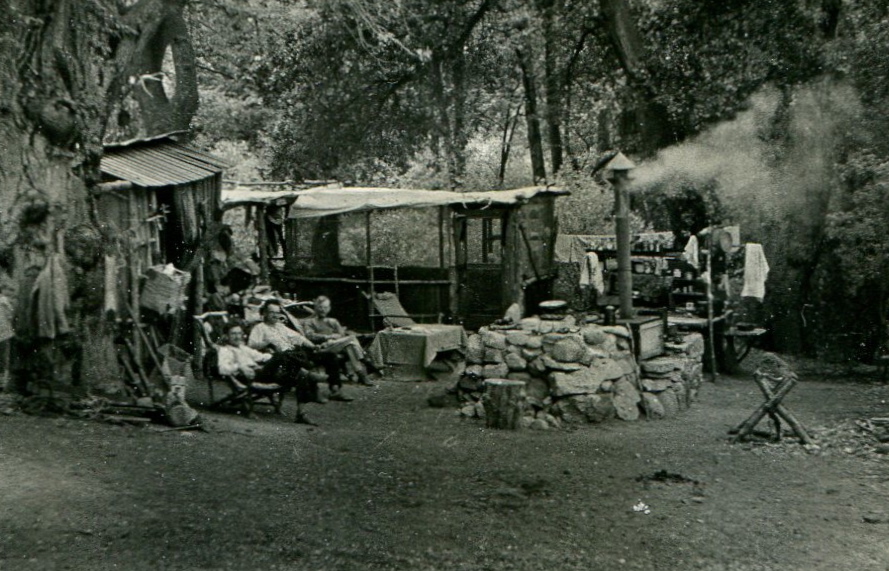
Hunters gather around the fire at Pelch Camp circa 1934 – image courtesy Amanda Pelch

Originally called Camp P-P, the camp was the hunting retreat of Frank Pelch and Fred Pinkham. Pelch and Pinkham used the site as a base camp for deer hunting trips that they hosted for their friends during the 1930s. The camp had an outdoor stove and oven for cooking, a box for drying deer meat, and a screen covered dining area. There was also a small cabin that Pelch and Pinkham had built from wood gathered from the abandoned Romo Homestead, which was located several miles away.

According to Amanda Pelch, Frank Pelch’s granddaughter, the site was leased by her grandfather from the Forest Service under a 99-year lease, which ended when her grandfather passed away in 1963.

The name Pelch may be more familiar to those who remember Pelch & Sons Sporting Goods Store. The store was located in downtown Santa Barbara at the corner of State and Anapamu Streets, where State & A Restaurant used to be located.

In 1907, Mr. Pelch immigrated to the United States from what is now Czech Republic, and in 1909, moved with his wife to Santa Barbara. In 1911, he opened a barbershop with Basil Blauvelt; the shop also stocked pipe and chewing tobacco for its customers.

An avid hunter and fisherman, Mr. Pelch soon began stocking the shop with fishing gear and sporting goods, as well as a wide array of magazines and periodicals. In 1922, they moved across the street into a larger space at 1201 State Street, where the store was located until 1966. The store benefited from its central location across from Woolworth’s (where Old Navy is now located) and the Post Office (where Santa Barbara Museum of Art is now located).

In 1941, after Mr. Blauvelt retired, Mr. Pelch’s son, Otto, who had worked at the store, became a full partner. The store then became Pelch & Sons Sporting Goods and continued to operate until 1976.

Pelch Camp San Rafael Wilderness Grapevine Trail Los Padrees National Forest

Fireplace and oven from the hunting camp can still be seen at Pelch Camp

Today, at Pelch Camp, one can still find the remains of the outdoor fireplace and oven, and if you look carefully, in the surrounding area, you can find both the corrugated sheet metal from the cabin, as well as what’s left of the cast iron stove.

Continuing west, past the turnoff to Pelch Camp, Grapevine Trail follows Grapevine Creek upstream, before then climbing out of the canyon and continuing through a more open area referred to as Jackrabbit Flats. The trail crests one last rise and then descends towards Coche Creek and Santa Cruz Trail.

From Santa Cruz Trail, one can continue north towards Mission Pine Basin to complete a loop back to Cachuma Saddle, or continue south towards Santa Cruz Camp and Upper Oso.

In either direction one can find a nearby place to camp along Coche Creek. To the north, along Santa Cruz Trail, less than a quarter mile, is Coche Camp. The camp has three ice can stoves, and does not appear to be used that often.

To the south, along Santa Cruz Trail, also less than a quarter mile, is Kellogg Camp. The camp is more spacious than Coche, and has a fire ring and raised wood table but no benches. The camp was named for Kerry Kellogg who served as Trails and Wilderness Manager for the Santa Barbara Ranger District.

This article originally appeared in section A of the May 30th, 2014 edition of Santa Barbara News-Press.

Posted by: James Wapotich | May 22, 2014

Trail Quest: Big Pine Mountain

Located at the eastern end of the San Rafael Mountains, Big Pine Mountain, 6,827 feet, has the distinction of being the highest point in Santa Barbara County. In our local area, the next highest mountains are found along Pine Mountain in Ventura County with Reyes Peak coming in at 7,514 feet, and the mountains associated with Mt. Pinos in Ventura and Kern Counties, with the tallest being Mt. Pinos, 8,831 feet.

However, because of its remoteness, Big Pine Mountain sees far fewer visitors than Reyes Peak or Mt. Pinos.

Two of the more common ways of reaching the summit are from Cachuma Saddle, along the top of the San Rafael Mountains, and from Cuyama Valley by way of Santa Barbara Canyon to Madulce Camp and Buckhorn Road. Both routes are best done as part of a multi-day backpacking trip as Big Pine Mountain is about 25 miles from Cachuma Saddle and about 14 miles from the trailhead in Santa Barbara Canyon.

Big Pine Mountain hike trail Los Padres national forest

Big Pine Mountain is seen from Mission Pine Trail near West Big Pine

The route along the top of the San Rafael Mountains follows McKinley Mountain Road and Mission Pine Trail from Cachuma Saddle to Buckhorn Road, and as part of a larger backpacking trip can make for an interesting way to visit Big Pine Mountain.

Cachuma Saddle is reached from Santa Barbara by taking State Route 154 north, past Lake Cachuma and turning onto Armour Ranch Road. From Armour Ranch Road, turning onto Happy Canyon Road, which climbs out of the Santa Ynez Valley towards Cachuma Saddle.

From Cachuma Saddle it’s roughly 9 miles east along McKinley Mountain Road to McKinley Spring Camp, where water can be found; and another half mile to McKinley Saddle and the beginning of Mission Pine Trail.

map Big Pine Mission Pine Trail Los Padres National Forest

Map courtesy Maps.com

Mission Pine Trail continues east along the ridge line, passing San Rafael Mountain, and arriving at Mission Pine Spring Camp, where one can find reliable water. Past Mission Pine Spring the trail continues towards Mission Pine Basin and the top of Santa Cruz Trail.

Intermittent water can sometimes be found in the creek just east of the Santa Cruz Trail juncture, but it is not a reliable water source. There is no water along Mission Pine Trail to the east, nor at Buckhorn Road. From Buckhorn Road, the next reliable water is about 4 miles north at Upper Bear Camp, or about 4.5 miles south at Bluff Camp, so careful planning is advised.

Mission Pine Trail from McKinley Saddle to Mission Pine Basin is in generally good shape. However, past Mission Pine Basin, the trail becomes more challenging. As one continues east, the trail threads its way through chaparral and several different side washes, following what, at times, can seem like a convoluted route; fortunately the trail is well-marked with cairns.

About halfway between Mission Pine Basin and West Big Pine, the trail crests one of the rises along the ridge offering views of West Big Pine in the distance. The trail then passes through several badly overgrown sections, including a series of switchbacks, before arriving at a low saddle and making the final climb towards West Big Pine. Here, trail conditions start to improve somewhat.

At about the 5.5-mile mark from Mission Pine Basin, the trail arrives at a signed trail juncture. From here it’s a short hike to the top of West Big Pine.

From West Big Pine the views include San Rafael Mountain to the west, the Santa Ynez Mountains and Channel Islands to the south, Big Pine Mountain, Mt. Pinos and Frazier Mountain to the northeast, and the Sierra Madre Mountains and Caliente Range to the north.

Big Pine Mountain hike trail Santa Barbara Los Padres National Forest

Conifers are seen alon the trail to Big Pine Mountain

At West Big Pine one can also find the cement foundations from the lookout that once stood there. To the left of the foundations, tucked up in the rocks, is the peak register, where you can add your name to the list of other adventurers who made it this far.

Past West Big Pine, Mission Pine Trail follows the old road cut that led to the lookout from Buckhorn Road, and trail conditions improve significantly.

At about the 7-mile mark from Mission Pine Basin, 14.5 miles from McKinley Saddle, Mission Pine Trail arrives at Buckhorn Road; this intersection is sometimes referred to as Windy Gap.

To the north along Buckhorn Road one can reach Big Pine Mountain, as well as craft various loop or shuttle hikes, such as following Sisquoc River Trail towards South Fork Station, and back towards Nira or Cachuma Saddle. To the south along Buckhorn Road one can access Grapevine Trail and connect to Santa Cruz Trail and return to Cachuma Saddle or continue to Upper Oso.

To reach Big Pine Mountain, continue north along Buckhorn Road. About a quarter of a mile later, the road passes the turnoff for Big Pine Camp on the left.

The signed trail leads about .25 miles down to Big Pine Camp, where one can find a spring, boxed in a metal culvert; however the water in the spring isn’t always that appealing. Surprisingly, the camp has six different campsites, each of which at one time had an ice can stove set in a cement foundation, remnants from when Big Pine Camp was a car camping destination.

Prior to World War II, Buckhorn Road was open to the public and provided a route across the backcountry to Cuyama Valley. The road now separates the San Rafael and Dick Smith Wildernesses, but is itself not designated wilderness, and therefore is open to mountain bikes. And while this does make for an alternate way to reach the trail to Big Pine Mountain, it is nonetheless 15 miles from where one can access the road near Santa Barbara Canyon.

Continuing north past the turnoff to Big Pine Camp, it’s roughly another half mile to the unmarked turnoff to Big Pine Mountain. The trail, on the right, follows the old, somewhat overgrown road cut that leads to the top of Big Pine Mountain. The trail is about .75 miles long and leads through mostly pines and cedar.

Big Pine Mountain, like Pine Mountain, Mount Pinos and similar places in our backcountry, can best be described as an island of pines in a sea of chaparral. That is, many of these summits are dominated by conifers, with typically chaparral climbing the southern face and pines extending along the northern face; and each summit often separated from the next by chaparral.

On Big Pine Mountain, the dominant trees are jeffery pine, sugar pine, white fir and cedar. Unfortunately many of these were badly damaged in the 2007 Zaca Fire. In fact, most of the trees on the top of Big Pine Mountain have been burned.

As the old road cut reaches the top it veers to the left, while an informal trail leads to the right and pile of sandstone rocks – the official top of Big Pine Mountain. Here, one can find the peak register. By wandering around the top of the mountain one can take in nearly panoramic views of our backcountry.

An alternate way to reach Big Pine Mountain is from Cuyama Valley; this is the route favored by peak baggers, who make the trek to visit what’s referred to as the “Big Four”, that is, Big Pine Mountain, West Big Pine Mountain, Madulce Peak, and Samon Peak.

The route starts from the trailhead in Santa Barbara Canyon and follows Santa Barbara Canyon Trail to Madulce Camp, and then Madulce Trail to Buckhorn Road, along the way passing the side trail that leads to Madulce Peak. From the Buckhorn Road one can base camp at Upper Bear Camp and visit Big Pine and West Big Pine Mountains to the north, and Samon Peak to the south. Of the four summits, Samon Peak is the most challenging to reach, following an overgrown off-trail route that starts near Chokecherry Spring.

This article originally appeared in section A of the May 17th, 2014 edition of Santa Barbara News-Press.

Big Pine Mountain Los Padres National Forest San Rafael Mountains highest point Santa Barbara County

Burned trees are all that remain from the pines at the top of Big Pine Mountain

Mission Pine Trail conditions summary: past Fall Canyon Trail, Mission Pine Trail is indistinct in places but well marked with cairns. As it climbs out of the basin and traces a ridge line east through the manzanita and chamise the trail becomes more overgrown, but still passable.

The trail then winds its way through chaparral and a number of small washes, here again the cairns are helpful. The trail then transitions, cutting across the south face of the ridge line; here the trail is noticeably overgrown, not dense growth, but with chaparral crowding in and wild grasses growing in the tread.

The trail then somewhat counter-intuitively descends down the south face of the mountain before turning east and eventually climbing a somewhat overgrown ridge line back towards the top of the mountain before continuing east.

As it continues towards a noticeably exposed summit trail conditions improve. Past the summit, as the trail continues along the ridge line, it again becomes more overgrown, with the worst section being a set a switchbacks that descend down towards a small saddle just before the final climb towards West Big Pine. At several points along the switchbacks the trail is actually closed up with chaparral.

As the trail climbs away from the low saddle it is also brushy in a number of places, but eventually starts to improve as it continues towards West Big Pine. Past West Big Pine trail conditions generally improve as the trail follows the old rut cut that led to the lookout from Buckhorn Road.

Posted by: James Wapotich | May 9, 2014

Trail Quest: Mission Pine Trail

In the mountains behind Santa Barbara there are three main ranges, the Santa Ynez, San Rafael and Sierra Madre Mountains. Of these three, the San Rafael Mountains are the tallest and in some ways the most remote.

Mission Pine Trail traces the top of the San Rafael Mountains from McKinley Saddle to Buckhorn Road, and offers some exceptional views out across the Santa Barbara backcountry. The trail itself is typically visited as part of a multi-day backpacking or horse-packing trip as there is no particularly easy way to reach the trail.

To get to the beginning of Mission Pine Trail, one needs to first get to Cachuma Saddle. From Santa Barbara, take State Route 154 north over San Marcos Pass; continue past Lake Cachuma, and turn right on to Armour Ranch Road. Follow Armour Ranch Road to the beginning of Happy Canyon Road, also on your right.

West Big Pine Mountain Mission Pine Trail Spring San Rafael Wilderness hike Los Padres National Forest

A view towards West Big Pine Mountain along Mission Pine Trail

Happy Canyon Road climbs out of the Santa Ynez Valley, and towards the top of the San Rafael Mountains, arriving at Cachuma Saddle, a low point in the ridge line. At Cachuma Saddle there is a four-way intersection, to the left is Figueroa Mountain Road, to the right is the beginning of McKinley Mountain Road, and straight ahead Happy Canyon Road becomes Sunset Valley Road, and continues towards Davy Brown and Nira Campgrounds. Parking at Cachuma Saddle is found in the large pullout at the intersection.

From the saddle, continue east along McKinley Mountain Road. The gated and unpaved Forest Service access road traces the ridge line along the top of the San Rafael Mountains to McKinley Saddle and the beginning of Mission Pine Trail. The route is mostly exposed and offers water at only two places. The first is a water tank with a faucet and trough past Cachuma Mountain, at about the 4-mile mark. The second is at McKinley Spring, at about the 9-mile mark.

McKinley Spring Camp, with its reliable water, can make for a good first night destination of a multi-day backpacking trip. The camp has a fire ring and grated stove, and two picnic tables. Both the spring and the mountain are named for President William McKinley.

A half mile past McKinley Spring, the trail arrives at McKinley Saddle and a sort of four-way intersection; to the right is the half mile trail to the top of McKinley Mountain, ahead, descending down into the Santa Cruz Creek drainage is Santa Cruz Peak Fire Trail, and to the left is the beginning of Mission Pine Trail.

map los padres national forest mission pine trail spring basin san rafael wilderness

Map courtesy Maps.com

From the saddle, Mission Pine Trail continues east and enters the San Rafael Wilderness, and gradually climbs towards San Rafael Mountain.

At the 1.75-mile mark from McKinley Saddle, the trail arrives at the turn off for San Rafael Mountain. From here, it is a very short hike to the top, and well worth the modest effort. San Rafael Mountain, 6,593 feet, is the second highest peak in Santa Barbara County after Big Pine Mountain at 6,827 feet. From the top, the views can include Hurricane Deck and the Sierra Madre Mountains to the north, the Santa Ynez Mountains and Channel Islands to the south, and to the northeast Mount Pinos, the tallest mountain in our area.

Past San Rafael Mountain, Mission Pine Trail descends towards Mission Pine Spring and transitions from chaparral dotted with pines to mostly conifers. This section of trail saw the least amount of burn damage from the 2007 Zaca Fire and is a reminder of just how beautiful Los Padres National Forest can be. In the winter one can often find snow along the ridge.

This trail along the top of the San Rafael Mountains is often referred to by local backpackers as our own mini-version of the Sierras, and some have even taken to calling it the “high route” because it traces the highest ridge in Santa Barbara County.

Snow Plant flower sacordes Los Padres National Forest San Rafael Wilderness Mission Pine Santa Barbara hike trail

Snow Plant

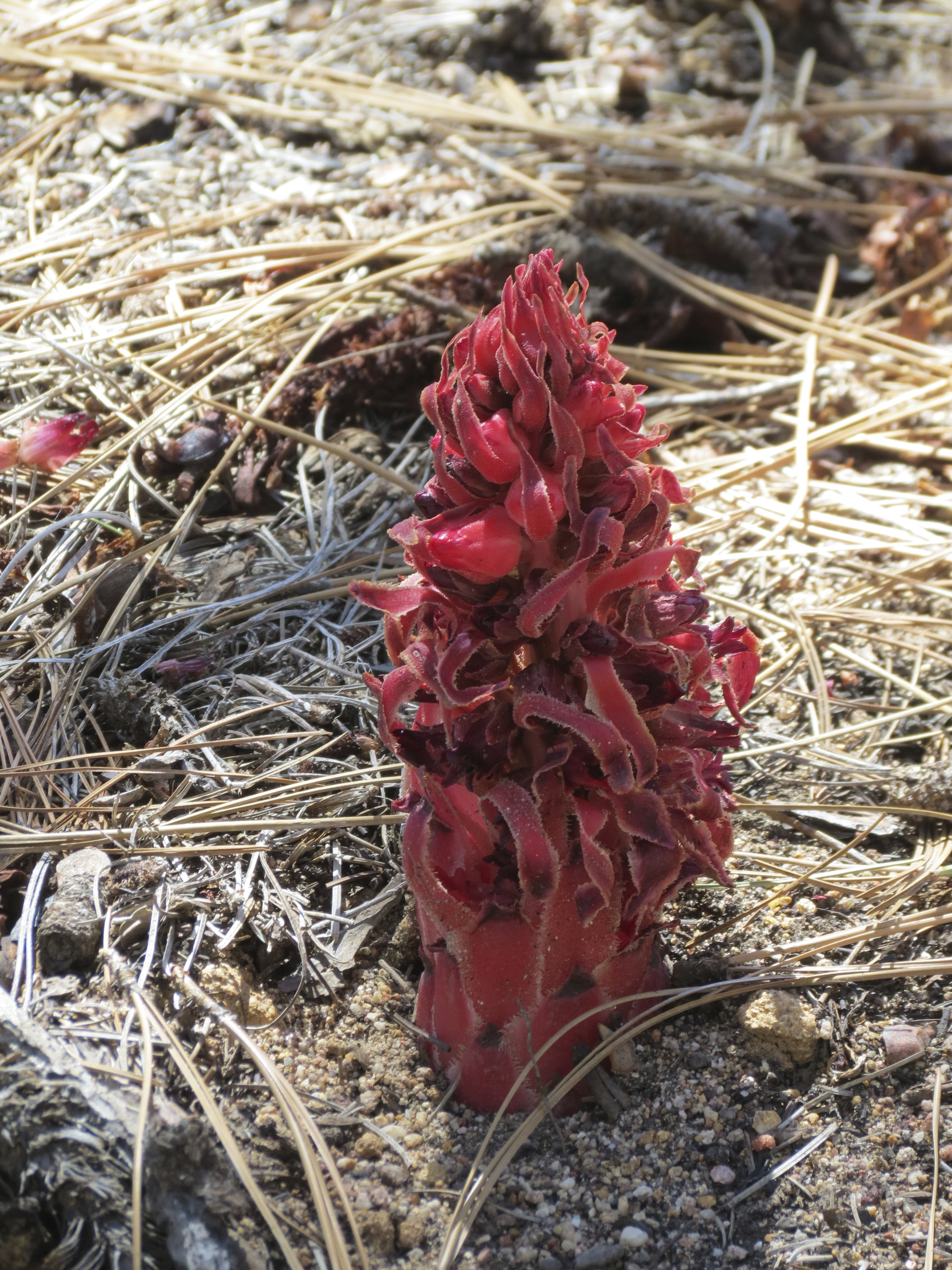
Adding to the comparison with the Sierras, through this section one can often find snow plant growing amongst the pine needles. Snow plant, or sarcodes, is a small, bright red, parasitic plant that gathers nutrients from a mycorrhizal fungi that grows on the roots of conifers. Snow plant typically blooms in the spring and early summer.

At the 3.5-mile mark from McKinley Saddle, the trail arrives at Mission Pine Spring Camp. The camp has one fire ring and a picnic table, and is located near a reliable spring at the edge of a small meadow.

The name Mission Pine comes from the story that beams and rafters in both the Santa Barbara and Santa Ynez Missions were hewn from pines harvested along the ridge. However, an argument could be made that those same pines could’ve more easily been harvested from the top of the Santa Ynez Mountains. Another version states that just the longest beams came from the pines in the San Rafael Mountains, which are said to grow taller than those in the Santa Ynez Mountains. It’s also said that settlers along the Sisquoc River came up to the ridge in the early 1900s to cut shakes for their homesteads.

Mission Pine Spring is the last reliable water found along the top of San Rafael Mountains heading east, so it is best to stock up here before continuing.

Mission Pine Spring Trail Santa Barbara Hike Los Padres National Forest

Mission Pine Spring

From Mission Pine Spring, Mission Pine Trail continues east towards Mission Pine Basin, and returns to a mix of chaparral and pines. And although Mission Pine Basin is actually at lower elevation than Mission Pine Spring, the route along the ridge line provides more than enough ups and downs to make up for it.

As one approaches Mission Pine Basin, the burn damage from the Zaca Fire becomes more evident, and it is encouraging to see so many coulter pines sprouting back up in what appear to be even greater numbers than the original trees.

At about the 7.5-mile mark, the trail arrives at Mission Pine Basin, and continues across an open grassy flat. Here, one finds a sign pointing back up a small wash to Mission Pine Basin Camp, which is about a quarter mile further along the somewhat overgrown side trail. Past the sign, under a lone ponderosa pine, is the top of Santa Cruz Trail.

Mission Pine Basin Camp was badly damage during the Zaca Fire, however, here too the pines are starting to grow back. The camp has a fire ring, and two ice can stoves that are now being used to support benches made from what’s left of the picnic table. Nearby is the horse corral, which has been damaged by fallen pines.

Mission Pine Basin for all intents and purposes is a dry camp. In the best of years, there can be some water in the creek near the Santa Cruz Trail junction; in dry years, a small pool of water can sometimes be found further downstream. Water can sometimes also be found near a stand of willows just downstream from the beginning of the old Fall Canyon Trail. However, neither of these should be relied upon.

The next nearest reliable water from Mission Pine Basin, is either Fall Canyon Spring in Fall Canyon, about 2 miles away, or at Coche Camp along Santa Cruz Trail, about 3 miles away.

Mission Pine Basin Trail Los Padres National Forest Santa Barbara hike San Rafael Wilderness

Mission Pine Basin

From Mission Pine Basin, one can continue east along Mission Pine Trail towards West Big Pine Mountain, Buckhorn Road and Big Pine Mountain, or turn south and continue along Santa Cruz Trail towards Upper Oso Campground.

For those continuing east, there is no water along ridge between Mission Pine Basin and Buckhorn Road, a hike of about 7 miles. And from Buckhorn Road the nearest reliable water is either at Upper Bear Camp, 4 miles further north, or Bluff Camp 4.5 miles further south, and so it’s best to research conditions beforehand and plan one’s trip accordingly.

The article originally appeared in section A of the May 9th, 2014 edition of the Santa Barbara News-Press.

Posted by: James Wapotich | May 7, 2014

Trail Quest: Chorro Grande

In the fall, and during drier years such as this, one of the challenges in planning a backpacking trip is knowing where to find water. In the springtime many of our creeks are flowing, making it fairly easy to find trail camps near water. As the water dries up a number of these creeks still flow intermittently, and so a percentage of trail camps remain viable destinations. However the challenge then becomes learning which ones.

It’s during these times that knowing where reliable springs are located can also be helpful for planning backpacking trips. In the area around Pine Mountain, beyond Ojai, there are two reliable springs, Chorro and Raspberry, situated near trail camps that can make appealing backpacking and day-hiking destinations. [When I wrote this article in 2014 Chorro seemed like a reliable spring, but the drought that followed dried it up. There is now occasionally water seeping in the spring, but I would not characterize it as reliable, even in the spring time. Raspberry Spring is still reliable.]

One way to connect these two sites is by hiking along Chorro Grande Trail to Chorro Spring, and then from there to the top of Pine Mountain and continuing down the backside of the mountain to Raspberry Spring. The hike to Chorro Spring is about 8.5 miles roundtrip, and the hike to Raspberry Spring is about 12 miles roundtrip.

Chorro Grande Trail Ojai hike Los Padres National Forest Pine Mountain

Chorro Grande Trail decorated in snow

To get to the trail head, from Ojai, continue north on State Route 33. The road follows North Fork Matilija Creek, eventually climbing out of the canyon, and then passing the turn off to Rose Valley. State Route 33 then descends down towards Sespe Creek and follows it towards Pine Mountain Summit. Chorro Grande Trail is about two-thirds of the way to Pine Mountain Summit from Rose Valley, and the signed trailhead is on the right hand side of the road. Parking is found in the pullouts along the road.

From the trailhead the trail climbs away from Sespe Creek and over towards Chorro Creek, and roughly a half mile later arrives at a point overlooking Chorro Grande Falls. The falls, when flowing, tumble over an outcropping of exposed sandstone, and are framed by trees growing at the base of the falls.

Chorro Grande is said to take its name from the spring found higher up in the canyon, chorro being Spanish for gushing, flowing water. However, an argument could also be made that the name refers to falls when they are fully flowing.

As the trail continues up Chorro Grande Creek, one can start to see conifers mixed in with chaparral and riparian plants. In fact, one of the treats along the trail is the wide variety of plants one can find. The trail is in generally good shape, overgrown in some places, but easy to follow.

Chorro Grande Spring map trail hike Ojai Oak Raspberry Pine Mountain Los Padres National Forest

Map courtesy Maps.com

At about the 1.75-mile mark, the trail arrives at Oak Camp. The camp is situated under a small grove of oaks overlooking the creek. There are three camp sites at Oak Camp, each with a grated stove. Water can often be found in the creek near the camp, and if not, further upstream along the trail. The camp can make for an easy destination for a day hike or overnight backpacking trip.

Chorro Grande Trail continues past Oak Camp, still following the creek for the next half mile. Through this section one can find several old roads cuts intersecting the trail. During the 1970s a proposed phosphate and gypsum mining operation in Chorro Grande and the nearby canyons was put forth by U.S. Gypsum. The mine never happened, but some of these unpaved roads may have been used for surveys.

As the trail leaves the creek, it begins the roughly 1,700 foot climb towards Chorro Spring. Along the way the trail offers great views out across Chorro Grande Canyon and Sespe Creek.

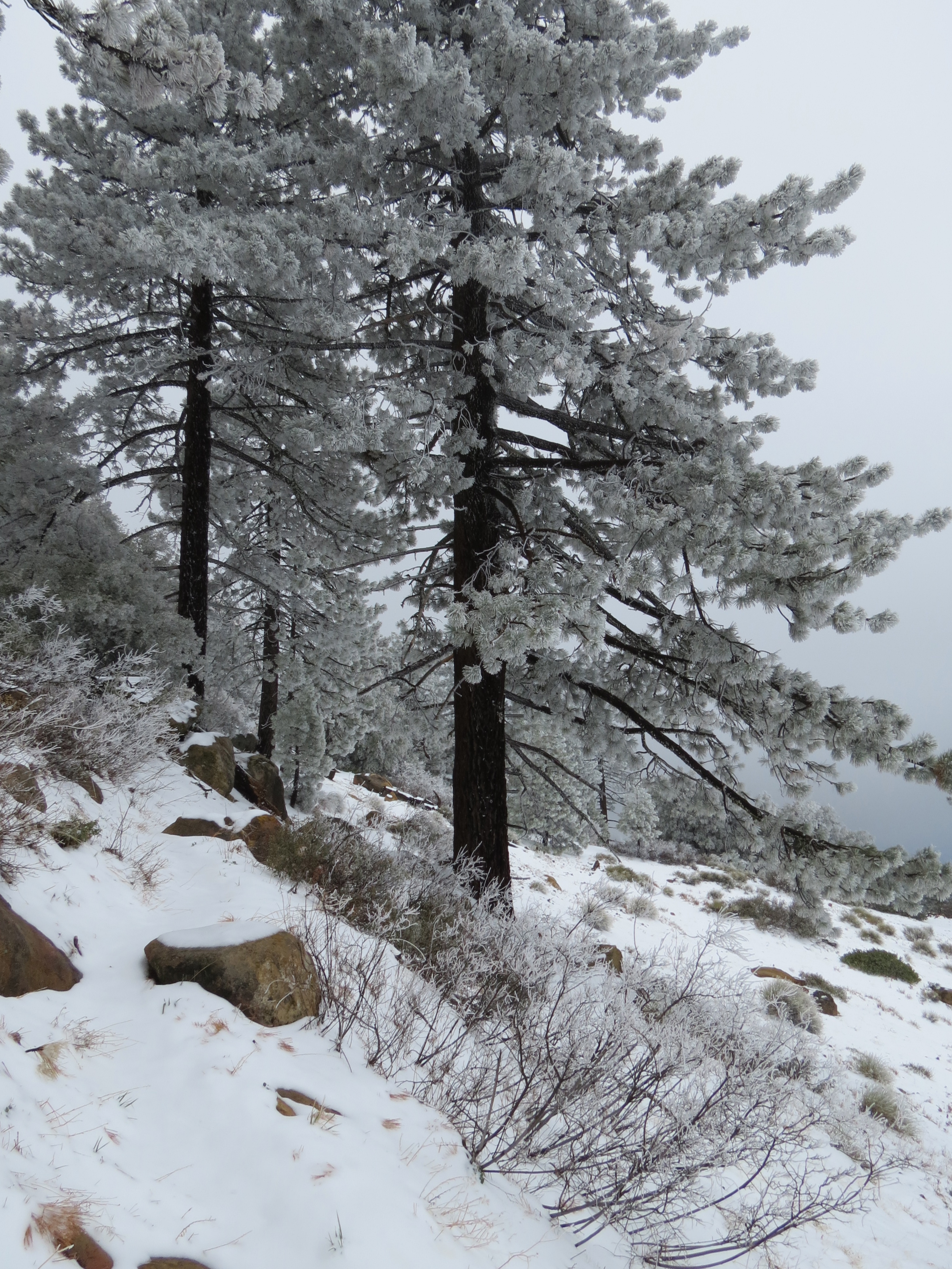
During this particular trip, with the recent rain and cold weather, snow was present on the trail. Even as early as Oak Camp there were patches of snow to be found on the ground, while halfway up the mountain snow covered the entire trail. And with the wind blown rain and snow, the pines looked like Christmas trees fresh from the flocking booth.

Because of its elevation Pine Mountain can often receive snow, while the lower elevations of the mountain don’t, making for a unique juxtaposition of wintery scenes next to more familiar snowless vistas.

Chorro Grande Trail Los Padres National forest Ojai hike

Snow graces Chorro Grande Camp

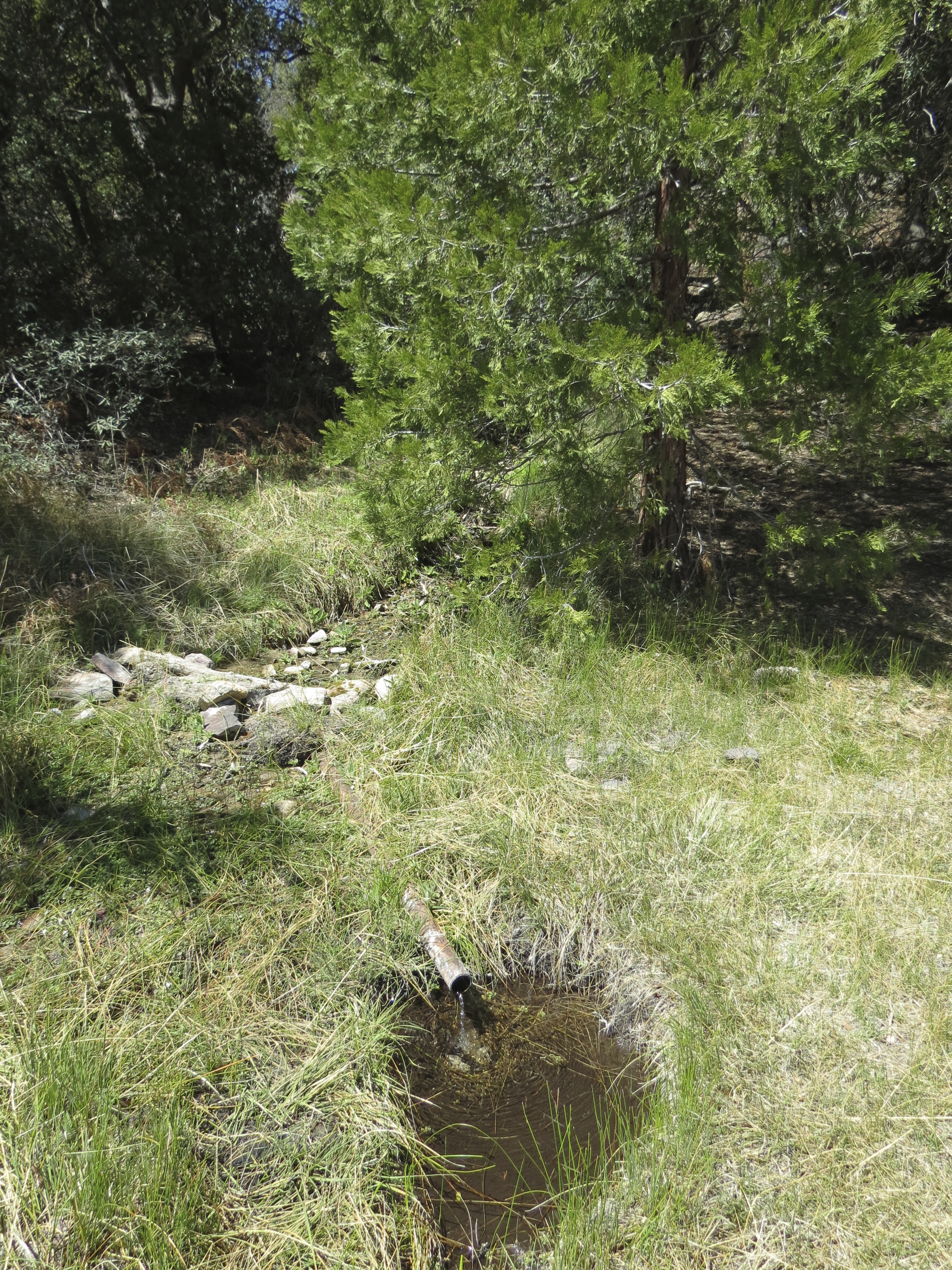
Eventually the trail returns to Chorro Grande Creek, just below Chorro Camp. And at about the 4.25-mile mark, the trail arrives at Chorro Spring. The spring is an interesting sight in that the water appears to issue from beneath a large boulder, forming a small, flowing creek. Near the spring are two campsites, one with a grated stove, the other with an old ice can stove.

From the spring, Chorro Grande Trail continues its climb towards the top of the mountain, and three-quarters of mile later arrives at Pine Mountain Road. The road was just paved last August; in fact, the pavement ends right at Chorro Grande Trail.

Views here from the road, on a clear day, can include the Channel Islands.

Pine Mountain Road, also known as Reyes Peak Road, represents an alternate way to access the area. The road is typically closed from mid-December to the end of April. When open, the road provides easy access to the campgrounds and trailheads associated with Pine Mountain Recreation Area.

Raspberry Spring Los Padres National Forest Ojai hike Pine Mountain

The trail down to Raspberry Spring

From the top of Chorro Grande Trail there are several options for extending the hike. One can continue east along Pine Mountain Road, which continues unpaved for another mile before arriving at the beginning of Reyes Peak Trail. From Reyes Peak Trail, one can follow the mile-long trail up to the top of Reyes Peak. The peak, with an elevation of 7,514 feet, is the highest point along the ridge line, collectively referred to as Pine Mountain. The hike to Reyes Peak from the trailhead is about 14 miles roundtrip.

Another option is continue on to Raspberry Spring, on the north side of the mountain. The spring with its enchanting scenery can make for an appealing destination, particularly if you’re backpacking and Pine Mountain Road is closed. From the top of Chorro Grande Trail, continue a half mile west along the paved road, past the different campsites associated with Reyes Creek Campground to the trail leading down to Raspberry Spring. The beginning of the trail is not well marked, but starts from the first campsite on the right, just past the easy to spot outhouse along the road.

Here, the trail descends down the backside of the mountain through the a rich forest of conifers, along the way offering glimpses out towards the Cuyama Valley. The hike in many ways is a study in contrasts. On the south facing side of Pine Mountain, along the upper reaches of Chorro Grande Trail, one finds oak, chaparral and pines mixed together, while along the backside of the mountain heading towards the Raspberry Spring the landscape is dominated almost exclusively by pines.

Chorro Grande Trail ojai hike los padres national forest Pine Mountain

Snow decorates the mountain side along Chorro Grande Trail

At about the 6-mile mark, the trail arrives at Raspberry Camp, which has two sites each with a grated stove. The spring is just west of the first site in a small canyon. Raspberry Spring takes its name from the wild raspberries that at one time used to grow around the spring. If you look closely you can still find remnant vines of the plant.

Both Chorro and Raspberry Springs can also be accessed from Pine Mountain Road, and make for easy day hikes from the campgrounds found along the road. For more information about Pine Mountain Recreation Area go to www.fs.usda.gov/Internet/FSE_DOCUMENTS/fsm9_034014.pdf. .

Regardless of how far you hike you’ll get to take in some great scenery.

This article originally appeared in section A of the May 3rd, 2014 edition of the Santa Barbara News-Press.

Posted by: James Wapotich | April 25, 2014

Nature as Oracle

Vision Quest Los Padres National Forest Santa Barbara hike ecopsychology

*

As we move into spring, now is the time to deepen our intentions around what we want to create in our lives, and shed off the winter coats of what we no longer need or want to carry. The springtime is also a great time of year to channel the energies of this growing season into our own growth and dreams. And as we sort out where to direct our energies and what to let go of the land can be a powerful mentor.

Nature as Oracle

Since the time of the ancient ones, men and women have journeyed into nature to seek guidance and insight. Today, more than ever, we need to step outside the narrow trance of our intellect, technology and social structures to reconnect to the more expansive intelligence of the natural world. By slowing down and becoming receptive to the non-human realms, we open ourselves to a larger collective wisdom. Nature as mirror, metaphor and teacher can reveal to us our own true nature, and give us a direct experience of the sacred web of life we are part of.

Join us on the trails for a one-day journey out on the land and see what wisdom finds you through:

    • Body/mind & mindfulness practices that expand perception and awareness
    • A “vision quest” structure for seeking guidance
    • 3.5 mile roundtrip trail hike
    • Council circle sharing & shamanic teachings
    • An embodied experience of eco-community & interconnectedness

Guides:

Maya Shaw Gale is a Mind/Body Wellness Coach and poet, and leads workshops on Embodied Mindfulness, Creative Writing and Ecopsychology. mayashawgale@verizon.net (805) 882-1893

James Wapotich is the co-founder of Revelation Dreamwork, a Volunteer Wilderness Ranger with the Los Padres National Forest, and leads trips and retreats into our local backcountry. jwapotich@yahoo.com (805) 729-4250

1-day retreat is $75 per person. Sunday, May 18th, from 9AM-4:30PM.

To sign up or for more information please contact us.

Posted by: James Wapotich | April 25, 2014

Trail Quest: Horn Canyon

There are a surprising number of trails that can be found in the mountains behind Ojai. The town itself is nestled in a small valley, which stood in for the Valley of Shangri-La in the 1937 movie Lost Horizon. And although the scene featuring Ojai was ultimately edited from the movie, the association with that idyllic, fictional setting still has its appeal.

One of the more picturesque trails behind Ojai is Horn Canyon Trail. Perhaps adding to its mystique, the trail was also said to be a favorite of Jiddu Krishnamurti, the philosopher and spiritual teacher from India who took up residence in Ojai. Both his home and Krishnamurti Foundation are located near Horn Canyon.

Horn Canyon Trail starts from Thacher School, and continues up Horn Canyon towards The Pines, a trail camp that is located about halfway to the top of the trail. The hike to The Pines and back is about 5 miles roundtrip, and the longer hike from the trailhead to Nordhoff Ridge Road is about 10 miles roundtrip.

Horn Canyon Creek Ojai Thacher Los Padres National Forest Hike trail

Alder trees line a section of Horn Canyon Creek

To get to the trailhead from downtown Ojai, continue east on Ojai Avenue, which is also State Route 150, to Carne Road, on your left. Follow Carne Road north, towards the mountains; the road then turns east, becoming Thacher Road. Continue on Thacher Road to the entrance of Thacher School, 5205 Thacher Road.

From the entrance of Thacher School, bear to the right and continue towards the school’s Gymkhana Fields. The paved road quickly arrives at a parking area and continues briefly, unpaved to the trailhead. Please respect private property, and keep an eye out for horseback riders.

Horn Canyon is said to take its name from Sergeant Charles Horn, a civil war veteran who homesteaded in the area in the late 1870s.

From the signed trailhead, Horn Canyon Trail continues up Horn Canyon appearing first as a narrow, unpaved access road. The trail crosses the creek several times before becoming a single track path. Early in the hike, on the left, one can see Thacher Observatory overlooking the canyon.

Horn Canyon map trail hike Ojai Thacher School Los Padres National Forest

Map courtesy Maps.com

Along the way there are several side trails that leave the canyon. These are part of a network horse trails created by Thacher students over the years. The main trail however continues up Horn Canyon.

Thacher School was founded in 1889 as an all-boys boarding school, and horseback riding was more of a necessity in the days before automobiles, as the school was seven miles from town. However, Sherman Day Thacher, the school’s founder, also noticed that “there’s something about the outside of a horse that’s good for the inside of a boy” and so horsemanship became part the school’s programs.

In 1977, the school became co-educational, and today all freshman are still required to learn the basics of horsemanship. Students are provided a horse, which they care for, and train with, for the school’s annual Gymkhana event. Freshmen also participate in at least one overnight horse-packing trip; and the school regularly offers camping and backpacking trips as part its outdoor program. Both the horse and outdoor programs make use of the local trails and campsites in Los Padres National Forest.

At about the half-mile mark, Horn Canyon Trail passes a good-sized maple tree before climbing away from the creek and narrowing down to a single track.

The trail is in good shape, and soon returns back to the creek, arriving at the fourth and last crossing, which currently has water flowing in it. Here, one can find blackberries ripening in the sun, and although this year’s wildflower display has been meager, one can find yellow bush poppies and the purple flowers of blue dicks blooming along the trail.

From the fourth creek crossing, the trail climbs up a side canyon as it makes its way towards The Pines. Along the way, one is treated to some great views back down the canyon, and out towards Ojai and Lake Casitas. As one continues, eventually a small grove of pines in the distance starts to come into view.

The Pines Horn Canyon Thacher Scholl Los Padres National Forest Ojai hiking  trail

A view looking up Horn Canyon towards The Pines

The coulter pines are said to have been planted by Jacinto D. Reyes, who was the first ranger from 1900-1931, of what was then, the Cuyama District. Mr. Reyes was the son of Rafael Reyes who established a ranch and homestead at the mouth of what is now Reyes Creek along the Cuyama River.

The area where the camp and trees are located was burned in the 1932 Matilija Fire; the trees were replanted only to be burned again in the 1948 Wheeler Fire. They were then replanted by ranger Howard Bald. Over the years pine trees have been planted there as well by students from Thacher School, who also help maintain the trail.

At the 2.5-mile mark the trail arrives at The Pines Camp. The site has two fire rings nestled under the pines and can make for a good resting place or return point. At the northern edge of the pines one can find a horse trough fed by water from the nearby spring. Water from the spring can be accessed by following the black plastic hose along an overgrown path up to the spring, which generally has some water in it that can be filtered.

The Pines Los Padres National Forest Ojai hiking Horn Canyon Trail

The Pines

Past The Pines, Horn Canyon Trail continues up towards the top of the mountains. The is trail overgrown in a couple places, but is still easy to follow. However, there is little shade along the trail and no water; the trail is also somewhat steep at times, so plan accordingly.

At about the 4-mile mark, Horn Canyon Trail crosses Sisar Canyon Road. From here, it’s roughly another mile to the top of the trail and Nordhoff Ridge Road. And then, just when you think you can’t hike uphill any further, you arrive at the end of Horn Canyon Trail, and are immediately treated to exceptional views of Topatopa Bluff to the east across Sisar Canyon. From Nordhoff Ridge Road one can also access Red Reef and Lion Canyon Trails, both of which lead down towards Sespe Creek, for longer backpacking trips.

Regardless of how far you go can you’ll get to a chance to see what makes the mountains behind Ojai a unique part of Los Padres National Forest.

This article originally appeared in section A of the April 25th, 2014 edition of the Santa Barbara News-Press.

spotted towhee Horn Canyon Trail hike ojai Los Padres National Forest

A spotted towhee rests in Horn Canyon

« Newer Posts - Older Posts »

Categories