Posted by: James Wapotich | July 27, 2015

Trail Quest: Willmann Homestead

During the late 1800s, a group of settlers made their way east from Santa Maria along the Santa Maria River in search of land that they could claim as their own. With much of the best land in the Santa Maria Valley either already homesteaded or part of former Mexican land grants, they pushed up river, past the Rancho Sisquoc land grant, and settled along the Sisquoc River and its tributaries in the Santa Barbara backcountry.

Life along the river was not easy. The settlers formed a close-knit community and relied on one another. Roughly 25-30 families lived along the river and its tributaries before the homesteading period in the area came to a close in the early 1900s.

Of the families living there, some stayed less than a year before moving on, while others remained until the end. Those who were cut out for homesteading typically proved up on their homestead claim by fulfilling the five-year residency requirement, and made their living raising cattle and farming the land.
Adolph Wellman Willmann homestead Los Padres National Forest San Rafael Wilderness Sisquoc River trail hike

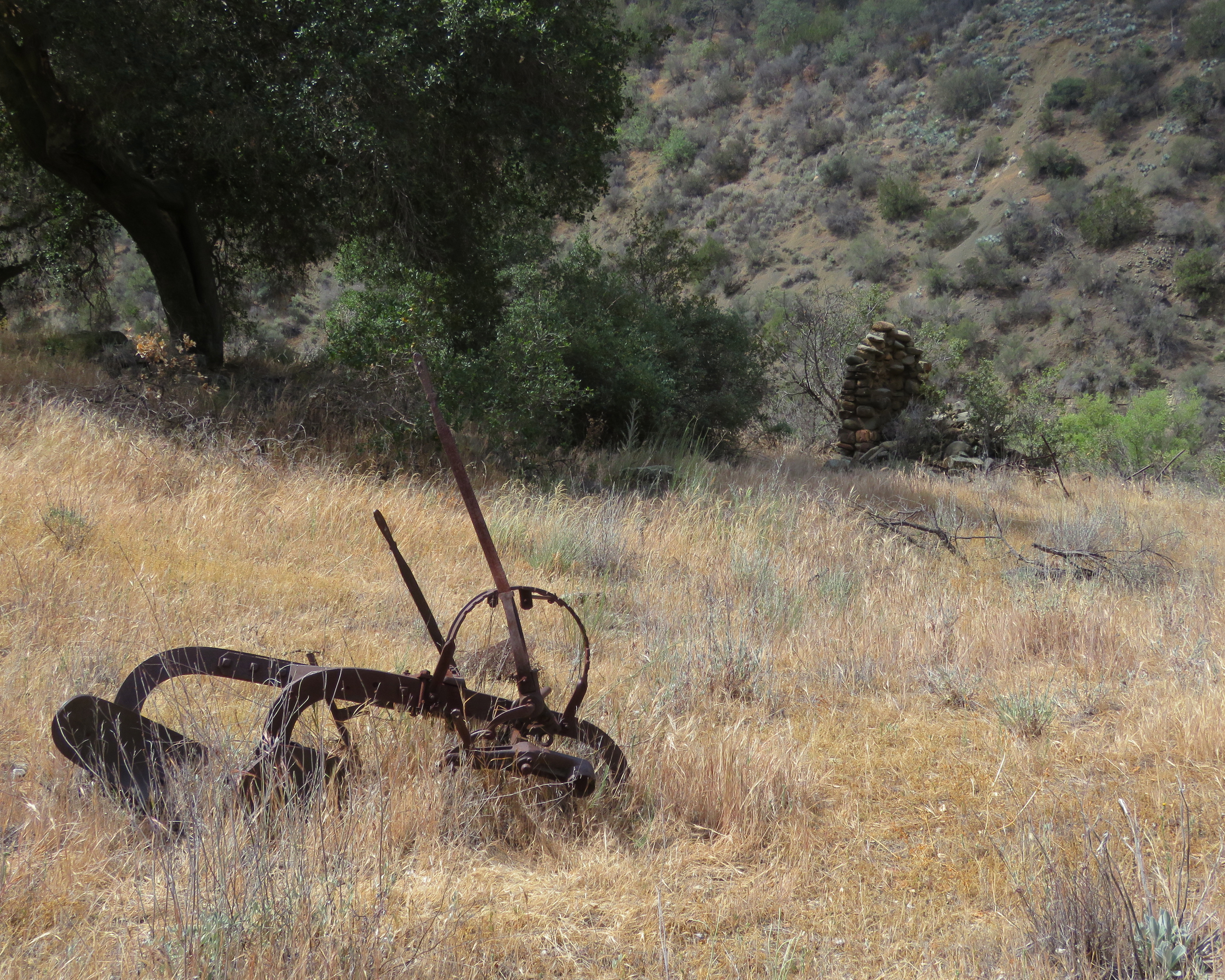
A plow and chimney are seen at the Adolph Willmann homestead site

One of the more successful homesteaders in the group was Adolph WIllmann. Born in Germany in 1854, Willmann immigrated to the United States and become a naturalized citizen in 1873.

Willmann made his way west and in 1896, joined the community of settlers living along Sisquoc River. Willmann homesteaded near the mouth of what is now called Wellman Canyon, a corruption of the name Willmann.

Willmann lived there with his wife, Louise Kleine, and their son, Henry Leo. Willmann ran cattle and the couple also raised turkeys. In addition to a having a garden and an apricot orchard, Willman also had a vineyard and made wine.

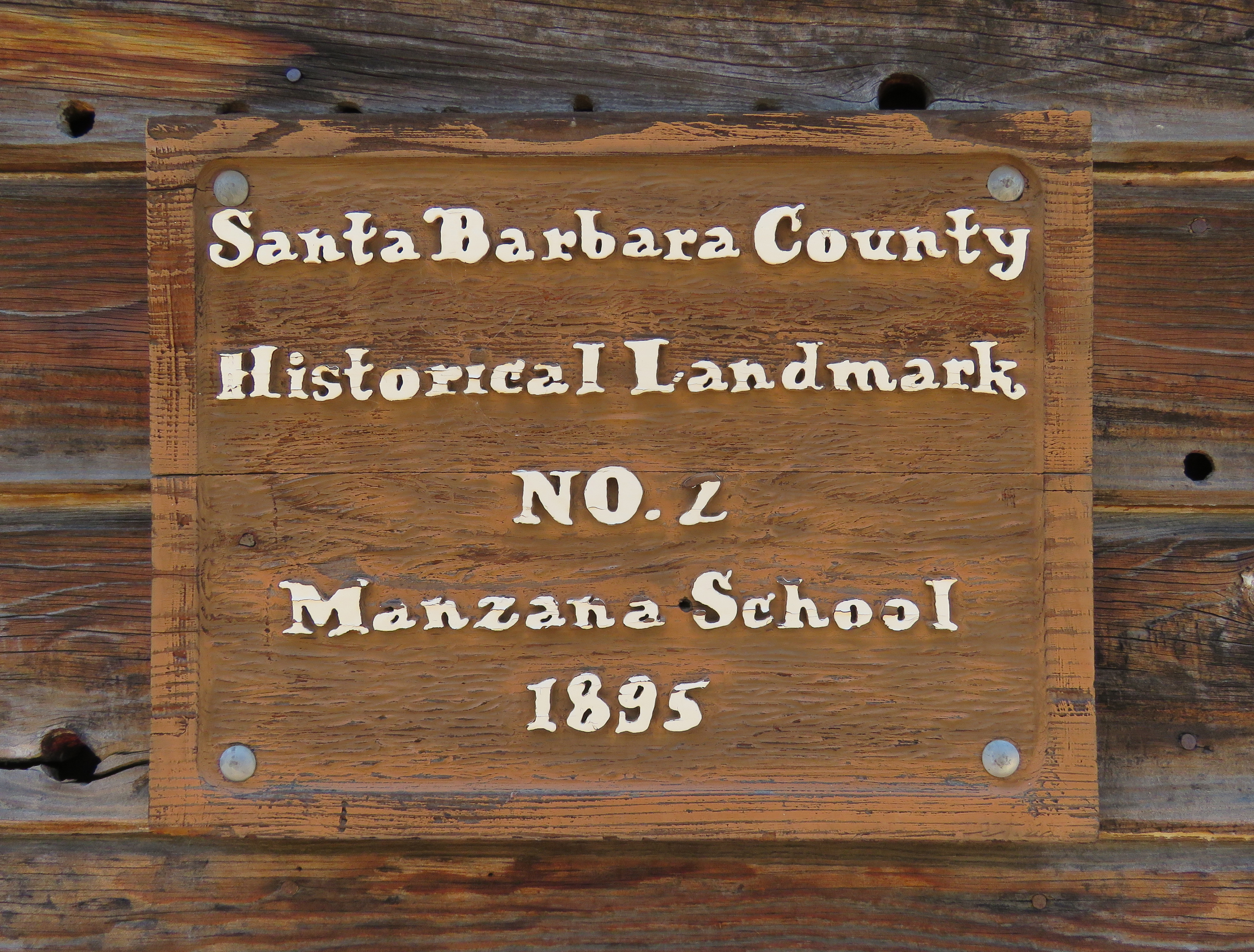
The Willmanns were active in the community of settlers along the Sisquoc River and its tributaries. He served on the board of Trustees for Manzana School District when the community petitioned the county to build a school there.

Louise Kleine Willmann’s younger sister, Bertha Kleine, was the last school teacher at Manzana Schoolhouse. Bertha Kleine was married to Joe Libeu, whose brother had a homestead at Zaca Lake.

When the school closed in 1902, with an enrollment of just one student, Henry Leo Willmann, the Willmanns decided to move to Santa Maria so their son could attend high school there.

Adolph Willmann died in 1908, and is buried in Nipomo. The home they built along Sisquoc River later burned down during a forest fire in the 1920s.

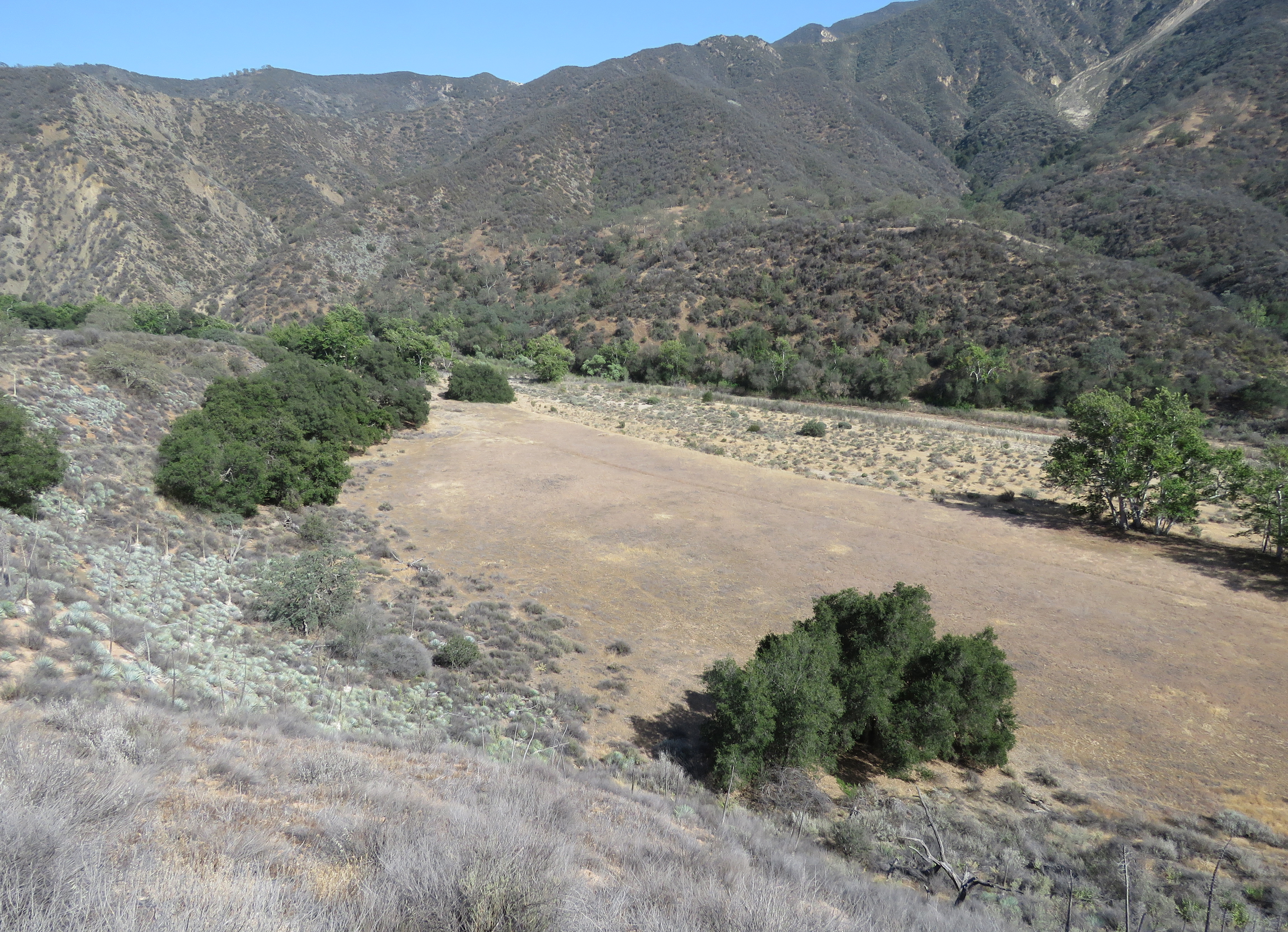
Today, what remains from the homestead is the chimney and nearby root cellar. Out in the field, by the homestead site, one can find what’s left of the well, a fair amount of corrugated metal, and some rusting farm equipment.
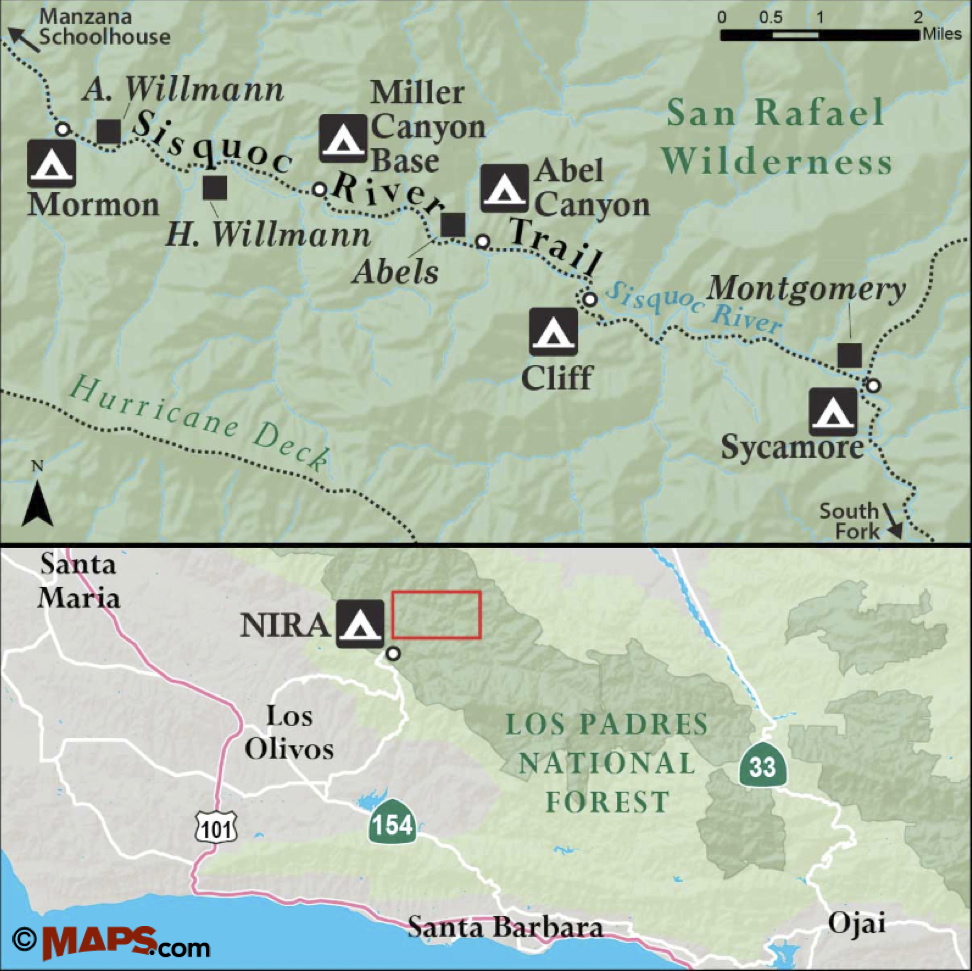
Sisquoc River Trail hike Map Mormon Wellman Willmann homestead Able Abel Cliff Sycamore Montgomery Miller Canyon Base Los Padres National Forest San Rafael Wilderness

Map courtesy Maps.com

The Willmann site is best reached as part of a backpacking trip. From the trailhead near Nira Campground, it’s about 14.5 miles to the homestead site. There are a number of trail camps along the way; however both Manzana Creek and Sisquoc River flow intermittently through the summer, and so it’s best to check with the forest service regarding current conditions.

The route follows Manzana and Sisquoc River Trails. The trailhead is reached from Santa Barbara by way of State Route 154 and Happy Canyon Road. The Manzana trailhead is just before Nira Campground, where the road ends.

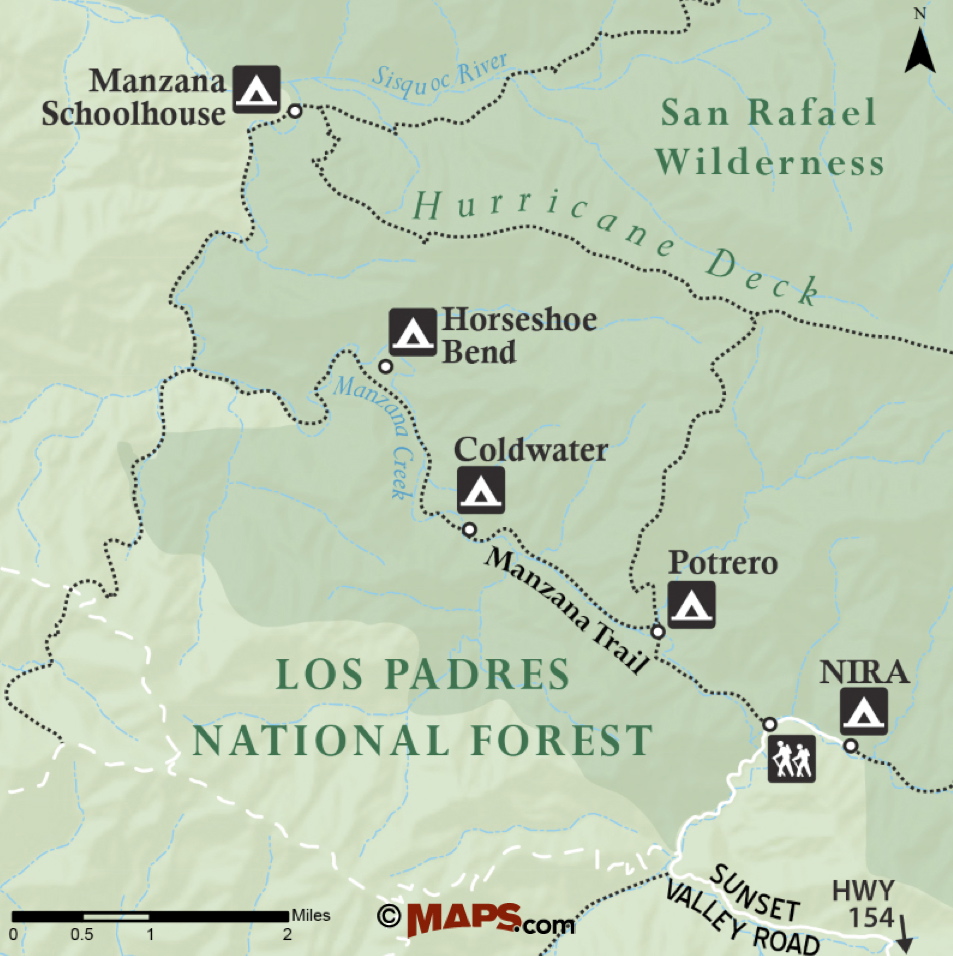
From the trailhead, Manzana Trail follows Manzana Creek downstream to Manzana Schoolhouse Camp, where it meets Sisquoc River Trail. From Manzana Schoolhouse, continue upriver along Sisquoc River Trail. The trail follows the Sisquoc River through the San Rafael Wilderness and, in places, travels along the old road cut used by the early homesteaders.

The trail leads past Water Canyon and Lorna Camps before arriving at Mormon Camp. About a quarter mile past Mormon Camp, the trail arrives at the Willmann homestead. The homestead site is on the north side of the river in a small side canyon.

Continuing upriver from the Willmann site, the trail crosses the river several times before veering north, away from the river. Here, about a mile past the Willmann site, the road cut branches. The more overgrown road cut to the left leads up to Wellman Mesa, where Adolph Willmann used to grow grain. To the right, the more traveled route follows the other road cut, which leads back down to the river.
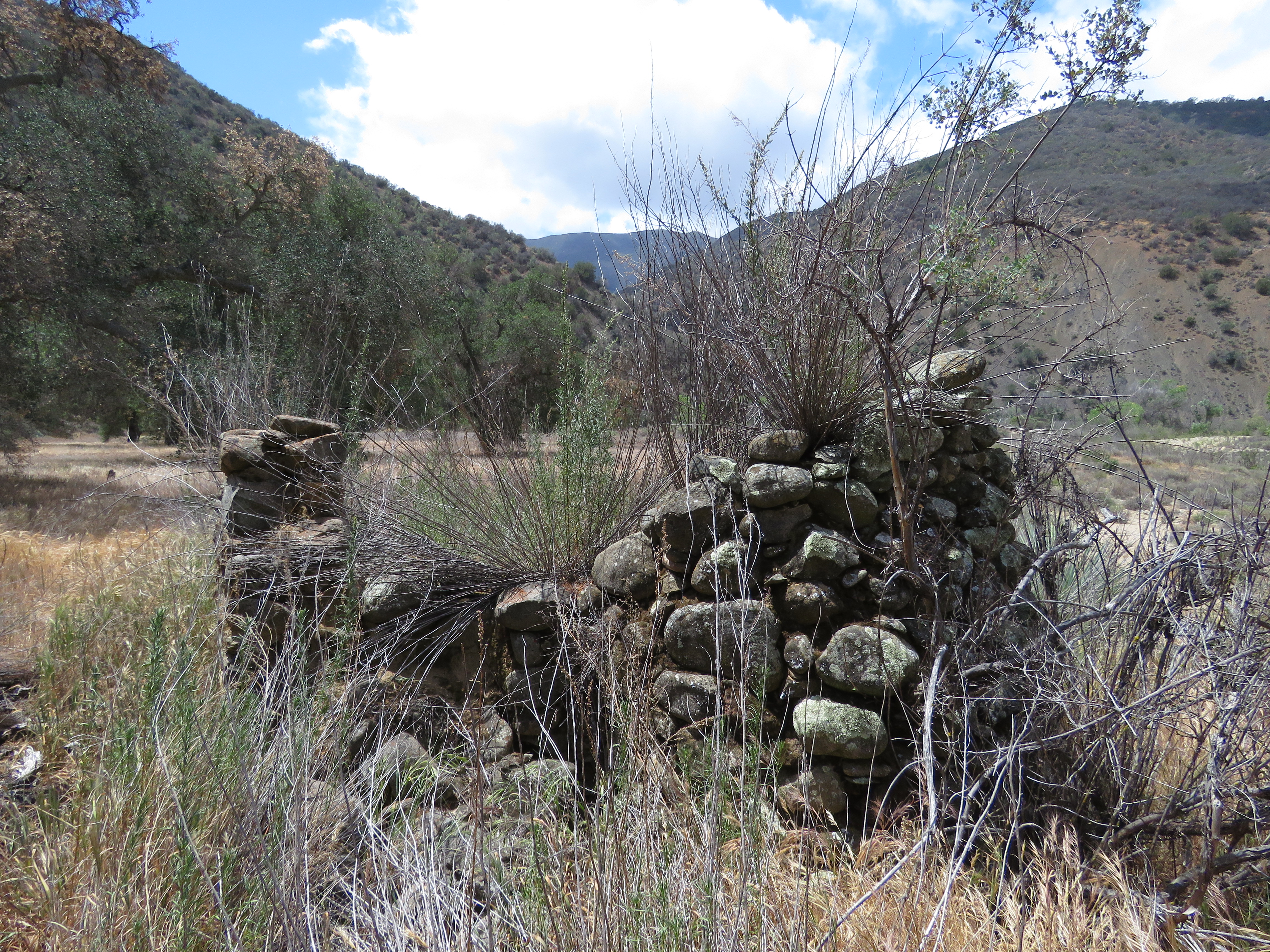
Herman Wellman Willmann homestead Los Padres National Forest San Rafael Wilderness Sisquoc River trail hike

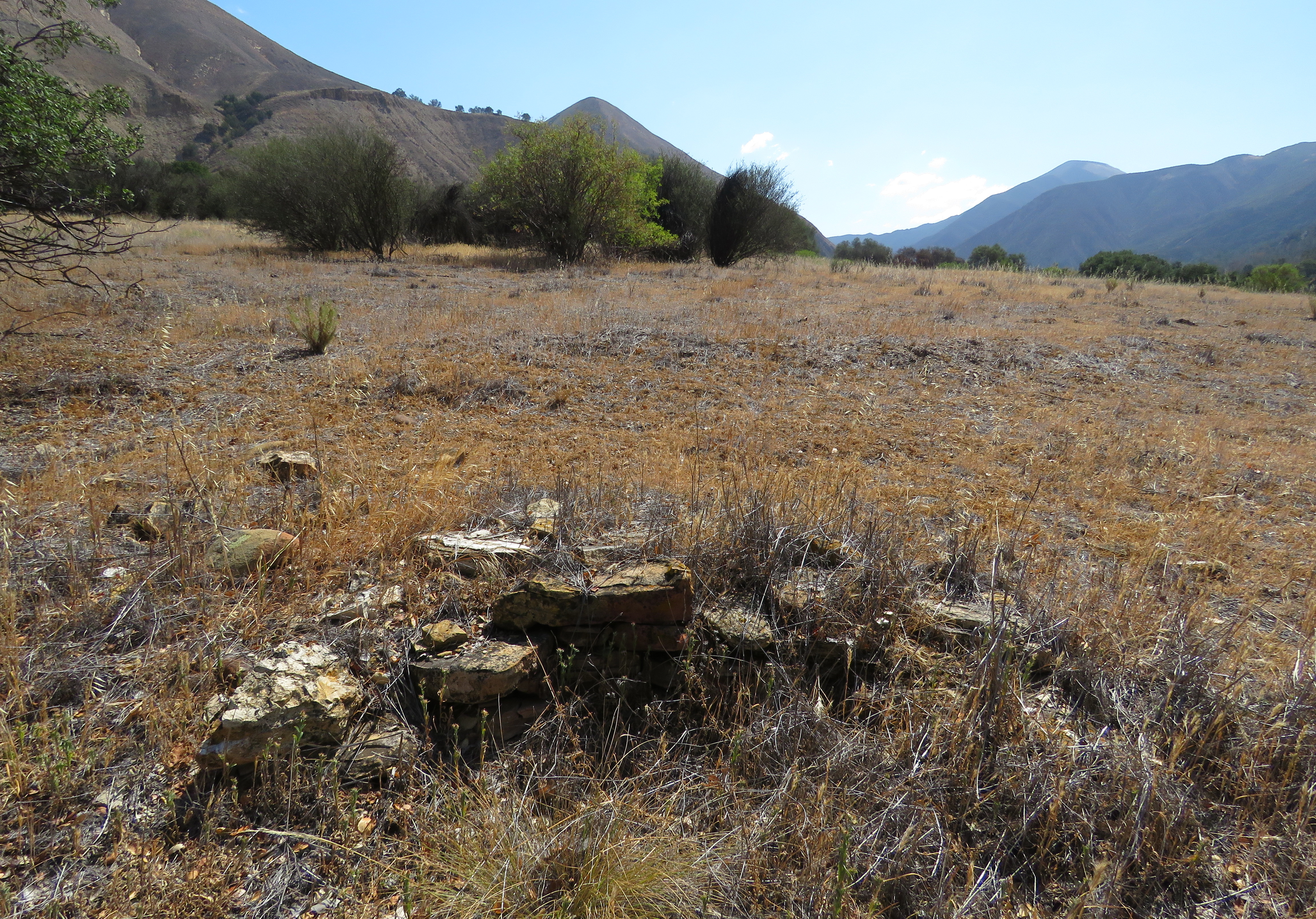
The remains of the Herman Willmann homestead

Just as the trail starts to level out along the river, look for a pile of stones across the river, on the south side. This is the remains of Herman Willmann’s homestead, Adolph Willmann’s younger brother.

Herman Willmann began building his house there out of river stone. However, he died of tuberculosis before he could complete it. Herman Willmann is buried on the low mesa just east of his brother’s homestead. The grave is under an oak tree and marked with a rectangle of stones.

Wellman Mesa, which is located just west of the Herman Willmann homestead site, is near where the 1966 Wellman Fire started.

On June 11, 1966, four airmen from Vandenberg Air Force Base flying over the area on a sightseeing tour attempted to land on the mesa.

While approaching the large, and mostly level mesa the pilot misread the prevailing wind conditions and touched down with too much speed to safely land before reaching the end of the mesa. Realizing his error, the pilot attempted to take back off. However, during the takeoff attempt, the tail wheel hit a bush causing the plane to tip and turn. The plane then crashed into a juniper. The collision tore off one of the wings and sent the plane over the edge of the mesa, where it crashed in the riverbed below.

On impact, the plane split open. The two men in the back half of the plane, both with broken legs, were able to crawl clear of the wreckage before a ruptured wing tank burst into flames. The pilot and other passenger, who were trapped in the wreckage, died in the fire. The two survivors, who spent the night avoiding the fire as it spread, were airlifted out the next day when two forest service fire fighters arrived to investigate the reported plume of smoke.

The fire, which was first spotted from Figueroa Mountain Lookout, burned through an area that hadn’t been burned since the 1920s. From Wellman Mesa, the fire burned north to the top of the Sierra Madres Mountains. To the west, it burned to Horse Gulch Canyon; and to the east, it burned past Sycamore Camp. The fire posed the greatest potential threat to the south. It burned up and over Hurricane Deck, continued to the top of the San Rafael Mountains, and down into the Santa Cruz Creek drainage before it was contained.

The fire burned for 12 days before a shift in the weather brought cooler temperatures that aided in containing the fire. The fire burned 92,000 acres and was similar in scope to the 2009 La Brea Fire, which burned close to 90,000 acres and took about two weeks to contain. In comparison, the 2007 Zaca Fire burned more than 240,000 acres and took almost two months to fully contain.

All three fires burned through parts of what is now San Rafael Wilderness. And it’s interesting to note that the area along Sisquoc River burned by the Wellman Fire lies between the burn areas of the La Brea and Zaca Fires and was spared during those fires.

Past Wellman Mesa and the Willmann homesteads, the road used by the early settlers continued upriver to the last homestead site along the river, that of Edward Montgomery, where the road ended.

This article originally appeared in section A of July 27th, 2015 edition of Santa Barbara News-Press. The next, and last, article in the series covers the Miller, Abels, and Montgomery homesteads.

Posted by: James Wapotich | July 20, 2015

Trail Quest: Sisquoc Homesteads

This is the fifth in a series of articles on the homesteads along Manzana Creek and Sisquoc River. This one covers the homesteads between Manzana Schoolhouse and Water Canyon Camp, including Roberts, Spitler, Forrester, and Twitchell, as well as the Sisquoc Guard Station. Article appears in section A of today’s edition of Santa Barbara News-Press. The next article will cover the Willmann homesteads.

Roberts Flat Sisquoc Guard Station trail hike backpacking Los Padres national forest san rafael wilderness

A dry Sisquoc River is seen from Roberts Flat

Sisquoc River Trail map Forrester homestead Wheat Wells Manzana Schoolhouse Water Canyon Lorna Mormon San Rafael Wilderness Los Padres National Forest

Map courtesy Maps.com

Older articles can be seen by scrolling down or using the search feature in the upper right corner. Articles from the News-Press appear here a couple months after they appear in the News-Press.

Los Padres national forest sisquoc river trail hike backpacking san rafael wilderness

Scenery along Sisquoc River Trail

Posted by: James Wapotich | July 6, 2015

Trail Quest: Forrester Homestead

Downstream from Manzana Schoolhouse, along Sisquoc River, are several homestead sites that date back to the late 1800s. The sites are from a time when settlers made their way east from Santa Maria to homestead federal land in the backcountry that was available through the Homestead Act of 1862.

At one time there were as many as 200 people living along the Sisquoc River and its tributaries. At the core of their community was a group of about a dozen families interrelated through marriage. The settlers built cabins and cultivated land to prove up on their claims, and many also raised cattle to make a living.

The homesteading period along the Sisquoc River and its tributaries was short-lived. Several factors combined that eventually caused most of these settlers to move out of the area. Changes in forest service policy curtailed the homesteaders practice of burning off chaparral in the fall to create grazing land. The 1890s marked the beginning of an extended period of drought. And in 1899, Sisquoc Ranch began to lock the gates on the wagon road that passed through its property. The road had served as the main route for the settlers to reach Santa Maria where they could sell their goods and purchase supplies.

Forrester homestead sisquoc river trail san rafael wilderness los padres national forest backpacking hiking

Forrester homestead site

Today, little remains of these homestead sites, but it is still possible to locate them, and in some case view remnants of the structures.

The sites below Manzana Schoolhouse can be reached by hiking downstream along Sisquoc River Trail. There are several routes that lead to Manzana Schoolhouse, the most commonly used is Manzana Trail.

The trailhead is reached from State Route 154 by way of Happy Canyon Road, and is located just before Nira Campground, where the road ends.

From the trailhead it is about 8.5 miles to Manzana Schoolhouse, and so the homestead sites are best visited as part of a backpacking trip. The campground at Manzana Schoolhouse has six campsites, each with a picnic table and metal fire ring. However, because of the drought both Manzana Creek and Sisquoc River are dry at the camp.

From Manzana Schoolhouse, Sisquoc River Trail continues downstream along the road used by these early settlers. The unpaved road crosses Sisquoc River and leads up to Wheat Mesa, and continues past the Wells and Wheat homestead sites.

Sisquoc River Trail map Forrester homestead Wheat Wells Manzana Schoolhouse Water Canyon Lorna Mormon San Rafael Wilderness Los Padres National Forest

Map courtesy Maps.com

Hiram Preserved Wheat was the patriarch of the community and Hiram Hiley Preserved Wells was one of his grandsons. The road passes the Wells homestead site, which is recognizable by the chimney that is still standing there. The Wheat homestead is located at the western edge of the mesa and is less noticeable as only a low pile of stones from the chimney remain.

Past the Wheat homestead, the road descends down to the river and crosses it. The trail then continues down a dry flood channel before veering to the right, and crossing Sisquoc River again. From here, the road continues along an open flat on the north side of the river. The flat is sometimes referred to as Miller’s Flat. John Miller homesteaded the site, but didn’t prove up on his claim.

At about the 2-mile mark from Manzana Schoolhouse, the road arrives at Horse Gulch Creek. Just past the creek, the road ends at the locked gate for Sisquoc Ranch. Please respect private property. From the National Forest side of the fence one can view the remains of the Forrester homestead, which includes part of the rock wall and foundation, as well as the chimney.

Known as “Whispirin’ Ed” because of his booming voice, Edward Everett Forrester was born in West Virginia in 1860. In 1880, Forrester arrived in Santa Maria, where he worked part-time as a blacksmith. Two years later he married Emily Malinda Wells, Hiram Hiley Preserved Wells’ sister, and in 1883, joined the settlers living along Sisquoc River and Manzana Creek.

Miller's Flat Sisquoc River Trail horse gulch canyon backpacking hiking los padres national forest san rafael wilderness

Miller’s Flat – Sisquoc River Trail

Forrester homesteaded at the mouth of Horse Gulch Canyon, then known as Brush Creek. He built a redwood sluice that diverted water from Horse Gulch to irrigate his orchard, which included apple, peach, pear and plum trees. He ran cattle, and on the flat terraces along the river had fields of alfalfa and hay.

The Forresters also raised goats and turkeys, and at one time were reported to have 2,500 goats. On their property was a barn and several other buildings.

Forrester had two brothers, Lucien Leonidas and William Merchant, both of who lived upstream along Sisquoc River. Their mother, Cassandra, lived with the Forresters at Horse Gulch, until she passed away in 1895. Her grave is on a small flat on the ridge just east of Horse Gulch.

Forrester added additional parcels to his property until he had a fairly large holding.

When Sisquoc Ranch commissioned a survey in 1899 of the Rancho Sisquoc land grant boundary, it was determined that the Forrester home lay just within the ranch’s property. The survey proved a point of contention between Forrester and the ranch, and later surveys only complicated the matter.

In 1901, Forrester moved to Imperial Valley where his family joined him two years later. The Horse Gulch property reverted to the federal government, and later through land exchanges portions of the property, including the site of the Forrester home, became part of Sisquoc Ranch.

After the Forresters left the area, the home was leased to the Garcia Family. It’s said that two of the Garcia’s sons died of typhoid at the home and are buried near Cassandra Forrester.

Further up Horse Gulch Canyon was the homestead Fred Carver, who sold the property in 1895, to William H. Elliot.

The site was located on an open flat above what is now Sluice Box Camp. It’s said that some of the homesteaders used to sluice for gold from the gravel in the creek bed near the camp. The camp is about four miles upstream from Sisquoc River, on the eastern side of the creek. The trail through the canyon is overgrown and does require some effort to follow.

Downstream from the Forrester homestead were several other homestead sites that are now part of Sisquoc Ranch.

The mesa just west of Horse Gulch was said to have been homesteaded by William K. Hobson. Hobson was related to the Tunnell family through marriage, and was the second husband of Eliza Tunnell. Her brothers, William and George, had homesteads further down river.

Their father Martin Luther Tunnell was a veteran of the Mexican-American War and was one of the early settlers of the Santa Maria Valley. Martin Luther Tunnel and his wife had ten children, and their ranch was located in what is now downtown Santa Maria.

In 1882, William Tunnell homesteaded along the north side of Sisquoc River, just west of the Hobson homestead. William Tunnell built a two-story house made from native pine cut at the Davis sawmill. The floor was made of sycamore, which was tongued and grooved by Dave Spaulding, who operated the mill with the Davises.

When the northern boundary of Sisquoc Ranch was surveyed it was found that most of his property, including the house, lay within the ranch boundary. In 1899, William Tunnel sold his land to Sisquoc Ranch and moved to Santa Maria, where he continued ranching. The house was later used by Sisquoc Ranch as line cabin for its cattle operations.

Downstream from William Tunnell’s homestead was the homestead of his brother, George. His property was also found to be within the ranch boundary, and he too sold his land to Sisquoc Ranch and moved on.

George and his brother Henry jointly owned property in Tepusquet Canyon, and after their father died in 1903, inherited part of the property in Santa Maria.

Upstream from Manzana Schoolhouse along Sisquoc River are a half dozen more homesteads sites in what is now San Rafael Wilderness.

This is the fourth in a series of articles on the homesteads along Manzana Creek and Sisquoc River. Article appears in section A of today’s edition of Santa Barbara News-Press. The next article will cover the homesteads along the Sisquoc between Manzana Schoolhouse and Mormon Camp.

Older articles can be seen by scrolling down or using the search feature in the upper right corner. Articles from the News-Press appear here a couple months after they appear in the News-Press.

Posted by: James Wapotich | June 26, 2015

Trail Quest: Wheat and Wells Homesteads

This is the third in a series of articles on the homesteads along Manzana Creek and Sisquoc River. This one covers the Wheat and Wells Homesteads found on Wheat Mesa just downstream from Manzana Schoolhouse along the Sisquoc. Article appears in section A of today’s edition of Santa Barbara News-Press. The next article will cover the homesteads in and around Horse Gulch.

Hiram Preserved Wheat Wells Homestead Manzana Sisquoc River Trail hike backpacking San Rafael Wilderness Los Padres National Forest

A low pile of stones from the chimney at the Wheat homestead

Sisquoc River Trail map Forrester homestead Wheat Wells Manzana Schoolhouse Water Canyon Lorna Mormon San Rafael Wilderness Los Padres National Forest

Map courtesy Maps.com

Older articles can be seen by scrolling down or using the search feature in the upper right corner. Articles from the News-Press appear here a couple months after they appear in the News-Press.

Posted by: James Wapotich | June 15, 2015

Trail Quest: Manzana Schoolhouse

This is the second in a series of articles on the homesteads along Manzana Creek and Sisquoc River. Article appears in section A of today’s edition of Santa Barbara News-Press. The next article will cover the Wheat and Wells Homesteads.

For other articles I’ve written about Manzana Schoolhouse see Trail Quest: Manzana Schoolhouse (from 2011) and Trail Quest: Sulphur Springs Trail.

Manzana Schoolhouse los padres national forest homestead Sisquoc River

*

Manzana Schoolhouse Camp Map Horseshoe Bend Potrero trail hike Coldwater Nira San Rafael Wilderness Los Padres National Forest

Map courtesy Maps.com

Older articles can be seen by scrolling down or using the search feature in the upper right corner. Articles from the News-Press appear here a couple months after they appear in the News-Press.

Posted by: James Wapotich | June 4, 2015

Trail Quest: Manzana Homesteads

A couple weeks ago I hiked along the Manzana and Sisquoc visiting the various homestead sites for a series of articles. This week’s article focuses on the homesteads found along Manzana Creek. Article appears in section A of today’s edition of Santa Barbara News-Press. The next article will cover the history of Manzana Schoolhouse.

Manzana Homesteads hike trail backpacking Santa Barbara los padres national forest san rafael wilderness

Scenery along Manzana Trail

Manzana Schoolhouse Camp Map Horseshoe Bend Potrero trail hike Coldwater Nira San Rafael Wilderness Los Padres National Forest

Map courtesy Maps.com

Older articles can be seen by scrolling down or using the search feature in the upper right corner. Articles from the News-Press appear here a couple months after they appear in the News-Press.

Posted by: James Wapotich | May 4, 2015

Trail Quest: Visiting P-Bar Flat Campground

There are four different campgrounds found in the upper Santa Ynez River Recreation Area. Each of them can make for a good base camp from which to explore the different nearby trails. The campground at P-Bar Flat is located near Blue Canyon Trail, which connects to Cottam Camp, and can make for an interesting day hike destination.

The hike to Cottam Camp from P-Bar Flat is about 4.5 miles roundtrip, and can include a side visit to an old hunting camp. The trail is mostly level and follows the Santa Ynez River and Blue Canyon Creek, both of which are currently flowing intermittently.

To get to the upper Santa Ynez River Recreation Area from Santa Barbara, find your way to Gibraltar Road in the foothills behind Santa Barbara. Follow Gibraltar Road to the top of the Santa Ynez Mountains, where it meets East Camino Cielo Road, and turn right on to East Camino Cielo.

Santa Ynez River hiking backpacking Santa Barbara Los Padres National Forest P-Bar Flat Campground Blue Canyon Trail

The Santa Ynez Mountains frame a view along Blue Canyon Trail

Currently, Gibraltar Road is closed for repairs until May 22nd. However, East Camino Cielo can also be reached from State Route 154. It is a longer route, but does provide access until Gibraltar Road reopens.

Continue east along East Camino Cielo, along the top of the mountains. The road eventually arrives at Romero Saddle, where it changes names, becoming Romero-Camuesa Road, and then continues, unpaved, down the backside of the mountains to the Santa Ynez River. The road crosses the river, and continues on towards the intersection with Big Caliente Road. From there, continue straight, past Middle Santa Ynez Campground, to the next campground, which is P-Bar Flat.

There are three different forest service gates along Romero-Camuesa Road that are closed during inclement weather. Current road closures and fire restrictions can be found on the Forest Service website, http://www.fs.usda.gov/lpnf.

P-Bar Flat Campground map trail hike Blue Canyon Middle Santa Ynez River Los Padres National Park Rowe's Gulch Rose Cottam

Map courtesy Maps.com

P-Bar Flat was established as a hunting camp around 1916. The camp takes its name from the chamber pot that is said to have hung from one of the trees and was used for target practice. The original name used more colorful language to describe the pot, but over the years it became known as P_____ Flat, or P-Bar Flat.

P-Bar Flat has four campsites located under the oak trees, each with a picnic table and metal fire ring. The campground is located next to Horse Canyon, across from the Santa Ynez River. An adventure pass is required to camp at the campground, but not to park at any of the trailheads.

For the hike to Cottam Camp, continue on foot, heading west along Romero-Camuesa Road to Blue Canyon Trail. The trailhead is about a half mile from the P-Bar Flat. Along the way, an interesting side visit can be made to an old hunting camp in Rose Canyon. The canyon is just before Blue Canyon Trail and is the first large canyon along the road past Horse Canyon.

What's left of the picnic table at the old Rowe's Gulch camp

What’s left of the picnic table at the old Rowe’s Gulch camp

There is no real trail through Rose Canyon, but the camp is less than a half mile in. The most direct route is along the creek bed, but occasionally one can find remnants of the trail on the eastern side of the creek. Little remains of the camp, which is also on the eastern side of the creek, but with some perseverance, one can find remnants of the picnic table, as well as an aluminum pot that’s been used for target practice.

The camp appears on one old recreation map as Rowe’s Gulch. During the 1920s and 1930s a number of hunting camps were established in the backcountry by families or groups of friends, and so one possibility is that this site was used by the Rowe Family.

During the 1930s trails were built to a number of these hunting camps by the Civilian Conservation Corp. However, during the Second War World, the amount of manpower available to maintain trails was reduced, and the forest service closed the forest for part of the year, including during the hunting season, as a fire control measure. As a result, these hunting camps were used less and less, and many of them faded into obscurity.

Cottam Camp Blue Canyon Trail hiking backpacking Los Padres National Forest Santa Barbara sierra blanca limestone

An outcropping of sierra blanca limestone is seen along Blue Canyon Trail

Just past Rose Canyon, along Romero-Camuesa Road, is the beginning of Blue Canyon Trail. The trailhead overlooks the Santa Ynez River, and is marked with a brown carsonite sign. Here, one can also find a small pullout for parking.

From the trailhead, Blue Canyon Trial makes it way down to the Santa Ynez River. The trail is a little indistinct as it crosses the river twice, but where you’re aiming for is the broad flood plain on the north side of the river. Here, one can find another carsonite sign marking the trail.

The trail passes a large outcropping of sierra blanca limestone, and continues downstream along the flood plain through an oak savannah of wild grasses and coast live oak. The trail then crosses the Santa Ynez River at more or less a right angle, and continues through more oak savannah before arriving at Blue Canyon Creek.

Cottam Camp hiking backpacking Los Padres National Forest Blue Canyon

Some water can still be found in Blue Canyon Creek at Cottam Camp

The trail crosses the creek and continues upstream toward Cottam Camp. The trail has one indistinct section where it crosses and travels up the middle of the creek, but then reestablishes itself on the eastern side of the canyon.

Blue Canyon Trail then arrives at Cottam Camp, where it meets Forbush Trail. Cottam Camp is located under the oaks and cottonwood at the edge of a large meadow, and features a picnic table and fire ring. Currently there is some water to be found in the creek near the camp.

Cottam Camp takes it name from Albert Cottam, who used to have cabin in the area. Albert Cottam was born in 1898, and moved with his family from New Jersey to Montecito when he was eight. When he was 14 years old he was invited by the foreman of Pendola Ranch to stay there for a couple of weeks. At the ranch, the foreman shared with him stories about the local backcountry, as well as tales of meeting Pancho Villa and Joaquin Murietta. And perhaps it was those experiences that inspired Cottam to build a cabin in Blue Canyon a couple years later with his older brother Russell.

The two brothers, still in their teens, hired a man to cut alder trees for them in nearby Forbush Canyon, which they used for the cabin’s frame. With the use of pack animals, they brought over the mountains all the boards and fixtures needed to build and furnish the cabin.

An experienced horse packer, Cottam brought in visitors to his cabin on the weekends. And when trail crews were working in Don Victor Valley, he would ride over there twice a week to bring the crews fresh supplies and meat, as well as newspapers and their mail.

Cottam also worked as a horse packer for his neighbor Roderick Show. Show ran a small guest ranch called Camp Ynez in Forbush Canyon. The camp was about a quarter-mile west of Cottam Camp.

Roderick Show Camp Ynez Forbush Canyon Trail Los Padres National Forest hiking Santa Barbara

A piece of corrugated sheet metal from the barn at Camp Ynez in Forbush Canyon along Forbush Trail

Remnants of Camp Ynez can still be found by hiking from Cottam Camp along Forbush Trail. As the trail makes its way up Forbush Canyon, look for the first open clearing along the trail. Here, one can find pieces of corrugated sheet metal, that are said to be part of the barn. Nearby, between the creek and the trail, hidden amongst the poison oak, one can also find a cement foundation from one of the camp’s structures.

Past the site, Forbush Trail continues up towards Forbush Flats, where Cottam’s other neighbor, Frederick Washington Forbush, homesteaded. It was Forbush who built the trail through the canyon that now bears his name.

Regardless of how far you hike you’ll have a chance to see some of Santa Barbara’s historic backcountry camps.

This article originally appeared in section A of the May 4th, 2015 edition of Santa Barbara News-Press.

Cottam Camp Los Padres National Forest Santa Barbara hiking backpacking Blue Canyon Trail

The Meadow at Cottam

Posted by: James Wapotich | April 21, 2015

Trail Quest: Fish Creek

Springtime is one of the best times of the year to head out on our local trails. Even with the drought, there is still water in many of the creeks; the wildflowers are blooming; and the scenery can be quite enchanting.

Perhaps one of the easier backcountry destinations in our area is Manzana Creek in the San Rafael Wilderness. Manzana Trail is accessed from the trailheads near Nira Campground and follows the creek in both directions. An interesting destination that allows for additional off-trail exploring is Fish Creek.

Fish Creek is upstream from Nira along Manzana Trail. Fish Camp, which is near the confluence of Manzana and Fish Creeks, is about 5 miles roundtrip from the trailhead. At the confluence of the two creeks, one can find a swimhole, and upstream, along Fish Creek one can explore the wilderness still further.

Fish Creek Manzana Trail hiking backpacking Santa Barbara Los Padres National Forest San Rafael Wilderness

Scenery along Fish Creek

To get to the trailhead from Santa Barbara, take State Route 154 past Lake Cachuma to Armour Ranch Road. You’ll know if you’ve gone too far if you arrive at the turnoff for State Route 246. Turn right onto Armour Ranch Road and follow it to the beginning of Happy Canyon Road. Turn right onto Happy Canyon Road. The road leads through ranch country before climbing out of the Santa Ynez Valley towards Cachuma Saddle and the top of the San Rafael Mountains.

From the 4-way intersection at Cachuma Saddle, continue north. Happy Canyon Road becomes Sunset Valley Road and descends down towards Manzana Creek. The road passes Davy Brown Campground, before ending at Nira Campground. Both campgrounds are shaded and offer campsites on a first come, first serve basis. An adventure pass is required to camp at either campground, but not to park at the trailheads. The drive from Santa Barbara to Nira is about 1.5 hours.

Lupine blue butterfly los padres national forest manzana creek san rafael wilderenss

Lupine blue

From the trailhead at Nira, Manzana Trail continues upstream and crosses Manzana Creek. The creek is currently flowing intermittently. From this first creek crossing, Manzana Trail stays on the north side of the creek until just before Fish Camp, where it crosses the creek a second time.

The trail is in generally good condition as it follows Manzana Creek upstream. Near the creek, the trail passes through a mix of riparian and chaparral plants, including sycamore, alder, and willow, as well as coast live oak, ceanothus and manzanita. Along the route, one can also find numerous grey pines that add to the scenery.

There are also some wildflowers to be found along the trail, such as larkspur, blue dicks, penstemon, and some lupine.

And while the wildflower bloom may be modest, the butterflies are another story altogether. The butterflies seem to have gotten an early start this year, and are currently quite active. Along the trail, one can spot more than a half-dozen different butterflies making voracious use of the wildflowers that are in bloom.

Checkerspot butterfly los padres national forest manzana creek san rafael wilderness

Checkerspot

Perhaps the most abundant of the butterflies along the trail is checkerspot. This medium-sized butterfly with its orange, yellow and black pattern can easily be found on purple yerba santa flowers, as well as the other flowers in bloom. Other butterflies in the mix are large swallowtails with their yellow and black pattern, as well as the occasional monarch with its orange and black pattern.

Next in size are the somewhat smaller California sister butterflies, which are black with touches of orange and white. Medium to small-sized butterflies along the trail can include: buckeyes, which have distinctive circles or “eyes” as part of their wing pattern; sulphur butterflies with their mostly creamy yellow color; Sara orangetip, which have white wings with orange tips; and checkered whites, which have an overall white or cream color accented with grey.

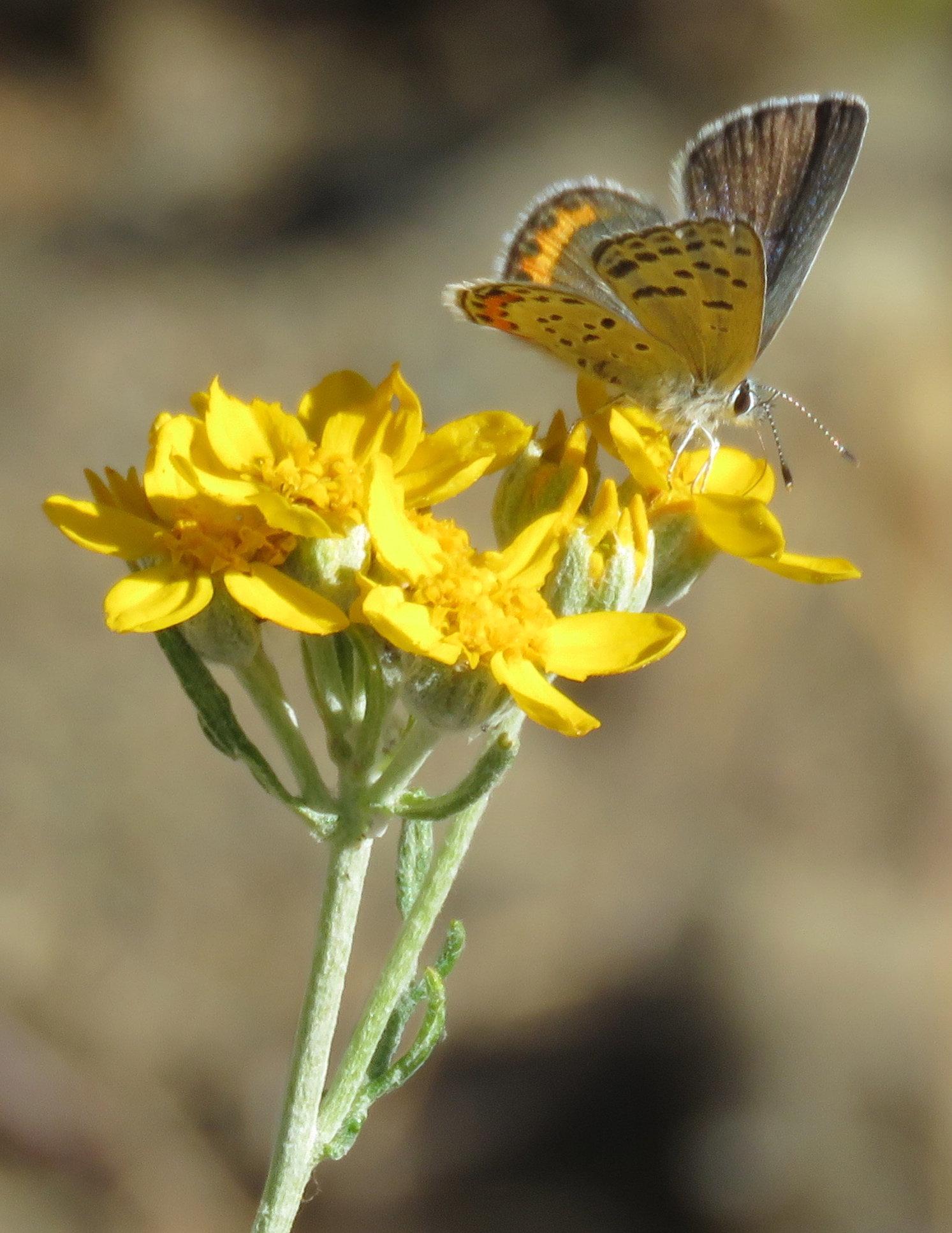
Careful eyes may also spot small blueish butterflies such as acmon and lupine blues, both of which have pale blue undersides that are accented with black and touches of orange.

Western tiger swallowtail los padres national forest manzana creek san rafael wilderness

Western tiger swallowtail

At about the 1-mile mark, Manzana Trail arrives at the beginning of Lost Valley Trail. Lost Valley Trail leads north, away from Manzana Creek. The trail connects over to Lost Valley Creek before eventually making its way to the top of Hurricane Deck.

Just past the trail juncture, Manzana Trail arrives at Lost Valley Camp. The camp has two sites situated under the grey pines. Both sites have a picnic table and fire ring, and currently there is water in the creek at the camp.

About a half-mile past the camp, Manzana Trail crosses Lost Valley Creek, which is typically dry here. Past the crossing, the trail climbs away from Manzana Creek passing through mostly chaparral and offering views out across the canyon.

The trail then descends back down to the creek, crosses it, and arrives at Fish Camp. Currently the crossing is dry, but water can be found just downstream at the confluence of Fish and Manzana Creeks.

Fish Camp has two campsites, each with a picnic table and metal fire ring; and one of the features of Fish Camp is the nearby swimhole. When the creeks are flowing a nice pool of water is found at the confluence of Fish and Manzana Creeks.

Manzana Creek trail camp fish creek los padres national forest hike backpacking san rafael wilderness

Water at the confluence of Manzana and Fish Creeks

Fish Creek can be explored further by hiking upstream along the creek. There is no designated route, but one can find an informal route along the creek used by hunters and occasional hikers, as well as the local wildlife, that is relatively easy to follow. The canyon is wide enough that there are only few places where one has to navigate through the brush.

From the confluence with Manzana Creek, Fish Creek’s meandering course leads southward towards its source in the San Rafael Mountains. The creek is currently flowing along most of its length, and an interesting destination is the small grotto that can be found about a mile upstream from the confluence.

In addition to the other plants founds along Manzana Trail, Fish Creek also includes juniper. In fact, early on in the hike, the creek passes a whole hillside covered with California juniper bushes.

About a mile from the confluence with Manzana Creek, Fish Creek branches. To the left is East Fork Fish Creek and to the right Fish Creek. Both creeks are currently flowing. From this confluence, hike up the small ridge that separates the two creeks. The informal trail then bears to the right, continuing above Fish Creek a short way, before rejoining the creek just above the grotto.

Fish Creek grotto San Rafael wilderness los padres national forest

Fish Creek grotto

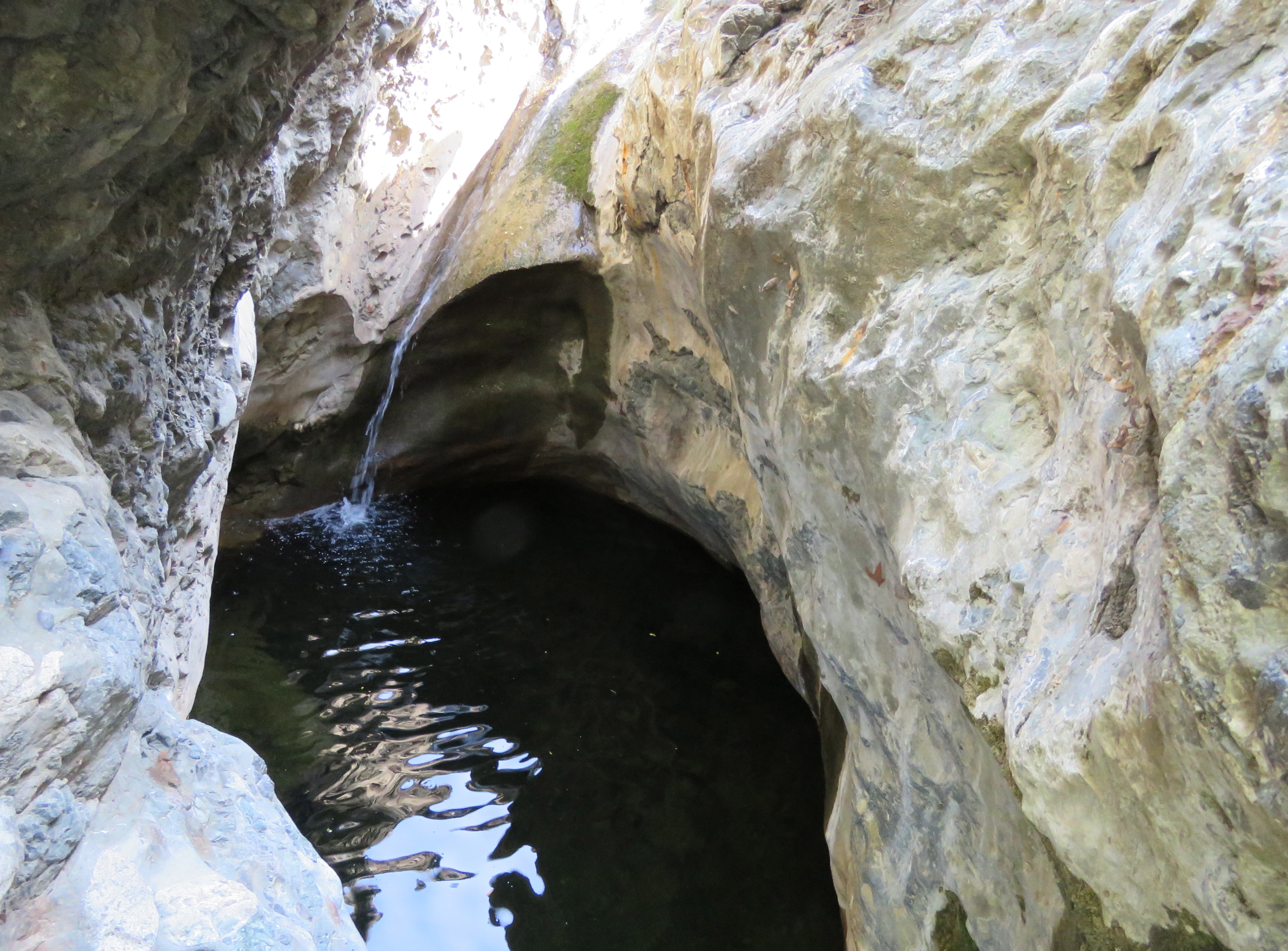
The grotto is formed where Fish Creek has carved through conglomerate stone and has created an almost hidden pool of water. The canyon’s geology represents another interesting aspect of the hike. From Nira, Manzana Trail passes through mostly Cachuma Formation shale. Cachuma Formation material was deposited 100-66 million years ago under the ocean, and then uplifted and eroded over time along with the other layers of sedimentary and metamorphic rocks in the San Rafael Mountains.

At the mouth of Fish Creek is Cachuma Formation sandstone, which dramatically frames the swimhole. Upstream from the swimhole, Fish Creek passes through Cachuma Formation shale all the way until it transitions to Cachuma Formation conglomerate stone. Conglomerates are sedimentary rocks that contain other rocks that have been cemented together with finer-grained material.

The grotto can make a good return point for the hike. Past the grotto one can continue upstream roughly another quarter-mile along mostly conglomerate stone, before the creek starts to become closed in with brush and trees.

Regardless of how far you hike you’ll get to explore a unique part of the San Rafael Wilderness.

This article originally appeared in the April 21st, 2015 edition of the Santa Barbara News-Press.

This article is also the 200th Trail Quest article.

Fish Creek Manzana Trail San Rafael Wilderness hiking backpacking Los Padres National Forest

Scenery along Manzana Trail near Fish Creek

Lagniappe

I first did this hike with the Sierra Club as one of the outings I joined them on for an article I wrote about them. Since the article only referenced Fish Creek and I liked the hike so much I thought I’d go back and revisit it for a new article about the hike. This time on the hike in, because of nature’s timing, I was blown away by the variety of butterflies I saw. I often see a lot of butterflies in the springtime along Manzana Trail heading up towards the Narrows. But what I mostly see is checkerspot and maybe a couple others all enjoying the yerba santa when it’s in bloom. This time, however, it was like the butterfly equivalent of a “superbloom” with such a rich variety of butterflies that I found myself regularly stopping and photographing each different one I saw.

When I got home I tried my hand at identifying them online, but what I really needed was a field guide for our local area. Fortunately, I was able to track down a regional guide, which I highly recommend, An Introduction to Southern California Butterflies by Fred Heath.

An Introduction to Southern California Butterflies by Fred Heath

*

.

Posted by: James Wapotich | April 20, 2015

Trail Quest: Alejandro Trail

Alejandro Canyon is one of a number of small canyons that connect to La Brea Creek in the mountainous area between the Sierra Madre Mountains and Sisquoc River. The trail through the canyon leads to Alejandro Camp, and although the trail is somewhat overgrown, it can make for an interesting day hike.

The hike to Alejandro Camp is about 5.5 miles roundtrip. A loop hike can be made from the camp, by continuing along the trail to Weber Trail, and returning along La Brea Canyon and Colson Canyon Roads to the trailhead. The loop hike is about 8.5 miles roundtrip.

To get to the trailhead from Santa Barbara, take Highway 101 north towards Los Alamos. There are several routes that connect from Highway 101 over to Foxen Canyon Road to reach Tepusquet Road. The shortest, in terms of drive time, is Palmer Canyon Road, which starts north of Los Alamos.

Alejandro Canyon Trail creek camp hike los padres national forest

Alejandro Canyon

Palmer Canyon Road leads over Solomon Hills to the small town of Sisquoc, where it meets Foxen Canyon Road. From there, continue east on Foxen Canyon Road to Tepusquet Road and turn left. Tepusquet Road crosses Sisquoc River and continues north through Tepusquet Canyon, traveling through scenic ranch country.

From Tepusquet Road, look for Colson Canyon Road on the left. The road is unpaved and continues up Colson Canyon. About four miles in, the road arrives at the unmarked turnoff for Colson Campground. The campground has two sites, each with a picnic table and metal fire ring.

Alejandro Trail is about a half mile farther along Colson Canyon Road, and so one option is to walk from the campground. Colson Canyon Road continues its gradual climb up Colson Canyon, arriving at the saddle overlooking Rattlesnake Canyon. From here, Colson Canyon Road continues down towards North Fork La Brea Creek. Just past the saddle, the road is closed to vehicles at a forest service gate. The road has been closed since the 2009 La Brea Fire due fire and flood damage.

Alejandro Canyon Trail map hike Colson Barrel Spring La Brea Creek Weber Los Padres National Forest

Map courtesy Maps.com

At the saddle is the beginning of Alejandro Trail, and across from it is the gated turnoff to Colson Quarry. Parking for Alejandro Trail can be found at the saddle.

From the trailhead, Alejandro Trail climbs up the ridge line that separates Colson and Rattlesnake Canyons. The trail is in good shape and leads through a mix of oak woodland and chaparral. The trail at times is overgrown, and offers views out across both canyons, as well as North Fork La Brea Creek.

The trail then arrives at the ridge that separates Colson and Alejandro Canyons. Here, the trail turns left and continues briefly along the ridge line looking more like a fuel break through the chaparral. The trail arrives at the high point that separates all three canyons.

Colson Alejandro Canyon La Brea creek trail madrone Los Padres National Forest hike trail

Flowering Madrone

From this vantage, the view across Rattlesnake Canyon includes Colson Quarry. The quarry site, which provides flagstone, was established by Henry Antolini. His father, Giovanni Antolini, was a stone mason, who’s work can be seen on the stone arch facing Anacapa Street at the Santa Barbara County Courthouse.

Past this vantage, Alejandro Trail continues south along the ridge line between Rattlesnake and Alejandro Canyons, before arriving at the top of a small, side canyon that leads down to Alejandro Creek. The trail down to the creek, is a little overgrown, but still followable.

At Alejandro Creek, the trail continues downstream through the canyon. Alejandro Canyon is surprisingly lush, particularly this time of year. The creek is currently flowing intermittently and several small pools along the creek can be found. At one of these pools is a healthy looking madrone tree, an unusual find, as most madrone trees in our area grow on the backside of the Santa Ynez Mountains.

Hummingbird Sage Alejandro Canyon colson los Padres National Forest hike trail

Hummingbird Sage

As the trail continues downstream, the canyon starts to widen and, at about the 2.75-mile mark, arrives at the edge of a large meadow.

Alejandro Camp is located at the far end of the meadow under several oak trees. The camp is surrounded by a barb wire fence to keep out wandering cattle, and essentially looks like a corral. There are two sites at the camp, each with a picnic table and fire ring. The camp is named after Alejandro Ontiveros, who used the site as a hunting camp.

Just past the camp, Alejandro Trail begins to move away from the creek and becomes less distinct. The direction of the trail is marked with a brown carsonite signed tied to an oak tree. The trail continues briefly above the creek, passing through another small meadow, before essentially turning 90 degrees and climbing up towards the ridge line that serparates Alejandro Canyon and North Fork La Brea Creek.

Alejandro Trail canyon creek camp los padres national forest hike

Alejandro Trail

About two-thirds of the way up, a large oak tree has fallen along the length of the trail, effectively obscuring it. To add to the confusion, to the right of the downfall is an enticing cattle trail that leads in the wrong direction up to the ridge. By maneuvering around the oak tree, the overgrown trail can be refound as it continues towards the left, and actually starts to head back up Alejandro Canyon before tying into the ridge, where trail conditions start to improve.

At the ridge, Alejandro Trail arrives at a small oak savannah and offers views out towards the Sierra Madres Mountains.

From here, the trail descends down from the ridge and joins a road cut. The unpaved, overgrown road eventually leads to a private ranch, however, just a short way along the road, on the left, is the beginning of Weber Trail. The trail is marked with a brown carsonite sign and descends down towards North Fork La Brea Creek and La Brea Canyon Road.

Alejandro Camp hike trail los padres national forest camp

The meadow near Alejandro Camp

Weber Trail is in generally good shape and leads through interior live oak woodland before transitioning into coast live oak woodland and chaparral. The trail then descends down a series of switchbacks to the canyon floor and arrives at La Brea Canyon Road.

From here, it’s about four miles back to the trailhead along the road. A short side trip can made a half-mile downstream along the road to Barrel Springs Campground.

Prior to the road closure, the campground could be reached with a high-clearance vehicle, and it’s interesting now to walk the road knowing that it’s been closed for the past five years. Much of the road has wild grasses growing on it, and at times is almost invisible.

Barrel Springs Campground has six sites, each with a picnic table and metal fire ring. The campground is shaded by coast live oak and non-native pines, and takes it’s name from the large barrel that used be at the spring to collect water.

For the hike back to the trailhead, continue upstream along La Brea Canyon Road. The road is indistinct at times, but does follow the creek. Where the road meets Rattlesnake Canyon, the route can become confusing. There are several compelling cattle trails that lead up Rattlesnake Canyon, however, the road actually crosses North Fork La Brea Creek here. Because of flood damage from the 2011 winter storms and the plants growing in and along the creek, the crossing is not apparent, and so one has to just make their way across the creek on faith and locate the road on the other side.

The road then continues to the intersection with Colson Canyon Road. Here, the roads are well-marked with road signs. Colson Canyon Road climbs away from the creek and eventually makes its way up Rattlesnake Canyon. The road is in good shape all the way back to the trailhead.

Regardless of how far you go you’ll get see a rarely visited corner of Los Padres National Forest.

This article originally appeared in section A of the April 6th, 2015 edition of Santa Barbara News-Press. Thanks again to Maps.com for producing maps for the articles.

Weber Trail Alejandro Los Padres National Forest hiking backpacking Colson La Brea

Wildflowers are seen along Alejandro Trail

Posted by: James Wapotich | April 12, 2015

Trail Quest: Visiting Mono Campground

Sometimes the best way to explore new trails is by car camping somewhere and day-hiking the nearby trails. There are a number of campgrounds within Los Padres National Forest that are located near trailheads, and each can offer new hiking opportunities.

Mono Campground is located in the upper Santa Ynez River Recreation Area and provides access to several different trails that lead into our backcountry, as well as Little Caliente Hot Spring.

To get to the campground from Santa Barbara, find your way to Gibraltar Road in the foothills behind Santa Barbara. Gibraltar Road leads to the top of the Santa Ynez Mountains. At the top, turn right and continue east along East Camino Cielo Road. The road travels along the top of the mountains and offers stunning views of the coast on one side and the backcountry on the other.

Mono basin is seen from Romero-Camuesa Road near Mono Campground

Mono basin is seen from Romero-Camuesa Road near Mono Campground

At Romero Saddle, the road transitions, becoming Romero-Camuesa Road and continues unpaved down the backside of the mountains. A high clearance vehicle is recommended. The road eventually crosses the upper Santa Ynez River and continues towards the campgrounds.

Just before Middle Santa Ynez Campground, the road arrives at the intersection with Big Caliente Road. To the right, Big Caliente Road continues towards Rock Campground and ends at Agua Caliente Hot Springs. To the left, Romero-Camuesa Road continues towards Middle Santa Ynez Campground, P-Bar Flat Campground and eventually arrives at Mono Campground. The drive to Mono Campground from Santa Barbara is about 1.5 hours.

Mono Campground Map Indian Canyon Little caliente hike trail Lower Middle Camuesa P-Bar Flat Middle Santa Ynez River Campground Los Padres National Forest Cold Spring Trail

Map courtesy Maps.com

Mono Campground is a walk-in site. From the parking area one needs to carry in their gear a short way across an open meadow to the campsites, which are tucked in under the oak trees. The campground features three campsites each with a picnic table and metal fire ring.

An adventure pass is required to camp at the campgrounds, but not to park at the trailheads. All campsites are on a first come, first serve basis. There are three different gates along Romero-Camuesa Road that are closed during inclement weather. Current road and campground conditions and closures for our area are listed on the forest service’s website at www.fs.usda.gov/lpnf/.

From the campground, a short walk can be made upstream along the well-established social trail to the base of Mono Debris Dam. The dam was built in 1936 to keep additional sediment from flowing into Gibraltar Reservoir. At the base of the 35-foot high dam there can sometimes be a great swim hole. Currently, with the lack of water we’ve received, the pool is not very inviting.

mono debris dam historic archive los padres national forest campground

Mono Debris Dam image courtesy Los Padres National Forest Archive

mono debris dam campground los padres national forest

Mono Debris Dam today

One of the main features of Mono Campground is its proximity to Little Caliente Hot Spring. From the campground, it’s about two miles roundtrip to the hot spring.

To walk there, continue north along Romero-Camuesa Road to the Y-shaped intersection. To the right, the road continues up Little Caliente Canyon towards the hot spring. To the left, the road continues a short way farther to a locked forest service gate that represents the trailhead for both Indian Canyon and Mono-Alamar Trails.

The road to Little Caliente Hot Spring is drivable and parking is found at the end of the road. From the parking area, it is a short walk over to the hot spring. There are three small developed pools tucked into the canyon. There is no shade at the site, which in the evening lends itself well to stargazing.

Little Caliente Hot Springs Los Padres National Forest Santa Barbara

Little Caliente Hot Springs

From the parking area, the road continues just briefly to the beginning of an old road that leads a quarter-mile down to Mono Creek. The road is gated and overgrown, appearing now as a single-track trail, but does tie into Mono-Alamar Trail and provides additional opportunities for exploring. In fact, a loop can be made back down to Romero-Camuesa Road along Mono-Alamar Trail. The loop, however, is best done during the day, as the lower stretch of Mono-Alamar Trail is badly overgrown, and, at times, difficult to follow.

Perhaps the nicest of the nearby trails is Indian Canyon Trail. From Mono Campground, continue along Romero-Camuesa Road, and stay to the left at the Y-shaped intersection to arrive at the forest service gate. From the small parking area at the gate, continue along the road. The road passes the beginning of Mono-Alamar Trail, crosses Mono Creek, and then almost immediately crosses Indian Creek, which is currently flowing.

Hummingbird Los Padres National Forest Indian Creek

A hummingbird hovers while taking a drink along Indian Creek

The road then continues up Indian Canyon, and, about a mile from the locked gate, arrives at the beginning of Indian Canyon Trail. From here, it’s a short walk along the trail to Indian Debris Dam. The small, cement flood control dam provides a great swim hole at its base. The hike to the swim hole from Mono Campground is about 2.5 miles round trip and is mostly level.

From the debris dam, the trail continues upstream along Indian Creek and provides additional hiking opportunities. The scenic canyon generally has water during the spring. Lower Buckhorn Camp is about 4.5 miles from the beginning of the trail, and Meadow Camp is roughly a half-mile farther.

Another hike that can be made along Romero-Camuesa Road is to Lower Camuesa Camp. From the the beginning of Indian Canyon Trail, continue along the road, which makes its way up a side canyon, eventually arriving at a cement water tower. From here, the road descends down into the next canyon, which joins Camuesa Creek.

At about the 1.75-mile mark from Indian Canyon Trail, the road arrives at a locked forest service gate. This gate represents the end of the OHV route that starts from Upper Oso. The road continues another .75 miles down into the canyon and arrives at the turnoff for Lower Camuesa Camp.

Lower Camuesa Camp has three campsites, two that each have a picnic table and metal fire ring, and a third that has two picnic tables and a cinder-block barbecue pit. Currently there is no water in Camuesa Creek at the campsites, but water is flowing just downstream. The hike to Lower Camuesa Camp from Mono Campground is about seven miles round trip.

Camuesa Peak Los Padres National Forest

Camuesa Peak is seen from Romero-Camuesa Road

Surprisingly it’s the trail that is closest to Mono Campground that is in the worst condition. At the parking area is the beginning of Cold Spring Trail, which is marked with a brown, flexible carsonite sign. Cold Spring Trail leads from Mono Campground, over the Santa Ynez Mountains, and ultimately arrives at Mountain Drive behind Montecito.

Cold Spring Trail as heads out of Mono Campground is overgrown and loaded with poison oak. The trail at times can be challenging to follow, but is flagged with blue ribbons tied every so often to brush or tree branches to mark the route. The trail follows the eastern edge of the basin, through an area largely dominated by cottonwood trees.

At about the 1.75-mile mark, the trail arrives at the Santa Ynez River, which currently has a little bit of water flowing in it, and is crossable. From here, the trail continues up a side canyon and about a quarter-mile later arrives at the beginning of Gibraltar Trail. Gibraltar Trail continues west, essentially paralleling the Santa Ynez River toward Gibraltar Reservoir. An interesting destination along this trail is Sunbird Quicksilver Mine, which is about three miles from the trail junction.

From the intersection with Gibraltar Trail, continue upstream along Cold Spring Trail. The trail soon arrives at what’s referred to as Emerald Pools. Here, mineral deposits have built up a series of small pools and a moss-covered cascade that can be quite picturesque during wetter years. From here, it’s another 1.5 miles uphill to Forbush Camp. The hike to Emerald Pools from Mono Campground is about four miles roundtrip.

Regardless of how far you hike you’ll have to a chance to visit some of Santa Barbara’s backcountry trails.

This article originally appeared in section A of the March 30th, 2015 edition of Santa Barbara News-Press. Thanks again to Maps.com for producing maps for the articles.

« Newer Posts - Older Posts »

Categories