Posted by: James Wapotich | March 23, 2015

Trail Quest: Lion Canyon Trail

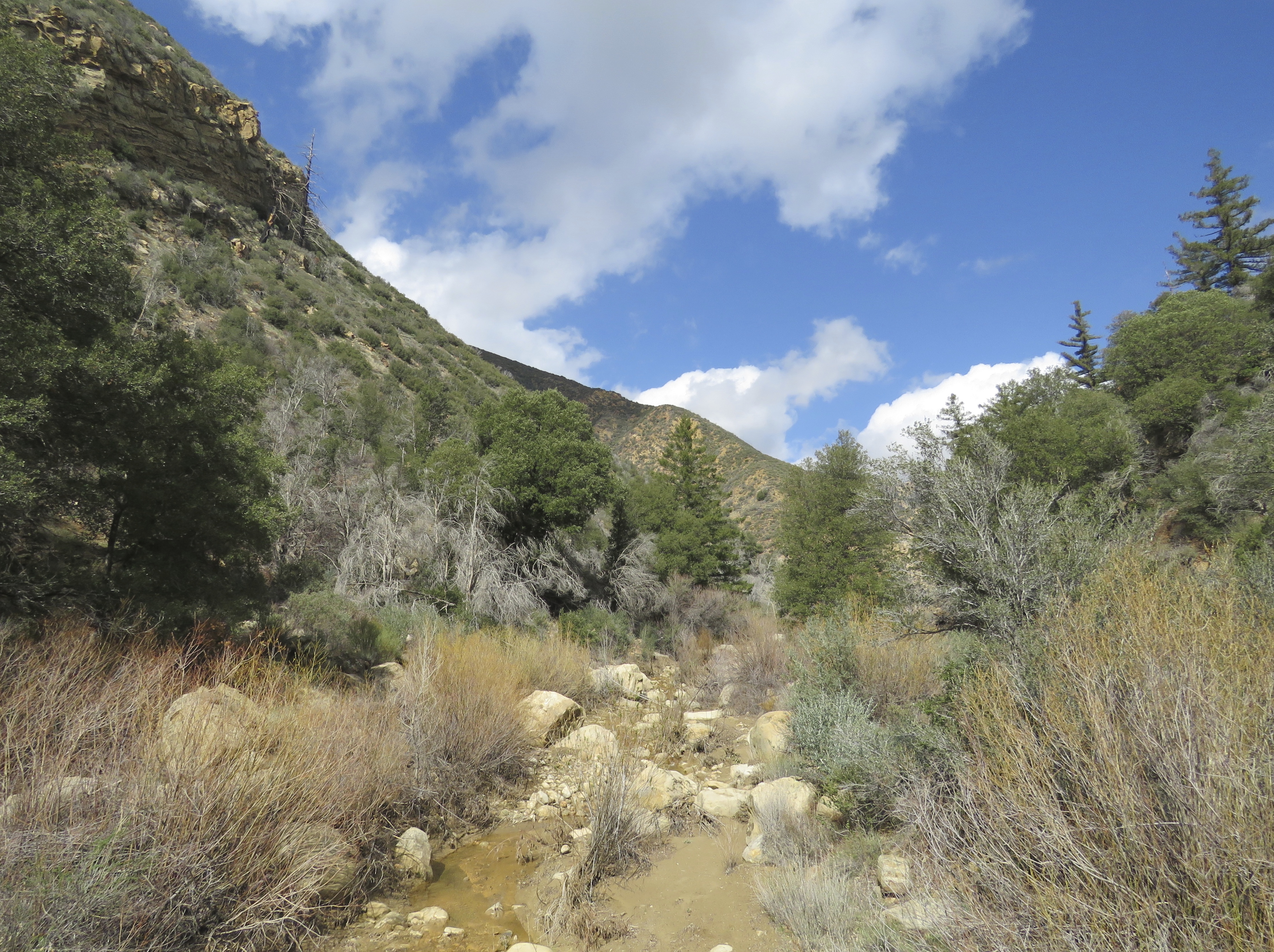
Lion Creek is one of the more scenic creeks along the backside of Nordhoff Ridge, behind Ojai. It flows into the Sespe River, and part of the creek is in Sespe Wilderness. Lion Canyon Trail follows the creek for the first two miles and provides access to two different trail camps, before continuing to the top of Nordhoff Ridge. Small waterfalls past each of the trail camps make them inviting destinations.

The trail can be explored as part of a day hike or short backpacking trip. The hike to either trail camp is about five miles roundtrip. A visit to both camps is about six miles roundtrip. And a hike that takes in all the features of the trail, including a hike to the top of Nordhoff Ridge, is about 13 miles roundtrip.

To get to the trailhead from Ojai, take State Route 33 north. The road follows North Fork Matilija Creek much of the way before climbing out of the Matilija drainage. And as it levels out, arrives at the turnoff for Rose Valley Road, on the right. Rose Valley Road continues east, through Rose Valley Recreation Area, and arrives at a 4-way intersection. To the right, the road leads up to Rose Valley Campground and Upper Rose Lake; to the left, the road leads down towards Lower Rose Lake.
Lion Canyon Trail Ojai hike backpacking Rose Valley Los Padres National Forest

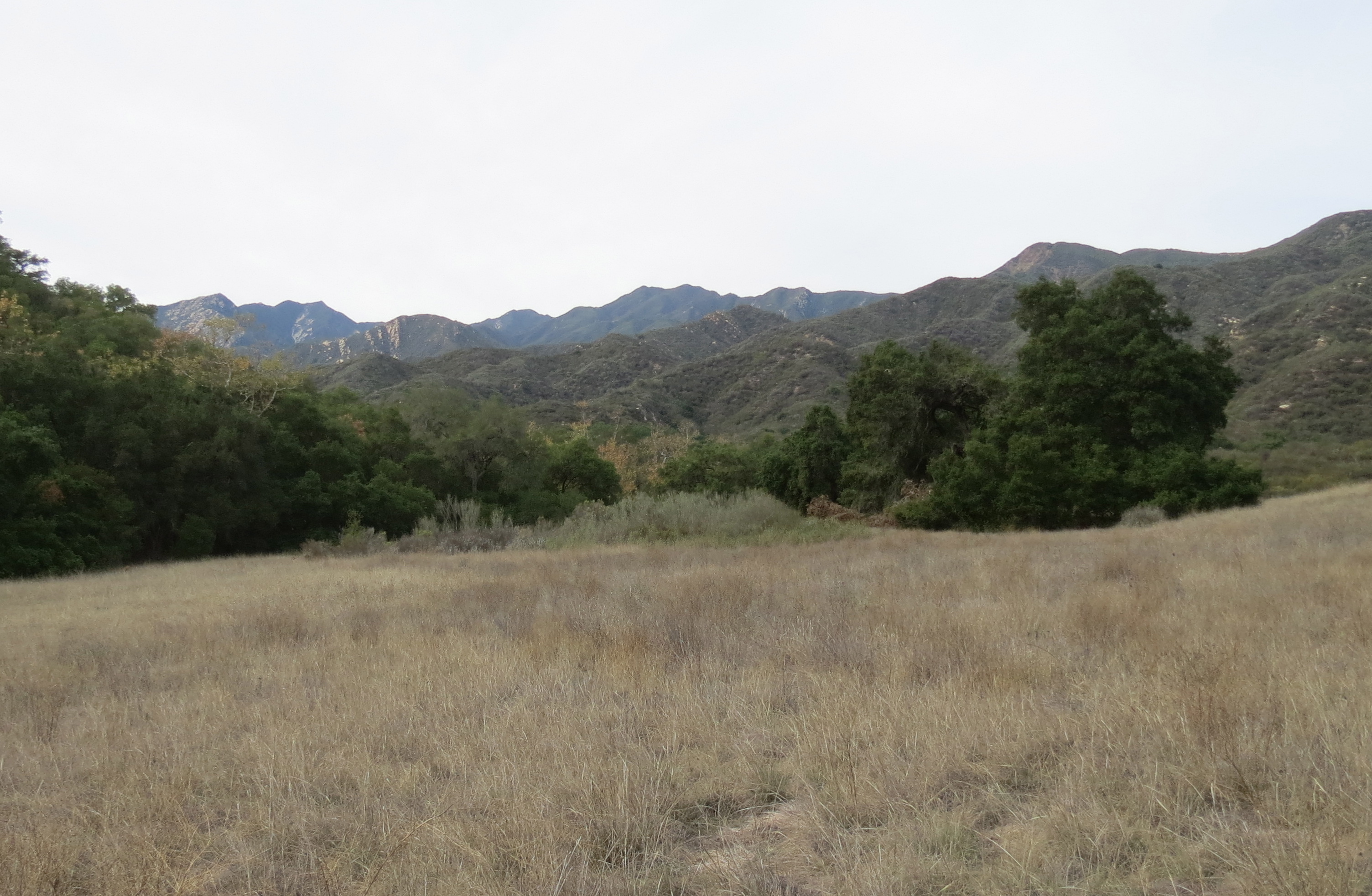
Lion Canyon

For Lion Canyon Trail, continue straight ahead; the road then arrives at the next intersection. Here, the road branches one last time. The road to the left continues down towards the Piedra Blanca Trailhead and the beginning of Sespe River Trail. The road to the right drops down into Lion Canyon, and ends at Middle Lion Campground.

One of the ways to explore Lion Canyon Trail is by car camping at Middle Lion and day-hiking along the trail. Campsites are on a first come first serve basis, and the campsites at both Middle Lion and Rose Valley each include a fire ring and picnic table. An adventure pass is required to camp or park at either campground.

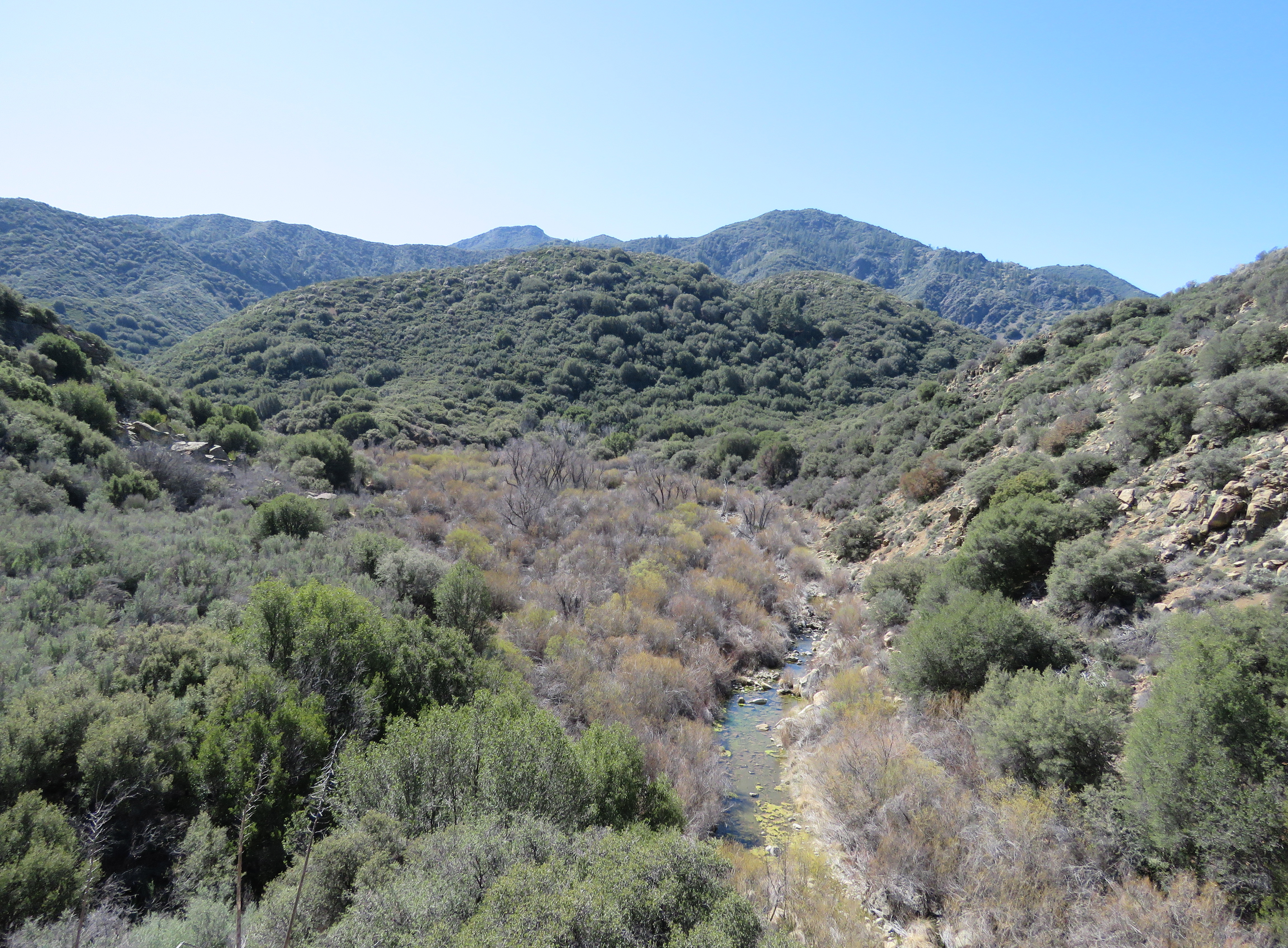
From the trailhead, Lion Canyon Trail quickly crosses Lion Creek, passing through a mix of alder and cottonwood trees. The trail follows the creek upstream, leading through a mix of chaparral on the side furthest from the creek and riparian plants on the creek side.

As the trail continues, one also starts to see big-cone spruce in the mix. The trail is in generally good shape, and although does climb above the creek for stretch, is otherwise mostly level towards the trail camps.
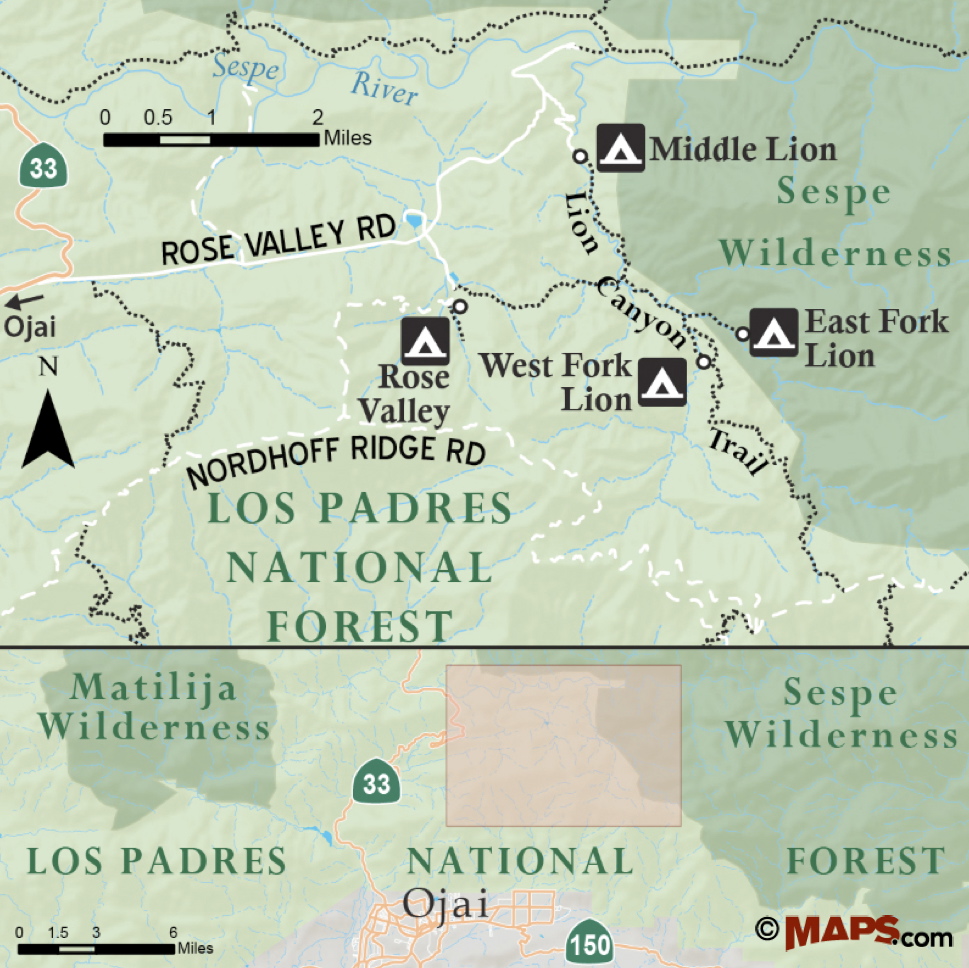
Lion Canyon Trail hike East West Fork Sepse Ojai Los Padres National Forest Middle

Map courtesy Maps.com

Where the trail does climb above the creek, it offers some scenic views down into the canyon. And it is this scenery that helps cast the creek as a hidden mountain stream, particularly in contrast to the nearby, and more popular, Sespe River Trail.

At about the 1.25-mile mark, the trail arrives at Rose-Lion Connector Trail. The roughly 1.5-mile long trail connects over to Rose Valley Campground and represents an alternate route to accessing the trail camps. This can be helpful to know if the campsites are full at Middle Lion, as one can sometimes find a spot at Rose Valley, which has more campsites.

As Lion Canyon Trail continues, it eventually returns down towards the creek and enters a broad canyon filled with willows. It’s here that East and West Fork Lion Creeks meet.

The trail crosses the canyon, and at about the 2-mile mark, arrives at the trail juncture for the two camps. The intersection is well-marked with a trail sign. The trail to the left leads to East Fork Lion Camp, and the trail to the right leads to West Fork Lion Camp, while the center trail continues to the top of Nordhoff Ridge.

The trail to East Fork Lion Camp continues east, and follows East Fork Lion Creek through the willows, crossing the creek several times, before settling in on the north side of the creek. Here, the wide flood plain of the creek makes for easy hiking.

About a half mile from the trail junction, the trail arrives at East Fork Lion Camp. The spacious, flat camp is situated under two large big-cone spruce trees and features a fire ring and grated stove, as well as the remnants of an ice can stove. The camp at one time was known as Spruce Falls Camp. The fire damage, noticeable on some of the trees is from the 1971 Bear Fire, which started in Bear Canyon, further to the east.

Currently, the creek is dry at the camp, but water can found just upstream. A short social trail leads upstream to an enchanting cascade and pool. Here, the creek flows over a number of large conglomerate rocks. Additional pools and cascades can be found further upstream.

Essentially looking like river stone frozen in silt, conglomerates are sedimentary rocks that contains other rocks or clasts that have been cemented together with finer-grained material. Conglomerates are classified by the size of the clasts, and so in this case the rocks in Lion Canyon are classified as cobble conglomerate.

The trail to West Fork Lion Camp, from the trail juncture, continues south along West Fork Lion Creek, and about a half mile later, arrives at West Fork Lion Camp. The camp features a fire ring and grated stove, and is unappealingly located right along the trail. Another smaller site can be found across the creek. From the camp, it is a short hike further upstream to the waterfall. Here too, the water is seen tumbling over an outcropping of conglomerate rock.

Geologically, the broad canyon where the trail juncture is located represents a transition in the landscape. And although the canyon there is filled with deposited material, running underneath it is the east-west Santa Ynez Fault, which has likely contributed to the canyon’s shape. To the south along the section of trail hiked so far, the next formation is Coldwater Sandstone; to the north, as the trail continues towards Nordhoff Ridge, it passes through an older, unnamed formation of sedimentary rock, which includes cobble conglomerate material.
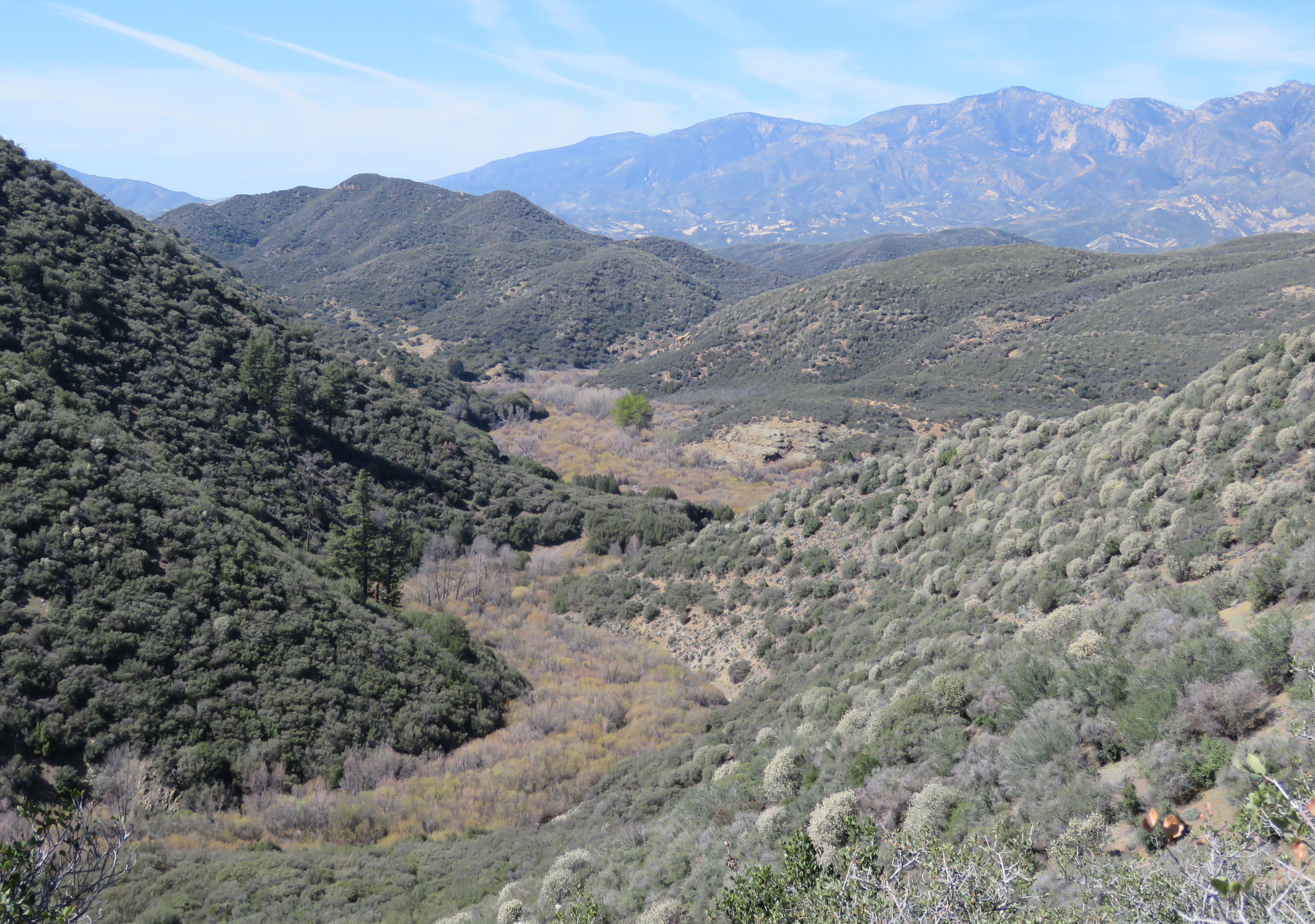
Lion Canyon Trail Ojai hiking backpacking Rose Valley Los Padres National Forest

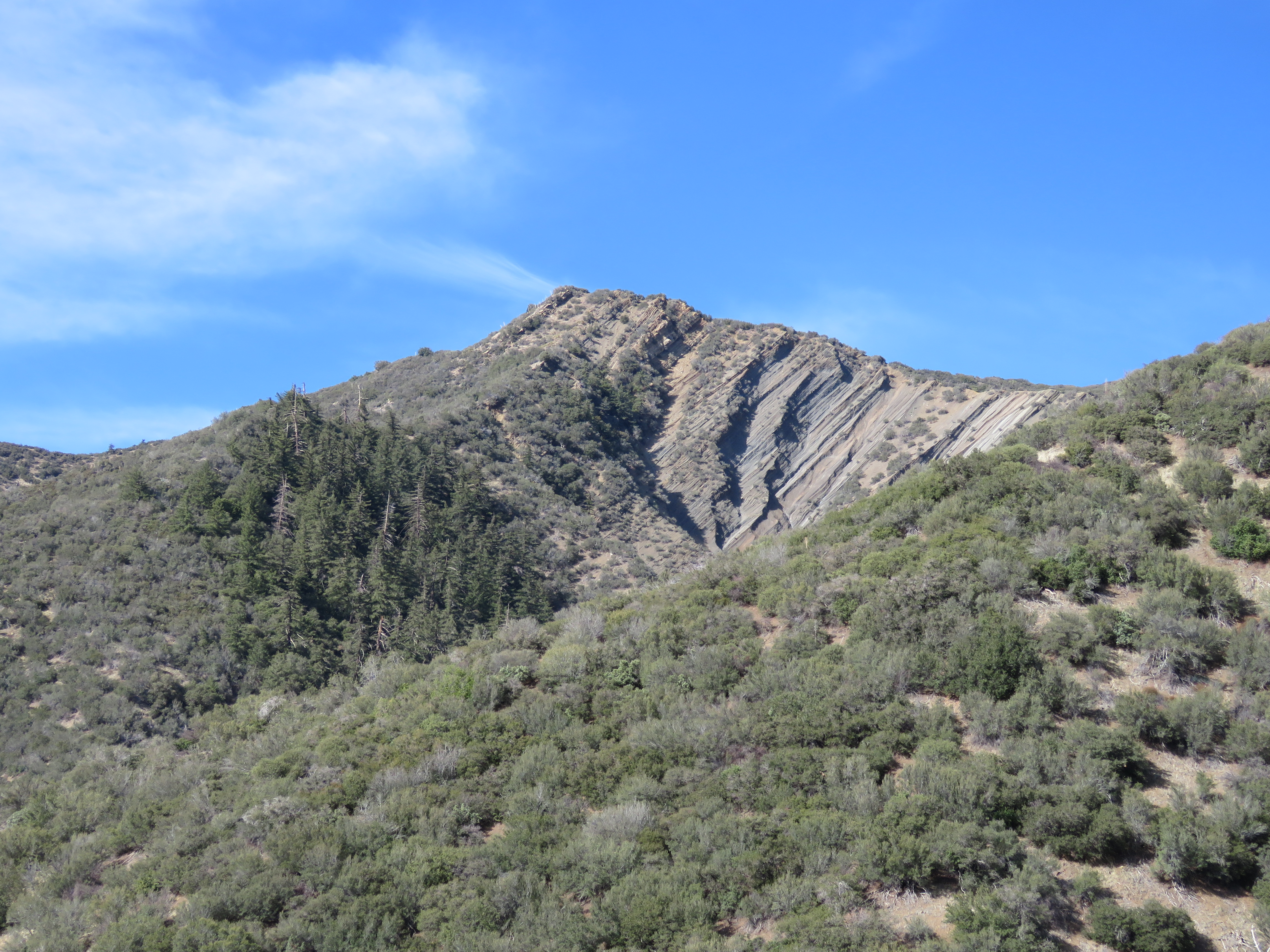
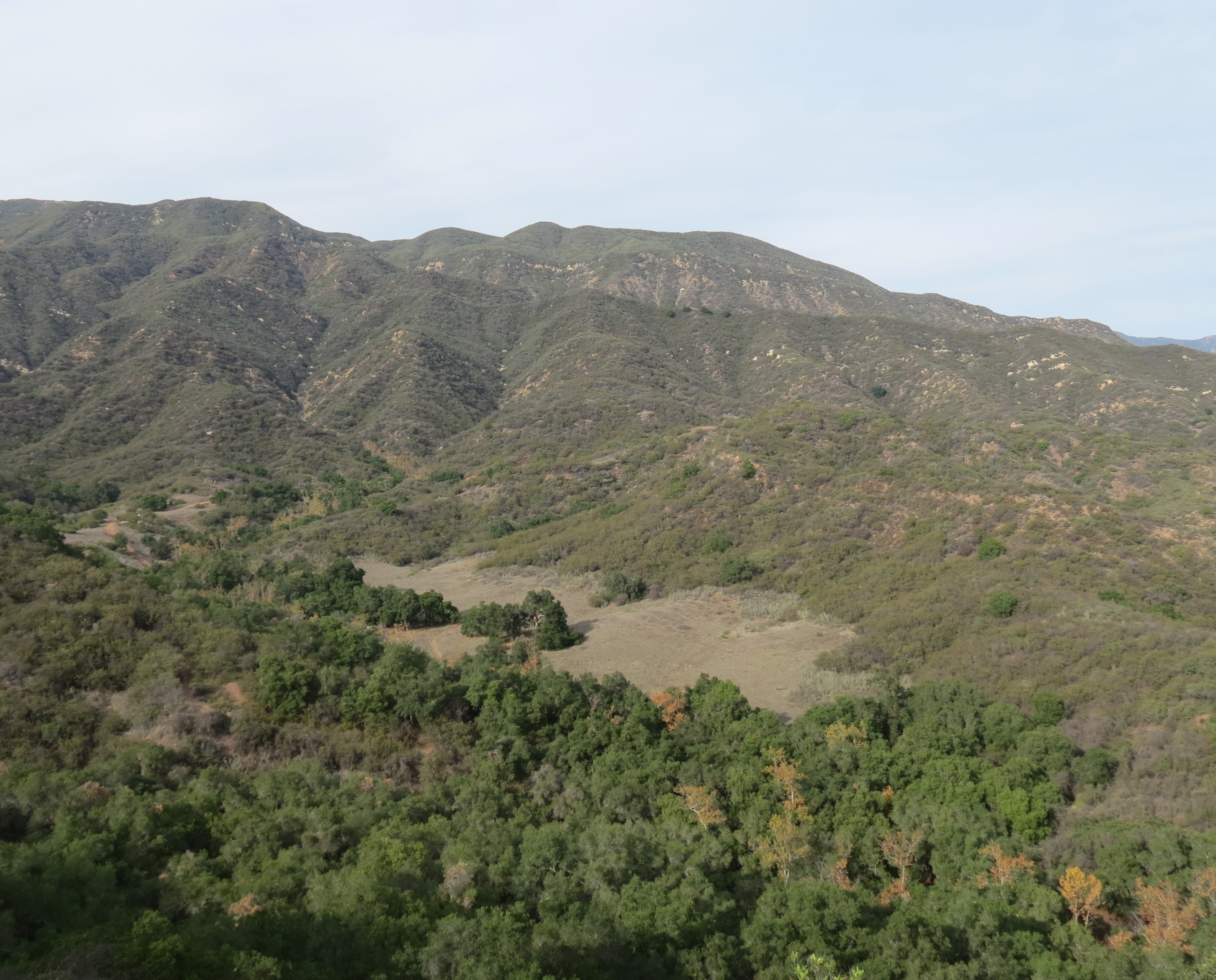
Pine Mountain Ridge frames a view of Lion Canyon

For the hike to Nordhoff Ridge, continue straight ahead at the trail juncture for the two camps. Here, Lion Canyon Trail begins its steady climb away from the creek. The trail follows West Fork Lion Canyon, and, as it gains elevation, offers some great views back down the canyon, as well at out towards Pine Mountain Ridge.

Roughly halfway up, Lion Canyon Trail crests the ridge that separates the east and west fork canyons, and continues the rest of the way towards Nordhoff Ridge, overlooking East Fork Lion Canyon.

At about the 5.5-mile mark from the trailhead, Lion Canyon Trail arrives at Nordhoff Ridge Road, which runs along the top of Nordhoff Ridge. Here, one is treated to views out across the upper Ojai Valley, Santa Clara Valley and Oxnard Plain, and out towards the Pacific Ocean. Immediately to the east, the views include an almost close-up view of the Topatopa Bluff.

Regardless of how far you hike you’ll get to explore this scenic canyon that shares its waters with Sespe River.

This article originally appeared in section A of the March 17th, 2015 edition of Santa Barbara News-Press. Thanks again to Maps.com for producing maps for the articles.

Posted by: James Wapotich | March 14, 2015

Backpacking Made Easy

Backpacking made easy workshop Santa Barbara trails hiking Los Padres National Forest

*

Backpacking made easy workshop hiking trails Santa Barbara Los Padres National Forest

*

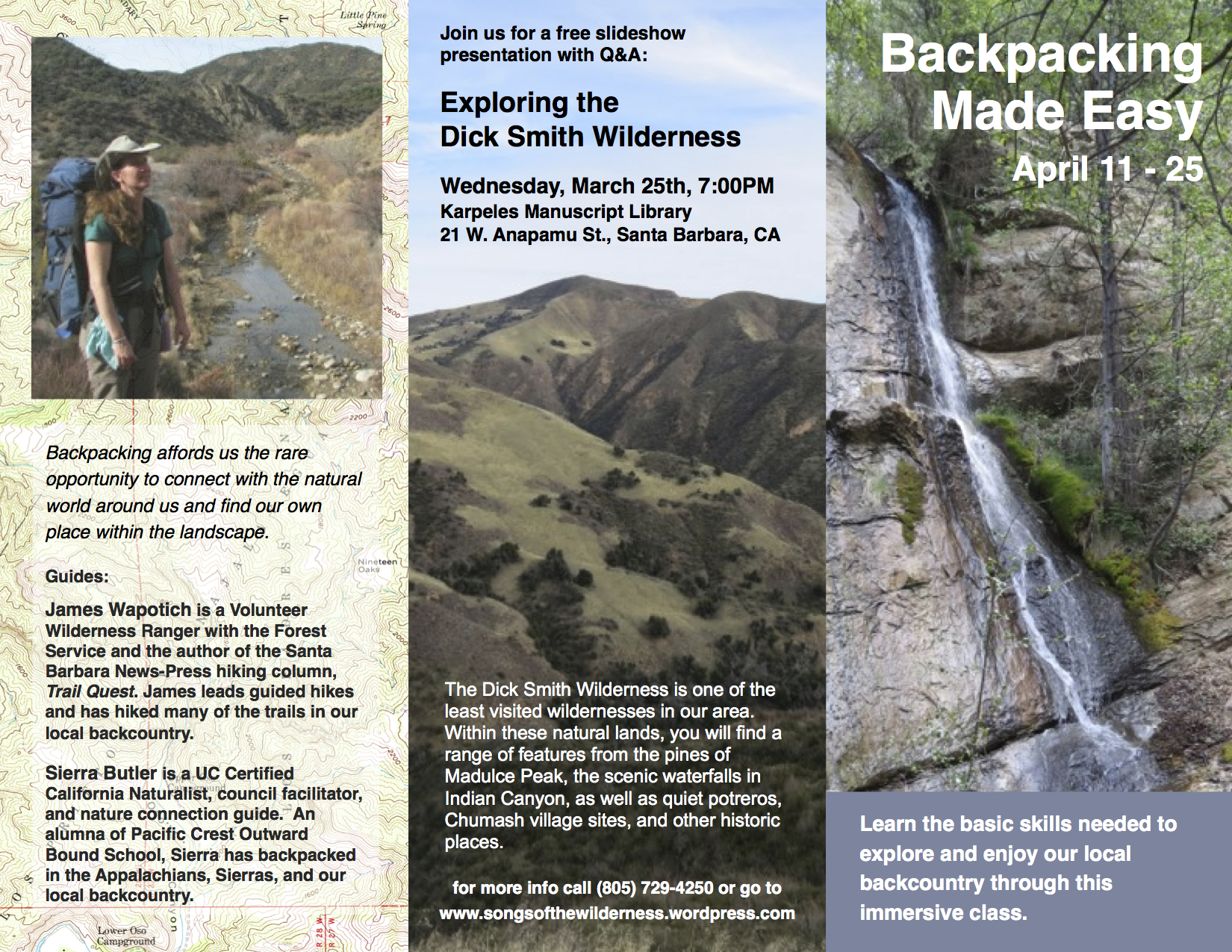
Backpacking Made Easy
April 11 – 25

Santa Barbara and Ojai are home to a variety of incredible backpacking destinations, and yet, often the biggest obstacle is simply having the knowledge and skills to get started.

Through this 3-week immersive class, you will learn the basic skills needed to comfortably explore and enjoy our local trails.

Hot springs, waterfalls, epic views, and unspoiled wilderness are just some of the rewards for those who are willing to make the journey.

Each class takes place on one of our local trails, and provides the skills and awareness to become a more relaxed and confident hiker.

Lay of the Land
April 11th 9AM-2PM

Learn how to orient yourself to the local landscape, and begin learning the skills that will help you remove the word lost from your vocabulary. Become familiar with maps and creating your own mental maps. Learn about the different gear options and how to choose equipment that suits you.

Nature Connection
April 18th 9AM-2PM

Venturing out onto the land is even more enjoyable when we take time to develop a meaningful connection with it.

Learn to see the natural world around you as an ally, rather than an obstacle to overcome, and shift your hikes from feeling like endurance contests to journeys of discovery. Practical skills include trail navigation, menu planning, personal care and basic first aid skills.

Pathfinding
April 25th 9AM-2PM

Many of our local trails are overgrown, particularly those off the beaten path. Learn how to read the trails, practice route-finding, and develop your own sense of “body radar” to help you navigate in the wilderness. Practical skills include trip planning, campsite evaluation, water assessment, and  camp set up.

Optional free
Overnight Backpacking Trip
May 2 – 3

For those who are interested, we will help organize a free, optional backpacking trip. Here’s a chance to put all these great skills to use, and build on the material covered so far.

Length of the hike and destination for the overnight trip to be determined according to current conditions and the capabilities of the participants.

Guides:

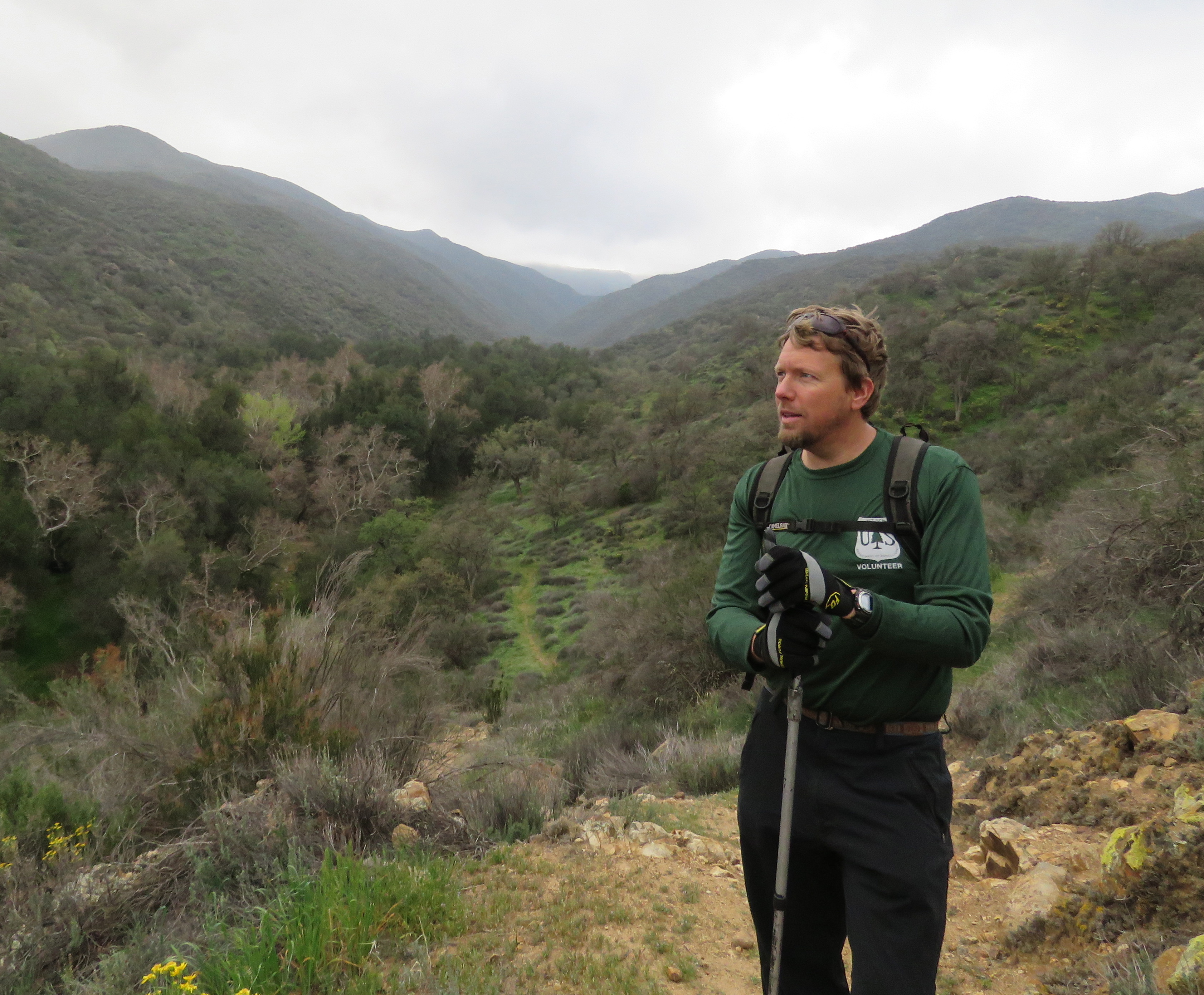
James Wapotich is a Volunteer Wilderness Ranger with the Forest Service and the author of the Santa Barbara News-Press hiking column, Trail Quest. James leads guided hikes and has hiked many of the trails in our local backcountry.

Sierra Butler is a UC Certified California Naturalist, council facilitator, and nature connection guide. An alumna of Pacific Crest Outward Bound School, Sierra has backpacked in the Appalachians, Sierras, and our local backcountry.

3-week course is $160 per person, or bring a friend and both 20% off.
Limit 12 students

To sign up or for more information please contact:

James (805) 729-4250 jwapotich@yahoo.com

Posted by: James Wapotich | March 14, 2015

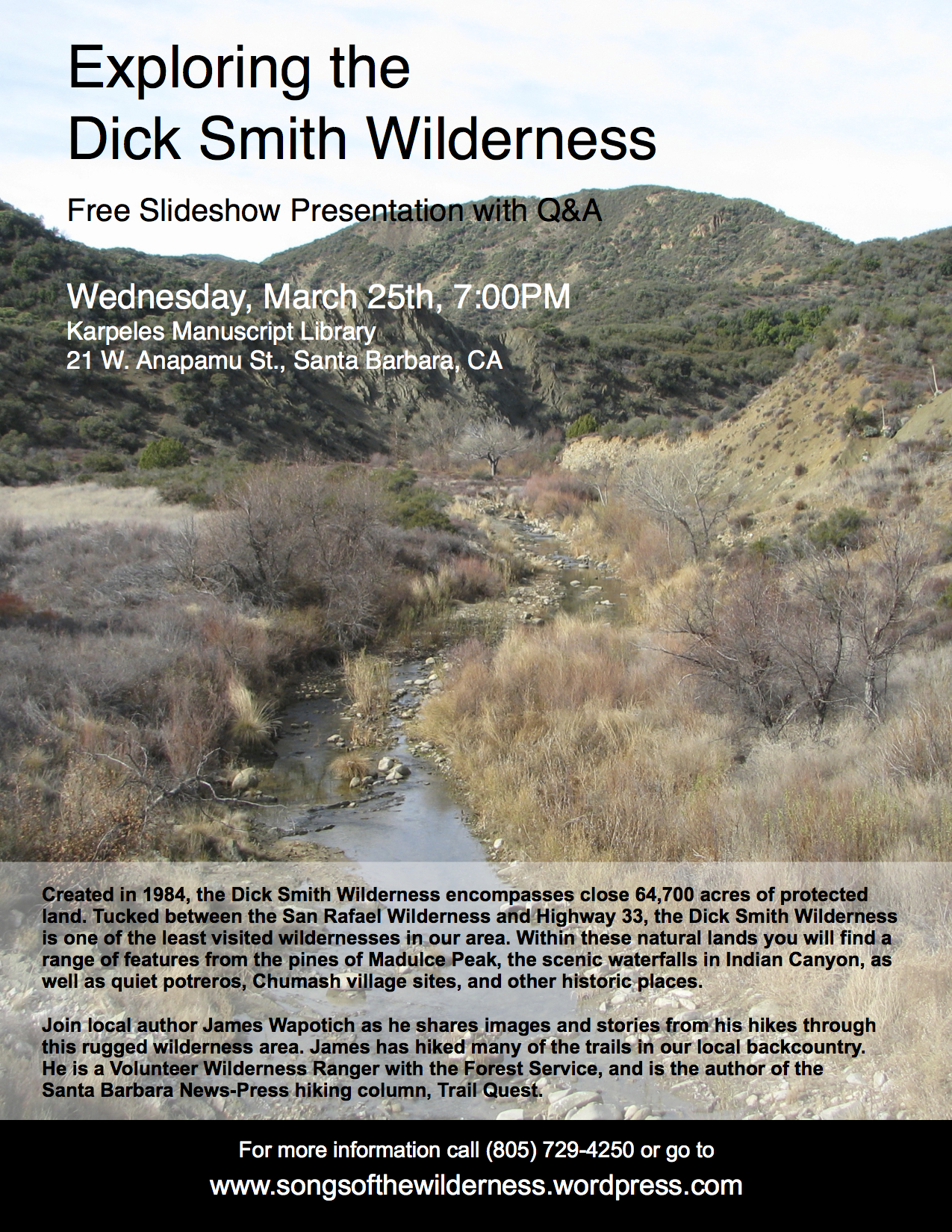
Exploring the Dick Smith Wilderness

Dick Smith Wilderness hiking backpacking Santa Barbara Los Padres National Forest

*

Exploring the Dick Smith Wilderness
Free Slideshow Presentation with Q&A

Wednesday, March 25th, 7:00PM
Karpeles Manuscript Library
21 W. Anapamu St., Santa Barbara, CA

Created in 1984, the Dick Smith Wilderness encompasses close 64,700 acres of protected land. Tucked between the San Rafael Wilderness and Highway 33, the Dick Smith Wilderness is one of the least visited wildernesses in our area. Within these natural lands you will find a range of features from the pines of Madulce Peak, the scenic waterfalls in Indian Canyon, as well as quiet potreros, Chumash village sites, and other historic places.

Join local author James Wapotich as he shares images and stories from his hikes through this rugged wilderness area. James has hiked many of the trails in our local backcountry. He is a Volunteer Wilderness Ranger with the Forest Service, and is the author of the Santa Barbara News-Press hiking column, Trail Quest.

For more information email me at jwapotich@yahoo.com or call (805) 729-4250.

Posted by: James Wapotich | March 9, 2015

Trail Quest: Herpetology Walk with Samuel Sweet

In March 2015, Dr. Samuel Sweet led an afternoon hike at Arroyo Hondo to search for reptiles and amphibians and shared his expertise. The walk was hosted by The Land Trust for Santa Barbara County, which manages the preserve.

The hike followed the main trail up the canyon, and as the group approached a wooden fence along the trail, the first lizard was spotted.

Dr. Sweet captured it with a noose on a long slender stick, similar to those fashioned from wild grass you may have seen kids use. He explained that lizards don’t weigh enough for them to be harmed by the experience. He then put the lizard in a clear, plastic container with air holes, and passed it around.

Dr. Samuel Sweet UCSB herpetology reptiles amphibians arroyo hondo walk

Dr. Sweet, tools in hand, searches for lizards

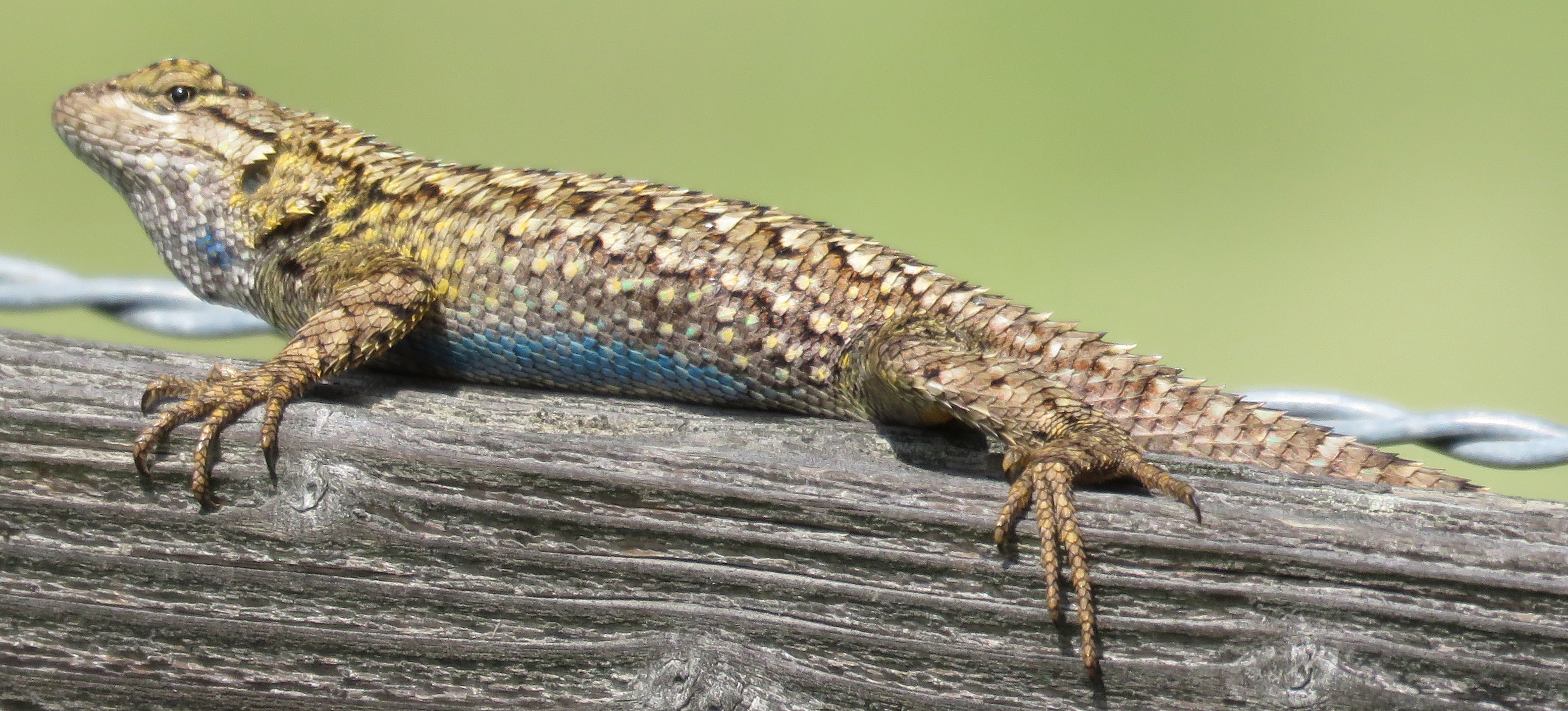
The specimen was a Western fence lizard, also known as a blue-belly lizard, because of the blue scales on their belly and throat. The lizard also has blue scales on its back, as well, and can change appearance by revealing or concealing those underlying blue scales.

In terms of overall color, large adult males tend to be black, while females and juvenile males are tan or brown. The females, unlike the males, stop growing once they reach maturity, channeling that energy instead into reproduction.

If you’ve seen blue-belly lizards, you may have wondered why they’re doing all those push-ups. “When they do their push-ups, another lizard can see that blue color.” Dr. Sweet told the News-Press. “They’re showing off that they own a particular piece of territory, and if it’s a good enough piece of territory, a bunch of females will like it and come and mate with them.”

Western Fence Lizard Blue-belly

Western Fence Lizard aka Blue-belly Lizard

He also explained that each species has its own unique head-bobbing pattern and can tell one other apart based on the pattern.

When holding the lizard, Dr. Sweet was careful to pin just one leg between his thumb and finger, rather than grasping it, allowing the lizard to “imagine that it’s still winning”, which helps keep it relaxed.

The next lizard that was caught was an alligator lizard, which Dr. Sweet pointed out are actually very different from blue-belly lizards. There are two major groups of lizards: those that rely more on visual information and those that rely on olfactory information.

For example, alligator lizards, which rely more on olfactory information don’t change color or make showy displays. And instead, prefer to remain hidden and mark their territories with scent. Another difference is in the way they hunt. Lizards that rely on visual information, such as blue-belly and horny toad lizards, wait until their prey moves and then catch it, whereas lizards that rely on olfactory information track their prey by smell.

Another feature Dr. Sweet pointed out was the ticks attached to the lizard. Ticks attach themselves to both blue-belly and alligator lizards, but what’s interesting is that antibodies in the blood of both species actually rid ticks of Lyme disease. That is, the antibodies counteract the bacteria that causes Lyme disease, effectively curing the tick.

Southern Pacific Rattlesnake

Southern Pacific Rattlesnake

As the walk continued, one of the participants spotted a rattlesnake resting in the brush. Using a potato rake that he carries on his walks, Dr. Sweet fished the snake out of the brush and placed it on the road for everyone to see.

The snake was anxious to return to the brush, but using the rake, Dr. Sweet continued to redirect it back to the middle of the road. The snake was surprisingly mild-mannered, and although at times rattled, did not try to strike.

“Rattlesnakes here are not very defensive, and don’t put on a big show. Most rattlesnakes you encounter locally will not even rattle, they’ll just sit still or leave.” Dr. Sweet observed. ”That changes if you go out to the Carrizo Plain or the drier parts of California, where they get upset pretty easily. In those places, they’re much more exposed.”

He also noted that the venom of Southern Pacific rattlesnakes typically isn’t fatal to humans and that there’s no advantage to the snake in wasting venom on humans that it could use for hunting, unless provoked.

Rattlesnakes are generally inactive from October through early March, and although not hibernating in the classic sense, tend to remain still, and only come out during that period if there’s a warm spell.

At several points along the hike, California newts were found in the stream. Although more toxic in other areas, their bright coloring is still a signal to predators not to eat them.

California Newt

A pair of California Newts

Newts can be found in the Santa Ynez Mountains from Hollister Ranch to near Lake Casitas, as well as in some of the year-round creeks on the back side of the Santa Ynez Mountains. Preferring wetter climates, their range in Southern California has become more limited since the last ice age, with the next nearest population to the south in the Santa Monica Mountains, and to the north in San Luis Obispo County.

A new threat facing newts, besides loss of habitat, is non-native crayfish, which eat the hatchlings or larvae before they’ve had a chance to develop their front and hind legs.

Other amphibians in our area are salamanders, toads and frogs. The most common native toad in our area is the Western toad, found throughout our local backcountry. Less common is the endangered arroyo toad, which has a much more restricted range.

The native frogs in our area include Pacific tree frog, California tree frog, and the endangered California red-legged frog. Pacific tree frogs come in a variety of colors, while the California tree frogs are typically grey.

At one point during the walk, Dr. Sweet went down to the creek, towards a place where he suspected he’d find turtles. Using a fishing net, he caught a turtle and brought it over to one of the picnic tables, and identified it as a male western pond turtle.

Western Pond Turtle

Western Pond Turtle

Western pond turtles are the only native turtles in our area, and the males have a thin, concave shell on their underside and a long tail so they can fit on top of the females in order to mate.

Although turtles here don’t hibernate in the classic sense, they will, according to Dr. Sweet, employ one of two strategies during the winter. In rivers, like the Santa Ynez River, they will either bury themselves in the cattail mats, or just lie in the deeper water, where it’s 10-15 feet deep, and stay there all winter. In canyons, like Arroyo Hondo, where winter rains can bring down huge boulders crashing through the creek, turtles will climb up the hillsides, and dig in under the brush, or under a wood rat nest, returning to the creeks when it’s time to mate.

The main threat facing western pond turtles, in addition to loss of habitat, is reproductive failure. “A single raccoon will spend all night looking for a pond turtle nest and usually find all of the eggs.” Dr. Sweet explained. “The problem is that raccoons are now supported by human garbage and radiate out for miles from where they get the garbage. And there’s just not enough predators like bobcats and mountain lions to keep the excess population in check.”

Raccoons will also try to eat turtles, sometimes managing to take a leg. Once a turtle reaches adulthood, however it’s only predator is bears, which have strong enough jaws to crack open the shells. Western pond turtles can live for 40-50 years.

A native of Connecticut, Dr. Sweet, attended Cornell University in New York, before attending UC Berkeley for his graduate studies. After college he was hired in 1977 by UC Santa Barbara; today he serves as a professor of Evolution and Ecology at the University. Since first moving to Santa Barbara, Dr. Sweet has also visited most of the local backcountry.

If you have questions regarding our local reptiles and amphibians, Dr. Sweet can be contacted at, sweet at lifesci dot ucsb dot edu.

This article originally appeared in section A the March 9th, 2015 edition of Santa Barbara News-Press.

Posted by: James Wapotich | March 2, 2015

Trail Quest: Trail Survey with Bryan Conant

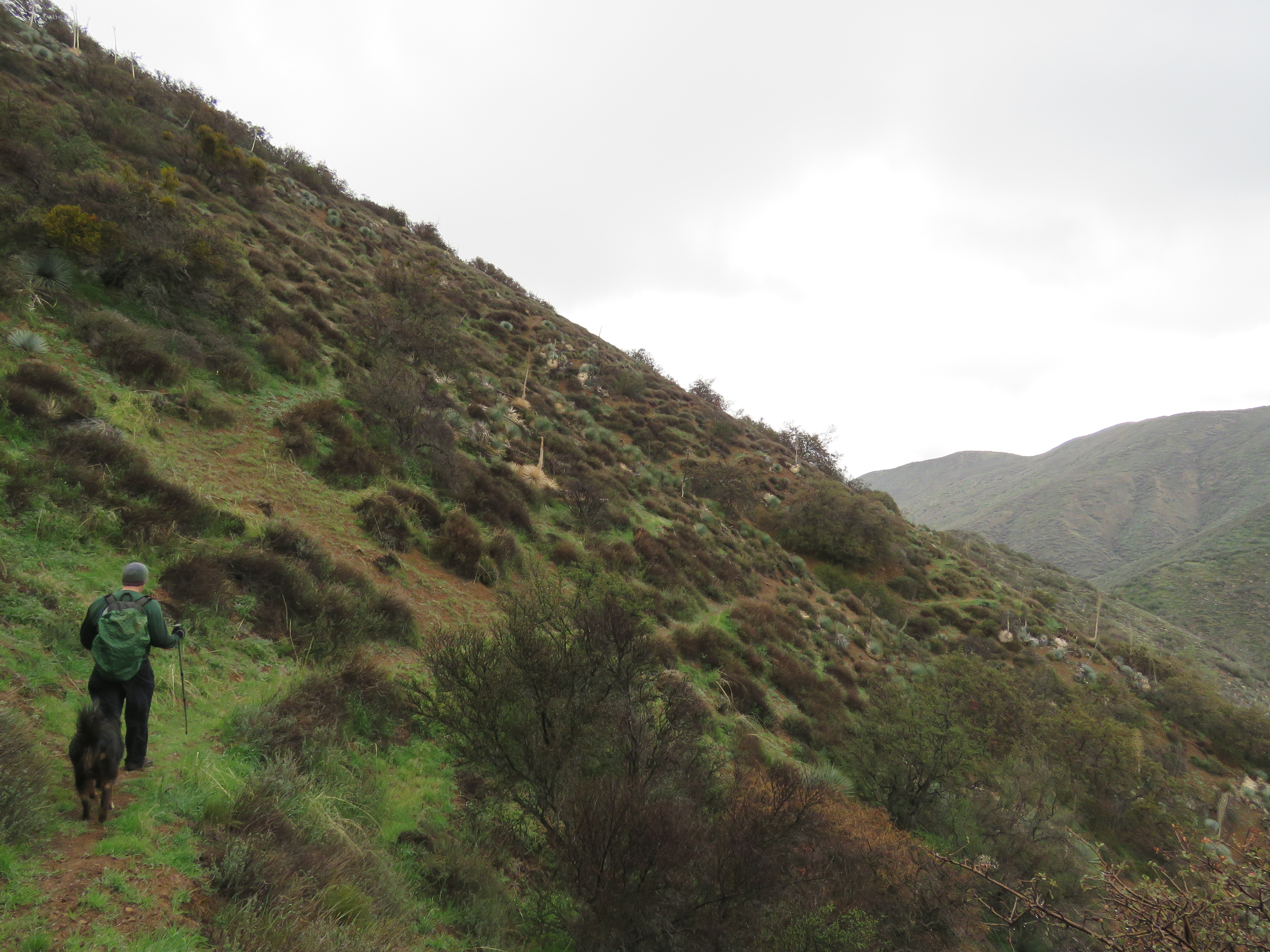
Under an overcast sky, Bryan Conant makes his way up McPherson Peak Trail, along the backside of the Sierra Madre Mountains, to check on trail conditions. The trail does not see many visitors, but is still shown on his map of the San Rafael Wilderness. The trail is overgrown, and by midday it has started to rain.

McPherson Peak Trail is just one of a dozen trails that Mr. Conant is currently surveying in preparation for the second revision of his San Rafael Wilderness map. Since the first revision, in 2008, he has visited most of the trails and camps on the map, verifying and updating the information shown there.

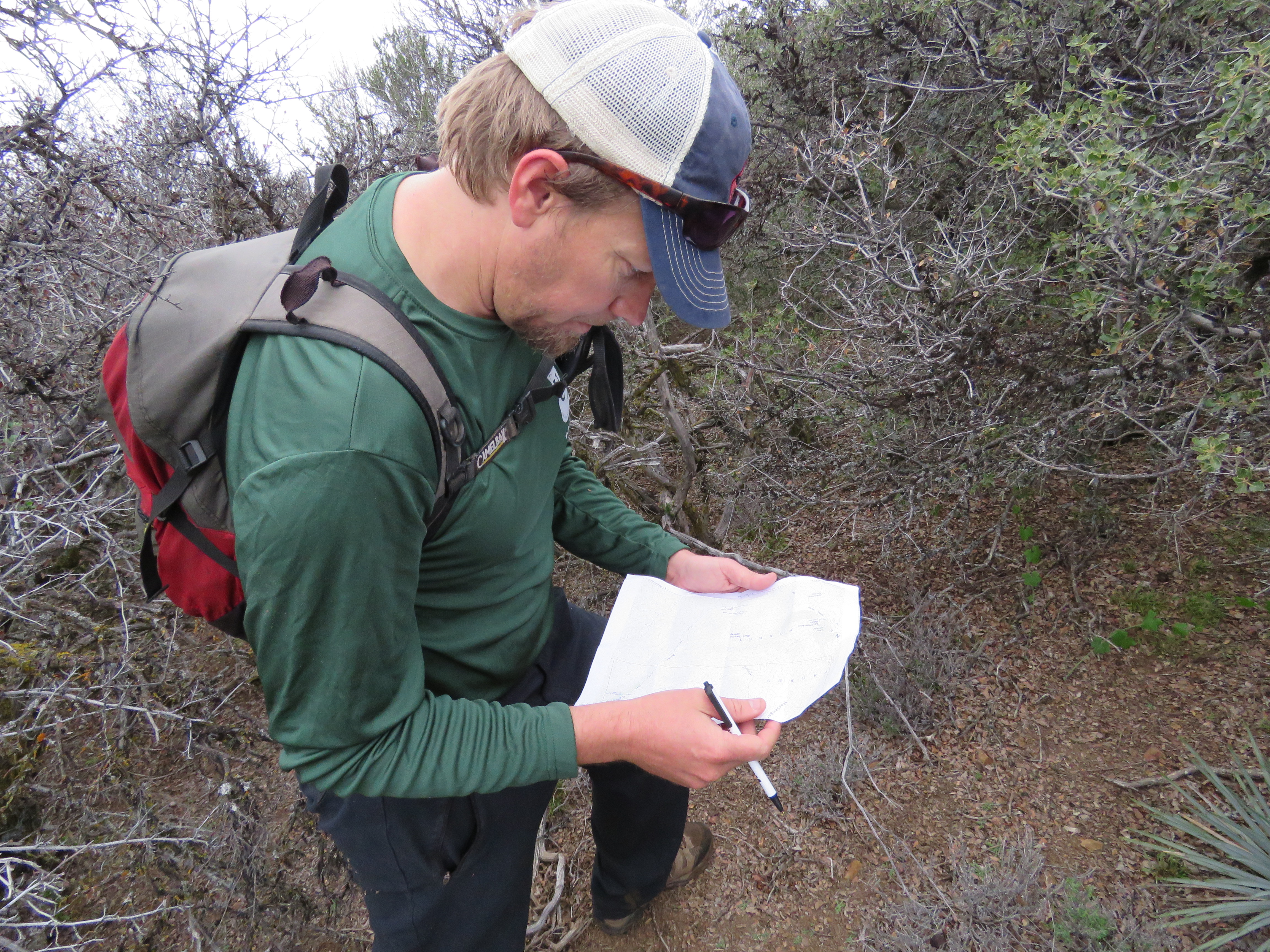
Unfazed by the rain, he continues towards McPherson Peak. On this survey, as with other trail surveys, he’s looking to see what are the current trail conditions. Is the trail followable? Is it marked? Is there a camp along trail, and if so, what condition is it in?

All of that field research and first hand experience of the backcountry is what makes Mr. Conant’s map different from other maps of the area.

Bryan Conant San Rafael Wilderness Map hiking backpacking Los Padres National Forest

Bryan Conant scans the terrain along McPherson Peak Trail

Another feature that he’s researched over the years is the availability of water along the trails, and at the camps, a topic that has taken on new significance during our current drought.

“If there is a positive about the drought,” Mr. Conant told the News-Press, “it’s in trying to figure out where there’s reliable year-round water. If there’s a place that had water last summer, it’s pretty much guaranteed that place has reliable year-round water.”

He also conveys that information on his maps, using a dashed line for seasonal water flows and a solid line where there’s generally reliable water.

In his research, Mr. Conant doesn’t just rely on his own information. In addition to looking at other maps, and reading trail reports and commentaries, he also regularly talks with the forest service and other trail users. Since the map was first published in 2003, he’s interacted with thousands of trail users, who have contacted him and often provide updates from their own hikes.

Another unique aspect of his maps is that the trails are color-coded to reflect the current trail conditions. Yellow signifies that the trail is easy to follow and in generally good shape; purple signifies that the trail may require some bushwhacking and/or searching for the route; and green reflects that the trail sees little or no use, and is either non-existent or extremely hard to follow.

For example, based on his survey, McPherson Peak Trail will likely be designated as yellow as it climbs out of the canyon from Aliso Campground, and then purple where it becomes overgrown and continues along the ridge line up to McPherson Peak.

Bryan Conant San Rafael Wilderness Map hiking backpacking Los Padres National Forest

Bryan Conant studies a map printout at an overgrown trail junction

The day before, Mr. Conant surveyed several other trails along State Route 166, on his way to Aliso Campground, including Willow Spring Trail. In 2014, Central Coast Concerned Mountain Bikers (CCCMB) led a trail project there to redesign and reroute the beginning of the trail to make it more accessible and user friendly. He also surveyed Adobe and Gifford Trails. Only a portion of Gifford Trail even appears on his map, as the rest of it is outside the map area; nevertheless the trail will be included to help people using the map locate the trail.

The original inspiration for the map grew out of Mr. Conant’s twin passions of cartography and backpacking.

“I’d studied cartography at UCSB, and was making maps at work; and at the same time was out there hiking in the backcountry, trying to explore as much of it as I could,” Mr. Conant recalled, “and was pretty frustrated with the existing maps.”

In 2003, an opportunity arose for Mr. Conant to take six months off from work, and he decided to use that time to make the map he had been envisioning. At the time, an affordable GPS with the capabilities he needed wasn’t available, and Google Earth, with its satellite images, didn’t exist. And so he built his own trundle wheel from a kids BMX bike that a friend let him have.

For four months he surveyed and measured the trails in the San Rafael Wilderness, and then spent the next two months creating the map. Once GPS units became more advanced and affordable, the trundle wheel stayed at home.

In 2008, he completed the first revision of the San Rafael Wilderness Map. In 2009, he completed the first edition of his Matilija and Dick Smith Wilderness Map, which includes the Santa Barbara front country trails. Both maps also required the addition of a new feature, outlines showing the fire perimeter for the 2007 Zaca Fire and 2009 La Brea Fire, both of which dramatically changed trail conditions in those areas.

Bryan Conant San Rafael Wilderness Map Los Padres National Forest

Bryan Conant and his dog Bailey surveying McPherson Trail

Born in Ventura, Mr. Conant grew up in Pacific Palisades, near the Santa Monica Mountains. His family regularly backpacked in the Sierras when he was growing up. In 1993, he moved to Santa Barbara to attend UCSB, and it was then that he had his first introduction to the Santa Barbara backcountry.

“My first couple of years at UCSB I didn’t even look at the mountains. Then one day a friend drove me out to Red Rock, and I saw the view coming off the backside of Highway 154, and was just blown away.”, Mr. Conant shared “I had no idea all of this was out here.”

After college, Mr. Conant began work at local map company Magellan Geographix, which later became Maps.com, and continued to explore the local backcountry in his spare time.

In addition to the maps he’s produced, Mr. Conant’s love of the backcountry and interest in our local trails has lead him to a number of opportunities.

Inspired by a talk about the Condor Trail, Mr. Conant eventually became President of the Condor Trail Association in 2009; and he has actively worked to help promote the trail. The trail is a through-hike route that makes use of existing trails and roads, and stretches from Lake Piru at the southern end of Los Padres National Forest to Botchers Gap in the Big Sur area, at the northern end of the national forest. The trail was included in the Central Coast Heritage Protection Act introduced by Representative Lois Capps. If the bill passes, the trail will become designated as a National Recreation Trail.

Since 2012, he has been working with web designer John Ziegler on Hike Los Padres. The website, www.hikelospadres.com, went live in 2014, and features an interactive map of the local backcountry, complete with trails and camps. One of the main benefits of the site is that it allows trail users to post updates and reports from their hikes.

In 2013, Mr. Conant transitioned from working full time with Maps.com to part time, and began work as the Executive Director of Los Padres Forest Association. The local non-profit organization works closely with the forest service to help educate trail users and maintain backcountry trails through volunteer trail work projects.

In 2014, Mr. Conant designed the kiosk maps for the forest service that now appear at a number of local trailheads, including Nira and Upper Oso. The kiosk maps combine his San Rafael and Dick Smith Wilderness maps, and with the updates he’s included, is actually his most current map of the backcountry, at least until the new San Rafael Wilderness Map hits the stores.

The second revision of the San Rafael Wilderness map is expected to be out in the spring, and can be found at most outdoor stores, and many local bookstores. For more information or questions about the map go to www.bryanconant.com, or contact Mr. Conant at bryanconant@yahoo.com.

This article originally appeared in section A of March 2nd, 2015 edition of Santa Barbara News-Press.

Posted by: James Wapotich | February 23, 2015

Trail Quest: Potrero John Falls

Potrero John Creek is one of the more scenic tributaries along the upper reaches of Sespe River. The creek originates on the south side of Pine Mountain Ridge and meets Sespe River upstream from Sespe Gorge.

The lower portion of Potrero John Canyon can be explored by trail and includes a trail camp that can make for an easy overnight backpacking destination. Past the camp, one can continue further up the canyon to Potrero John Falls. The hike to the falls, from the trailhead, is about six miles roundtrip.

To get the trailhead from Ojai, take State Route 33 north. Continue past the turnoff to Rose Valley. From here, State Route 33 begins to follow Sespe River and continues towards Sespe Gorge.

Potrero John Falls Creek hike trail Los Padres national forest Sespe Wilderness

Potrero John Creek

Sespe Gorge is a dramatic narrows along Sespe River. The southern wall of the gorge, also know as Black Wall, is a well-known rock climbing site. Here, one can often see rock climbers working some of the different routes along the exposed Matilija Sandstone. The rock climbing site is said to have gotten its name from the dark lichen growing on the rock formation.

State Route 33 continues through the narrows. Potrero John Creek is the second canyon on your right past the gorge. The trailhead is marked with a sign, and parking is found alongside the road.

Potrero John Trail follows the creek upstream. The beginning of the canyon is dramatic in its own way, as Potrero John Creek also cuts through Matilija Sandstone in this first section.

The trail passes through a mix of chaparral and riparian plants, and includes alder, cottonwood, willow, interior live oak, big cone spruce, and even a lone cedar tree. In the springtime, the canyon can also be a good place for to see Matilija poppies.

The trail soon enters the Sespe Wilderness. Along the trail one can still see the damage and regrowth from the 2002 Wolf Fire. The 21,645-acre fire started further north along State Route 33, near Wolf’s Grill, located where Pine Mountain Inn is now. The fire was started when a stray bullet from people target shooting ignited the dry brush.

As the trail continues, the canyon starts to open up. Here, the trail passes through several flat, open patches that could be described as a potreros. The word potrero is Spanish for pasture. And although these flats are not your classic open meadow, the chaparral and trees are thinner here with wild grasses growing in between them.

Steller Jay Potrero John Canyon Trail Los Padres National Forest

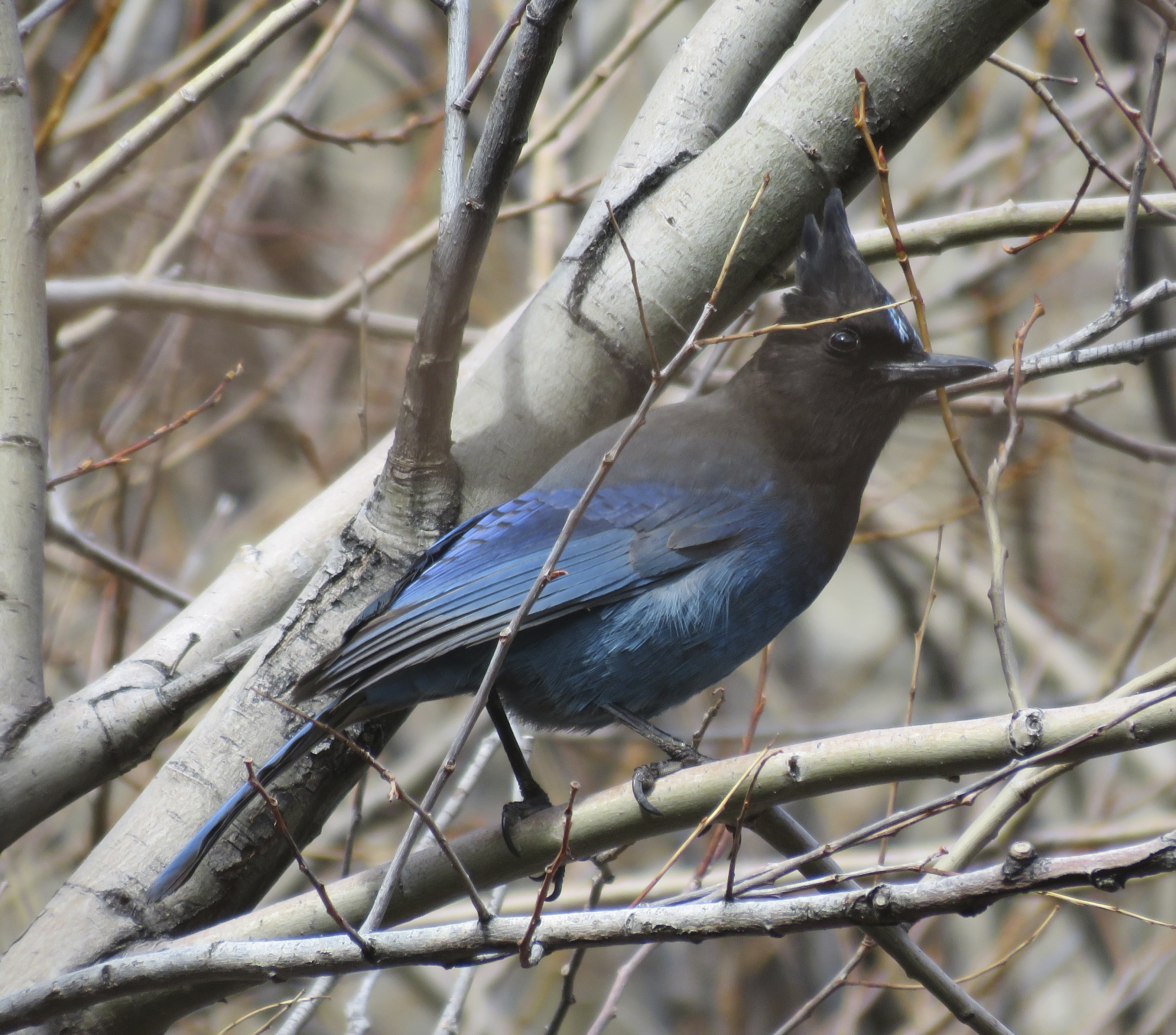
A Steller’s jay watches passing hikers

The potrero is named for John Power, who lived in the area during the early 1900s and would let his cattle graze in the canyon.

Along this section of the trail one can find an unofficial camp. It’s also through here that the views up towards Pine Mountain Ridge include Reyes Peak and Haddock Mountain.

At about the 1.75-mile mark, the trail arrives at the turnoff for Potrero John Camp. The camp is on the opposite side of the creek under several large interior live oaks. A side trail leads down the site. The camp includes a fire ring and grated stove, but no picnic table.

Continuing past the turnoff to the camp, the trail is unmaintained, and is less distinct at times. This does require one to pay closer attention in order to follow the route. Nevertheless, there is a fairly well-used social trail up to the falls. And while the trail crosses the creek a couple of times, it generally favors the west side of the creek.

Potrero John Creek Falls hike trail Los Padres National Forest Sespe Wilderness

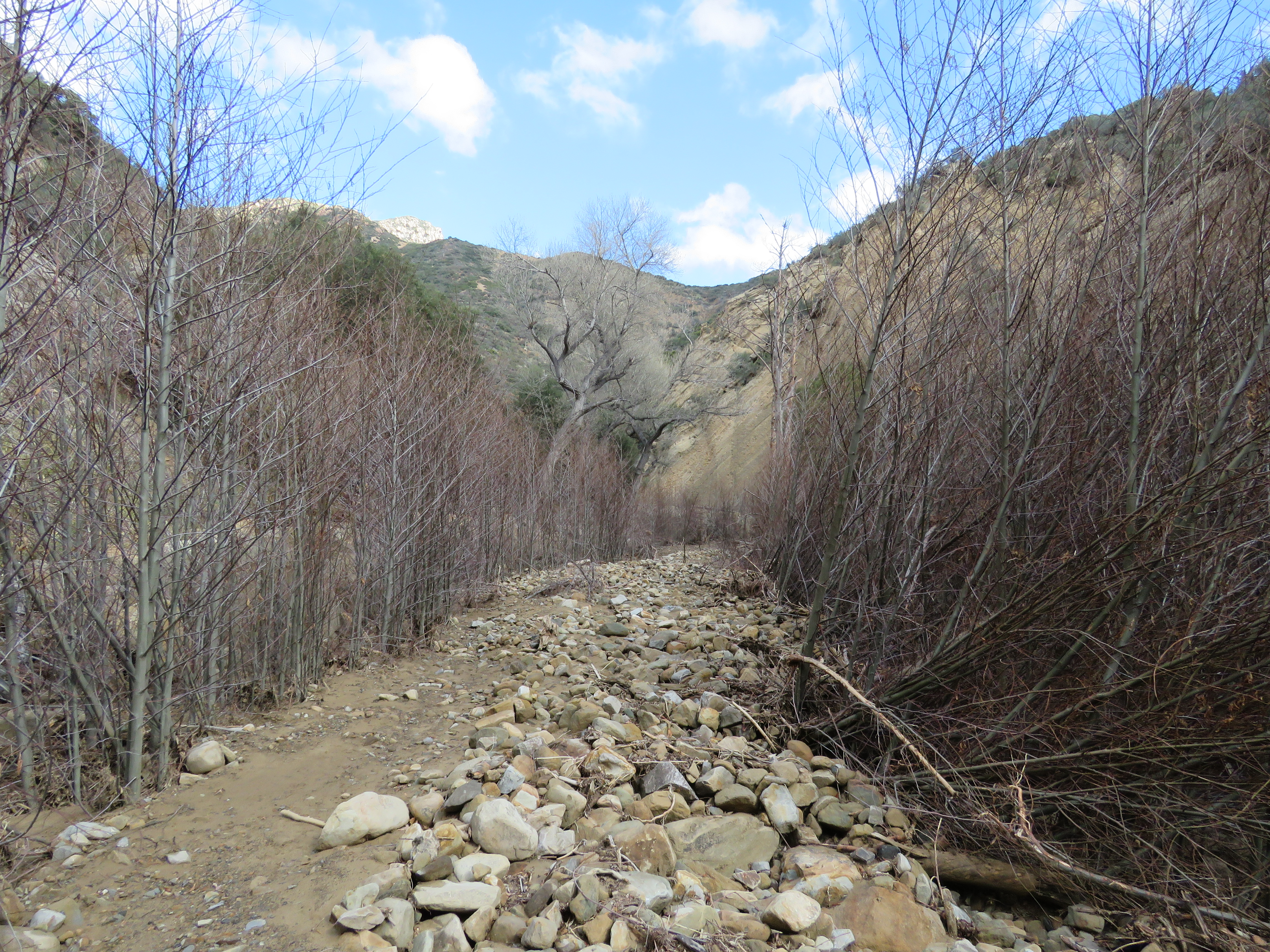
Debris fills a section of Potrero John Creek

As the trail continues, the canyon begins to narrow. Here, flood damage from the 2010 winter storms is evident, as the willow-lined creek itself is buried under rock debris. The debris serves as powerful reminder to avoid the canyon during heavy rains.

In January 2010, two teenagers were dropped off by one of the boys grandfather for four days of camping along the creek. However, two days later as the weather turned, the grandfather returned, and hiked up to the camp to bring the boys out. On the hike out, while trying to cross the now swollen creek, all three were swept downstream. One of the boys managed to get out of the water, but wasn’t able locate the other two, and so hiked out to State Route 33. There, he was able to flag down a passing Caltrans vehicle; the driver contacted the Sheriff’s Department, and a rescue helicopter was dispatched.

Meanwhile, the other boy and his grandfather managed to get out of the creek. They reported a substantial mudslide that came down the canyon and blocked them from hiking out through the canyon. And so they opted to hike east, over to the next canyon in an attempt to reach State Route 33. The two were eventually spotted by helicopter and evacuated. Although all three were cold and exhausted after the ordeal, no injuries were reported.

At this first narrow section, the trail, although indistinct, crosses the creek, and continues along the western side of the creek. From here, the trail is overgrown in places, but is generally easy to follow. The trail eventually gives out just as it enters a second narrow section.

This second narrow section is also littered with rock debris, and in places requires some modest rock scrambling. There is no trail through this section, but from here, it is a short way to the base of the first and smaller waterfall.

Potrero John Falls trail hiking backpacking Los Padres National Forest Ojai

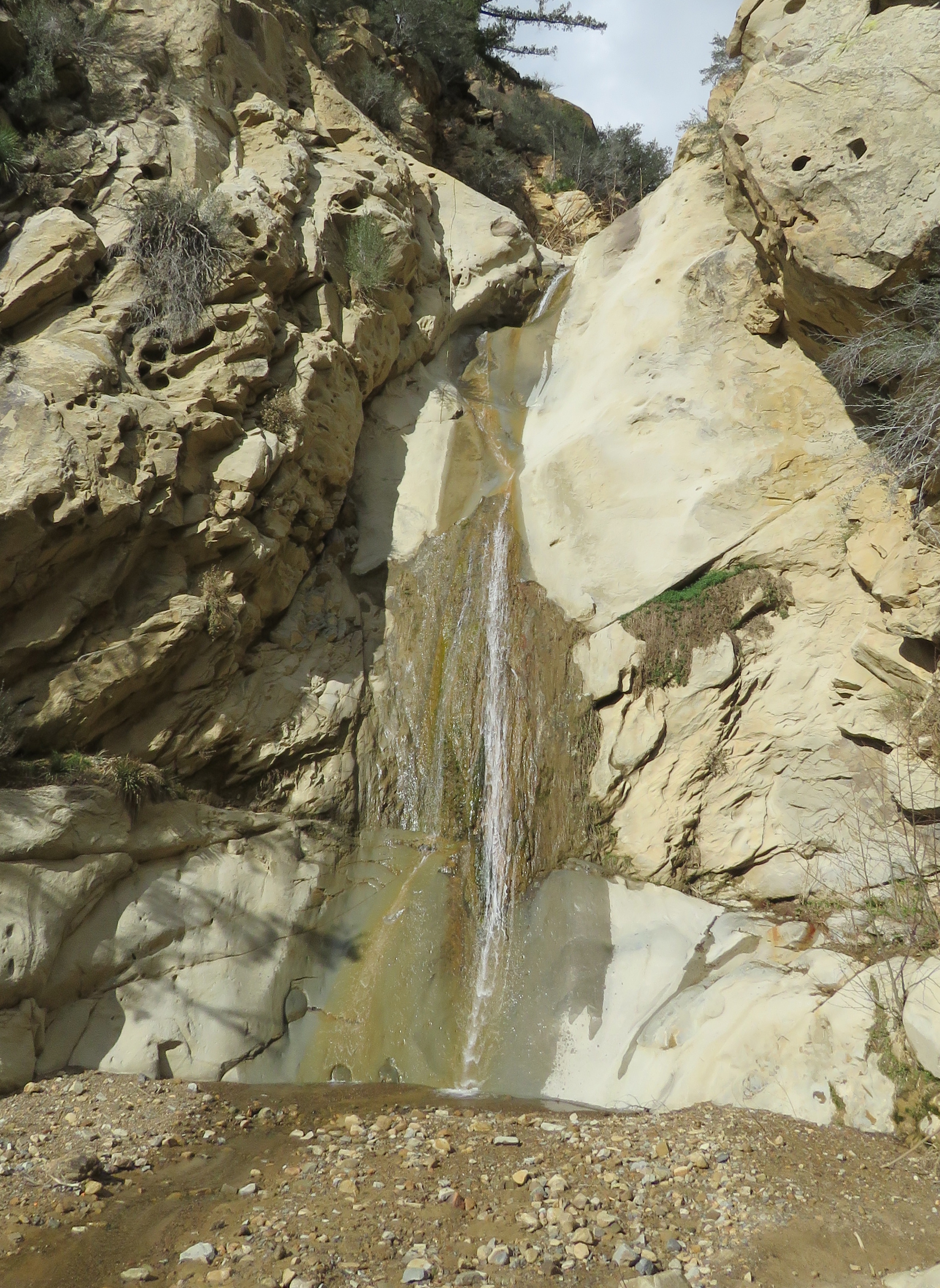
Potrero John Falls

Potrero John Falls is the larger of the two falls, and both can be seen in one view. To reach the base of the upper falls does require a little more effort and rock scrambling.

Currently the flow of water in the falls could be described as modest, reflective of the limited amount of rain we’ve received over the last couple of years. Nevertheless, the falls are an impressive sight, set deep in the canyon, tucked in along the southern side of Pine Mountain Ridge.

Regardless of how far you hike you’ll get to explore one of Sespe River’s many scenic tributaries.

This article originally appeared in section the February 23rd, 2015 edition of Santa Barbara News-Press. Thanks again to Maps.com for producing maps for the articles.
Potrero John Canyon Falls hike trail Los Padres national Forest Sespe Wilderness

Potrero John Canyon

Posted by: James Wapotich | February 16, 2015

Trail Quest: Nichols Adobe Site

While little remains of Nichols’ “Squat” Adobe, the hike to the site provides an opportunity to explore the Santa Ynez Mountains near Gaviota. The adobe site is roughly a mile east of Gaviota Peak, near the top of the San Onofre Creek drainage, and can be reached via Gaviota State Park.

The hike to the site is about 8.5 miles roundtrip, and offers some great views of the Gaviota Coast. Along the route, one can add on relatively short side trips to Gaviota Hot Springs and Gaviota Peak.

To get to the trailhead from Santa Barbara, take Highway 101 north, past Gaviota State Beach, to the Highway 1 exit. From the exit, turn right and double back along the frontage road, which ends at the trailhead. Parking is $2.00 per vehicle, per day. The park is open from 8:00 a.m. to sunset.

Squat Adobe Camp Nichols Trail Los Padres National Forest Gaviota hike

Squat Adobe in an image from the Los Padres National Forest Archive

Squat camp adobe trail hike Los Padres national Forest Gaviota Peak

The site as it appears today, looking in more or less the same direction as the archive image, with Gaviota Peak in the background. The two white arrows point to the approximate location of the southeast and northeast corners of the adobe.

From the trailhead, the hike follows Gaviota Peak Fire Road. The unpaved access road makes its way up the backside of the Santa Ynez Mountains, and provides a drawn out, but steady climb to the top of the mountains.

At about the quarter-mile mark, the road branches. The road to the right, also know as Trespass Trail, curves around to the south, before turning east and becoming more of a single-track trail. The trail then makes its way up the front of the Santa Ynez Mountains toward Gaviota Peak. The route along Trespass Trail is longer, and in several sections overgrown, but can make for an interesting loop when combined with Gaviota Peak Fire Road.

For the hike to the adobe site it is easier to stay to the left, and follow Gaviota Peak Fire Road to the top of the Santa Ynez Mountains. A quarter mile past the intersection with Trespass Trail, Gaviota Peak Fire Road crosses a small side creek. It’s here, on the right hand side of the road, that one can find the beginning of the short trail that leads to the hot springs.

The unsigned trail leads through a thriving mix of riparian plants before arriving at a pair of small concrete pools. The pools are said to have been built during the depression as part of a WPA (Works Progress Administration) program. The upper pool is the more inviting, although the temperature could best be described as warm. Nevertheless, the site makes for a scenic detour.

Continuing past the turnoff to the hot springs, the road transitions out of the riparian plants and continues through an open grassy hillside, and then returns to shaded oak woodland.

Squat Camp Los Padres National Forest Hiking Gaviota

The meadow at the Squat Adobe site

As the road continues to climb, it starts to transition into chaparral, with one of the more noticeable plants this time of year being ceanothus. This hearty shrub is currently in bloom, with its little, white flowers, at times, filling the air with a subtle, perfumed scent.

At about the 1.5-mile mark, the road leaves Gaviota State Park and enters Los Padres National Forest, becoming West Camino Cielo Road. The boundary is marked with a weathered, wooden forest service sign.

At about the 3-mile mark, the road arrives at the top of the mountains. From here, a side trail, on the right, continues steeply to the top of Gaviota Peak where one is treated to nearly panoramic views of the area. From this intersection, looking southeast one can actually see the grassy meadow where the adobe site is located. At one time there was even an old road that cut across the front of the mountains to the site; the route has since become badly overgrown.

From the turnoff to Gaviota Peak, continue east along West Camino Cielo, which now travels along the top of the mountains, and offers great views of the coast, and out towards the Channel Islands. To the north, from the road, one can catch glimpses of the San Rafael Mountains including Grass Mountain, Zaca Peak and Figueroa Mountain.

Squat Camp Los Padres National Forest Hiking trail gaviota

Northeast corner of Nichols ‘Squat’ Adobe

The route along the top of the mountains can at times feel like a bit of a roller coaster, as it climbs one rise and descends down the next. As the trail descends down the first of these small hills along the ridge, you may notice a rusted metal sign buried in the brush on the left hand side.

The sign marks the beginning of the 1.25-mile long Campbell Trail. The trail follows the small canyon and creek that parallels the ridge, and rejoins the road at the top of the canyon, past the turnoff to the adobe site.

Campbell Trail was built in the late 1970s by Bruce Campbell, who worked for the forest service. The trail is no longer maintained by the forest service, and has become so badly overgrown that it requires pushing through thick chaparral and at times crawling under brush in order to follow the route. Roughly midway along the trail is Corrie Meadow, which is also marked with a metal sign, and was named after Mr. Campbell’s daughter.

Continuing east along West Camino Cielo, the road gradually makes its way towards the next high point along the ridge, before descending towards the eastern end of Campbell Trail. The turnoff to the adobe site is easy to miss, but is before that next high point. The turnoff to the site is on the right, and follows a trail that descends down the front of the mountains, following a ridge line that’s more or less perpendicular to the road.

The half-mile trail down to the adobe site follows an old road cut that led to the adobe. The road has since become so overgrown that it is now essentially an overgrown single-track trail. The route descends somewhat steeply, before then turning west and continuing to the site.

When the trail does arrive at the site, the first thing one notices is an open meadow, tucked in by a small rise. The adobe site is difficult to locate, as it is now hidden amongst the chaparral. The site is in the southeast corner of the flat, near the oak trees, but not underneath them.

Campbell Trail gaviota Los Padres national Forest hiking

A view of the small side canyon traversed by Campbell Trail

According to local historian E. R. “Jim” Blakley, the one-room adobe was built by Juan Save in the late 1800s. Mr. Save was the owner and manager of Oak Park Dairy in Santa Barbara, but also owned the land where the adobe is located.

Mr. Save later sold the adobe to Charles T. Nichols, who in 1910 became the owner of the nearby Las Cruces Inn. Mr. Nichols is said to have used the site for running cattle. The adobe was later used by G. Raymond Cornelius of Solvang, until the wooden roof burned in the 1955 Refugio Fire. Once exposed to the rain, the adobe walls quickly eroded, until little remained of the structure.

In 2004, the Gaviota Fire burned through the site. Regrowth from the fire is evident along the trail, and has helped conceal what’s left of the adobe. However, one can still find the waist-high remains of the northeast corner of the adobe, hidden amongst the coastal sagebrush and yerba santa,

The site is said to have acquired the name Squat Camp or Squat Adobe because none of its residents lived there for any extended period of time; their occupancy seeming more akin to that of a squatter.

Near the ruin are several large oak trees, which offer a shady place to rest before making the return hike.

This article originally appeared in section A of the February 16th, 2015 edition of Santa Barbara News-Press.

Posted by: James Wapotich | February 9, 2015

Trail Quest: El Capitán to Haskell’s

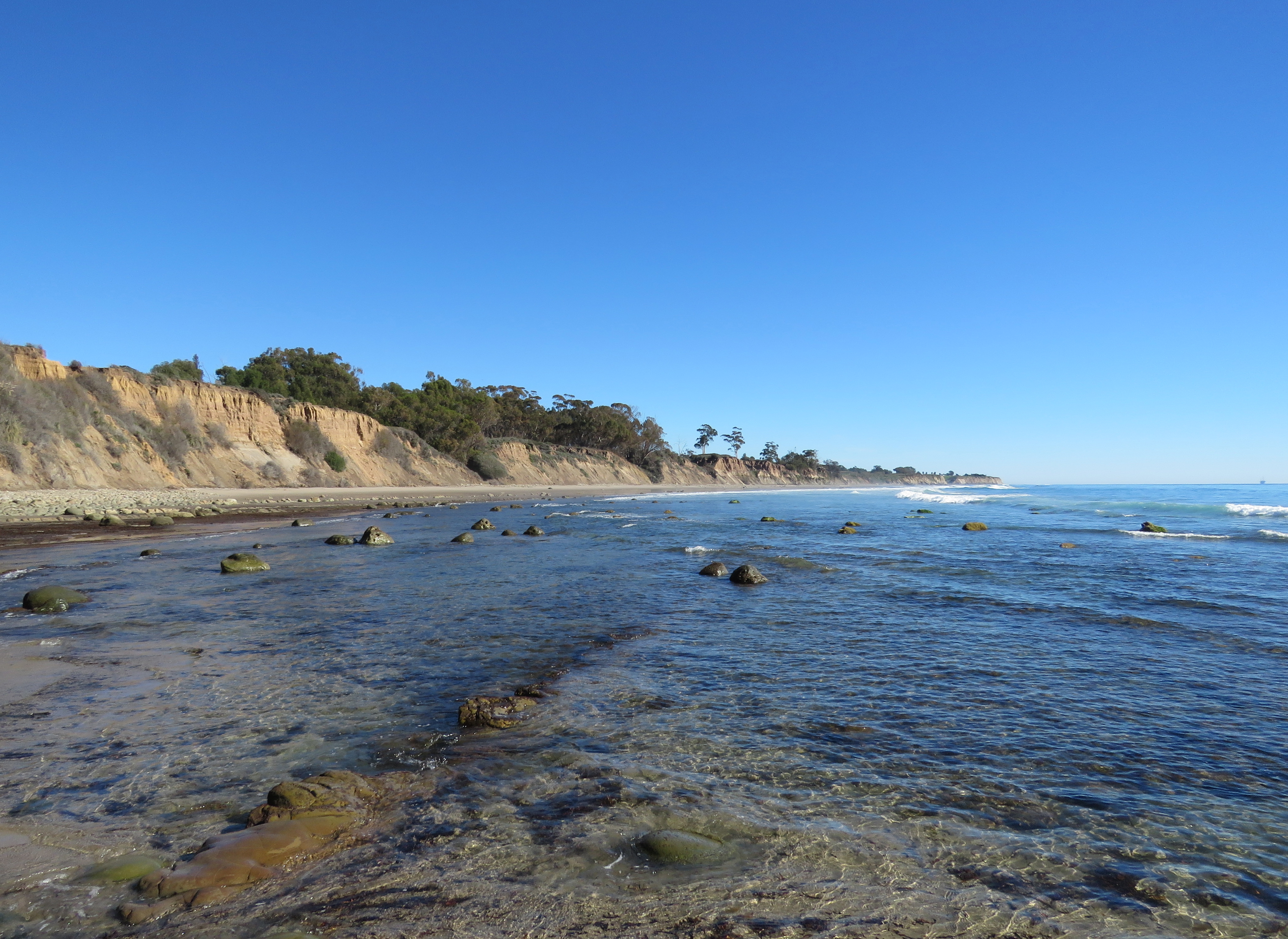
One of the best ways to enjoy the rich scenery along our coast can be with a long, secluded beach walk. Between Goleta and Gaviota we have a number of coastal access points to choose from, each of which can serve as interesting beginning and end points for a coastal hike.

The section of coast closest to Goleta is between El Capitán State Beach and Haskell’s Beach, near the Bacara. The hike between the two sites is about 6.5 miles one way, and is best done during a minus tide.

Although minus tides happen throughout the year, the best time for these types of beach walks is between November and February. There are a number of factors that influence the tides, including the position of the moon and sun. However, in January, the earth in its orbit is closest to the sun, which creates a wider fluctuation in the tides. This in turn creates more minus tides, which makes it easier to find a day when daytime tides are in your favor.

Gato Canyon El Capitan beach walk goleta coast

A view near Gato Cayon across the water towards Dos Pueblos Canyon

The hike from El Capitán to Haskell’s can take about 3-4 hours, and so it’s best to plan your hike so that you’re at the midway point when the tides are at their lowest. One way to approach the hike is as a shuttle trip, with a ride or car arranged at each end.

To get to El Capitán State Beach from Santa Barbara, take Highway 101 North, past Goleta, and take the El Capitán State Beach exit. Day-parking at the state beach is $12.00 per vehicle.

From the main parking area at El Capitán, continue down towards the beach and head east. One can also follow the quarter-mile long nature trail that starts near the park entrance. The nature trail crosses the creek by way of a bridge, and offers a chance to explore the riparian habitat along El Capitán Creek. The two routes meet just past the creek.

Continue east, along the coast as the route clears what could be described as El Capitán Point, and makes a wide curve before continuing along a largely unbroken expanse of beach towards the next point.

At about the 1-mile mark, one arrives at the mouth of Cañada de la Destiledera. A destiledera is a stone water-filter system. Water is dripped onto a porous volcanic-stone vessel and filtered into a large earthenware jar below. The filter stone is lined with clay, where moss and maidenhair fern is planted, which helps filter the water. And so, perhaps there was a feature further up the canyon that reminded someone of a destiledera giving the canyon its name.

Continuing east along the coast, the next noticeable canyon is Las Llagas Canyon. Halfway between these two canyons one reaches the end of El Capitán State Beach. From here to Haskell’s Beach, the land along the coast is privately owned. Hiking, however, is permitted along the beach below the mean high tide line. Please respect private property.

Dos Pueblos Canyon Beach walk hike El Capitan Goleta

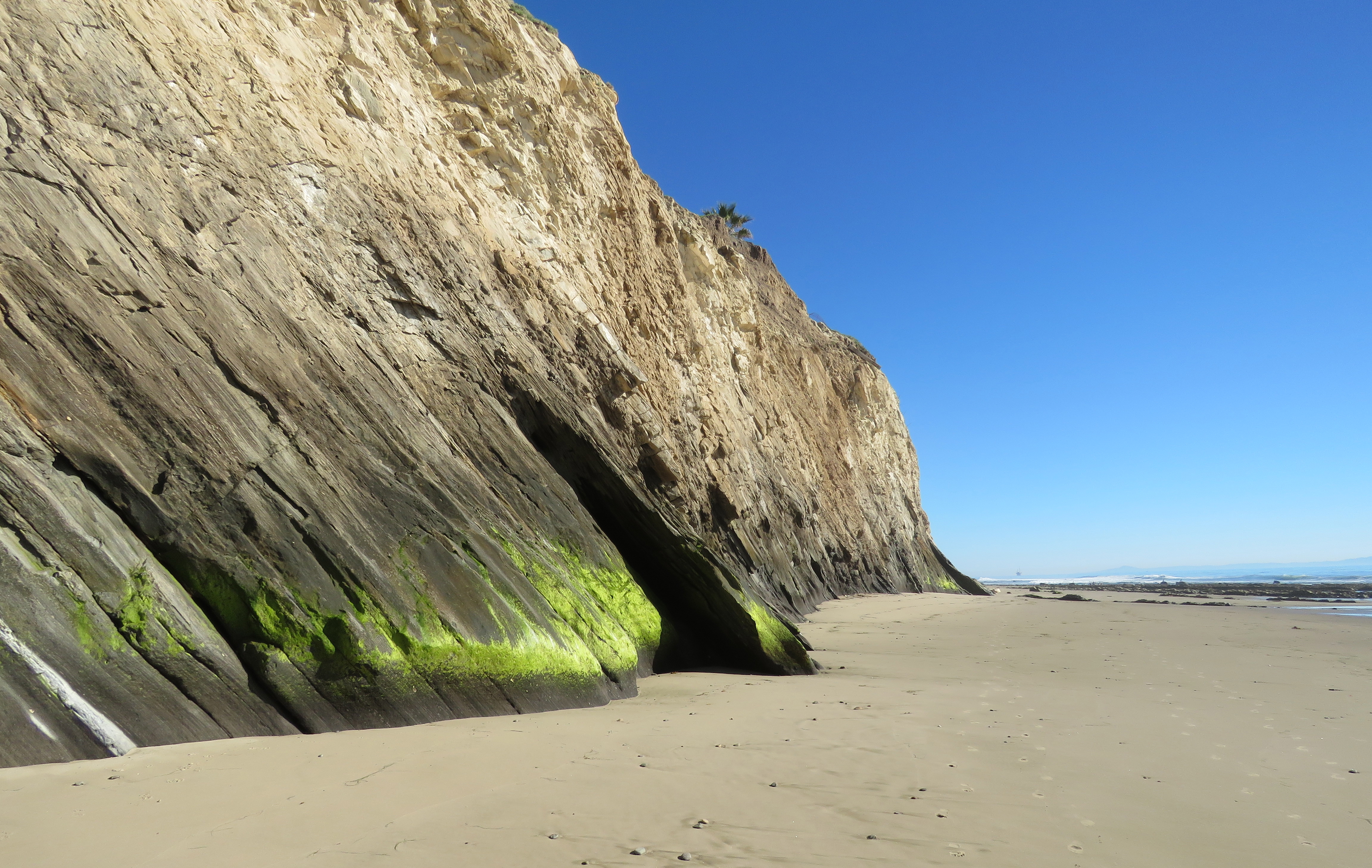
Green algae marks the high tide line near Dos Pueblos Canyon

This transition also marks a historical boundary. El Capitán was once part of the Rancho Cañada del Corral land grant, while the land past El Capitán to the east, all the way to the Goleta Slough, was once part of the 15,535-acre Rancho Dos Pueblos land grant.

Rancho Dos Pueblos was granted to Nicholas Den in 1842 by the governor of Alta California. Den was an Irish immigrant who arrived in Santa Barbara in 1836 and was the city’s first doctor. When Den passed away in 1862, he left the western half of the land to his wife, while the eastern half was held in trust for their ten children to be equally divided amongst them when they came of age. Since then, that land has been divided and sold into smaller tracts, some of which continue as ranching operations, and others of which are where UCSB, Isla Vista, and much of Goleta are now located.

At the about 2.25-mile mark, one arrives at Edwards Point. The point is named after John S. Edwards who purchased the 1,138-acre ranch in the late 1800s. After his passing in 1890, the land was divided between his wife and daughter, becoming Edwards Ranch and Las Varas Ranch respectively.

In 1944, during the second world war, a portion of Edwards Ranch served as the site of a prisoner of war camp. The camp was one of several satellite sites managed by Camp Cooke in Lompoc, which later became Vandenberg Air Force Base. Camp Cooke was one of 135 such sites throughout the United States used to house prisoners of war. The prisoners at Edwards Ranch were German soldiers who had been captured during campaigns in Europe and North Africa. The square-shaped prison compound, complete with barbed-wire fence, guard towers and quonset huts, operated at Edwards Ranch for 14 months and housed anywhere from 200-300 prisoners. In the 1970s, most of structures were removed, with the exception of the water tank tower.

Continuing past Edwards Point, which is one of the rockier sections of the hike, one arrives at the mouth of Gato Canyon. From here, the route again follows the curve of the coast, before straightening out and following another long expanse of beach.

Eagle Canyon Goleta Beach walk hike Haskell's

The coast is seen near Eagle Canyon

At about the 3.25-mile mark, one arrives at the next major canyon along the coast, Dos Pueblos Canyon. Both the name of canyon and the land grant are a reference to the two Chumash villages located there.

On the western side of the canyon was the village of Mikiw, and to the east on the opposite side was Kuya’mu. During Gaspar de Portolà’s land expedition in 1769, Franciscan missionary Juan Crespi named the site Dos Pueblos, Spanish for two towns or villages.

Continuing passed Dos Pueblos Creek, the coast starts to narrow. Through this section, one can easily find green algae growing on the water-smoothed cliff wall, assuring you that this section is not passable during high tide.

Continuing east, the coast rounds another bend, and the views eastward start to open up along the coast towards Ellwood Pier and Coal Oil Point.

At about the 5.5-mile mark, one arrives at the mouth of Eagle Canyon. From here the route leads past Ellwood Pier, before arriving at Tecolote Creek and Haskell’s Beach.

El Capitan Haskells beach walk Goleta hike

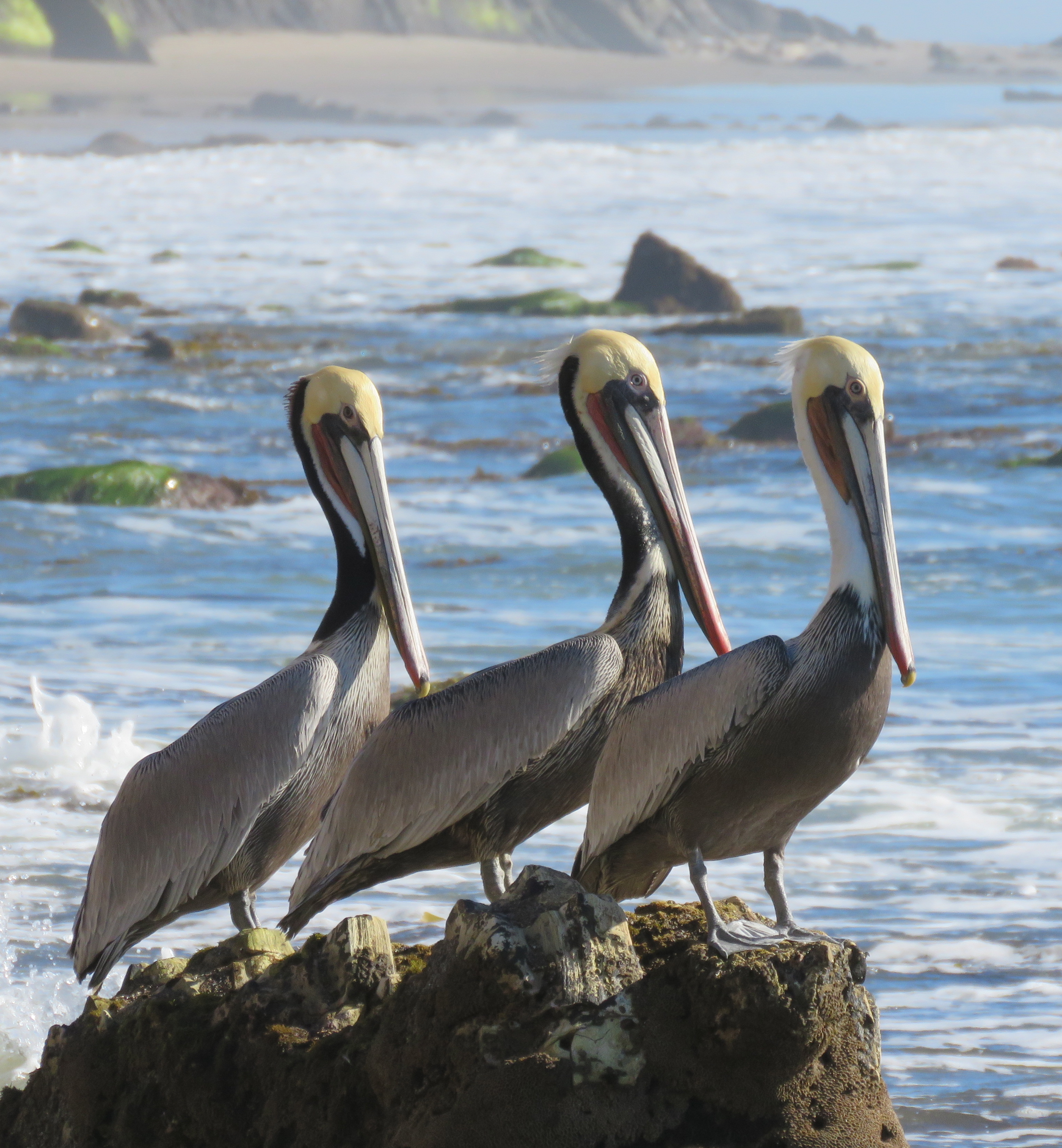
California brown pelicans gather near Dos Pueblos Canyon

Haskell’s Beach is said to be named for local surfer Mike Haskell, who grew up in the area and regularly surfed at the beach. The beach is known for its proximity to the Ellwood Oil Field, which during the the 1930s was one of the largest oil fields in California.

On February 23, 1942, just two and half months after the attack on Pearl Harbor, Kozo Nishino, the captain of Japanese submarine I-17 gave the command to fire on the installation, which was located above what is now Haskell’s Beach and included where Sandpiper Golf Course is now. Prior to the war, Nishino had visited the installation a number of times, as the skipper of a Japanese oil tanker. The shelling, which damaged the pier and an oil derrick, was the first attack on a mainland target during the war, and created heightened anxiety along the west coast. The attack was in part the impetus for the internment of Japanese-Americans.

From Haskell’s Beach, continue north along Chumash Nature Trail to the parking area to complete the hike. The interpretative signs along the trail were installed by Bacara in 2014, and describe different plants used by the Chumash. Each of the nearly 20 different signs includes the Chumash name for the plant and how it was used. The trail is ADA accessible.

The parking area at Haskell’s Beach can be reached from Highway 101, by taking the Winchester Canyon Road exit and continued west along Hollister.

Regardless of how far you hike you’ll get to see some of Santa Barbara County’s scenic and historic coastline.

This article originally appeared in section A of the February 9th, 2015 edition of Santa Barbara News-Press.

Posted by: James Wapotich | February 2, 2015

Trail Quest: Cherry Creek

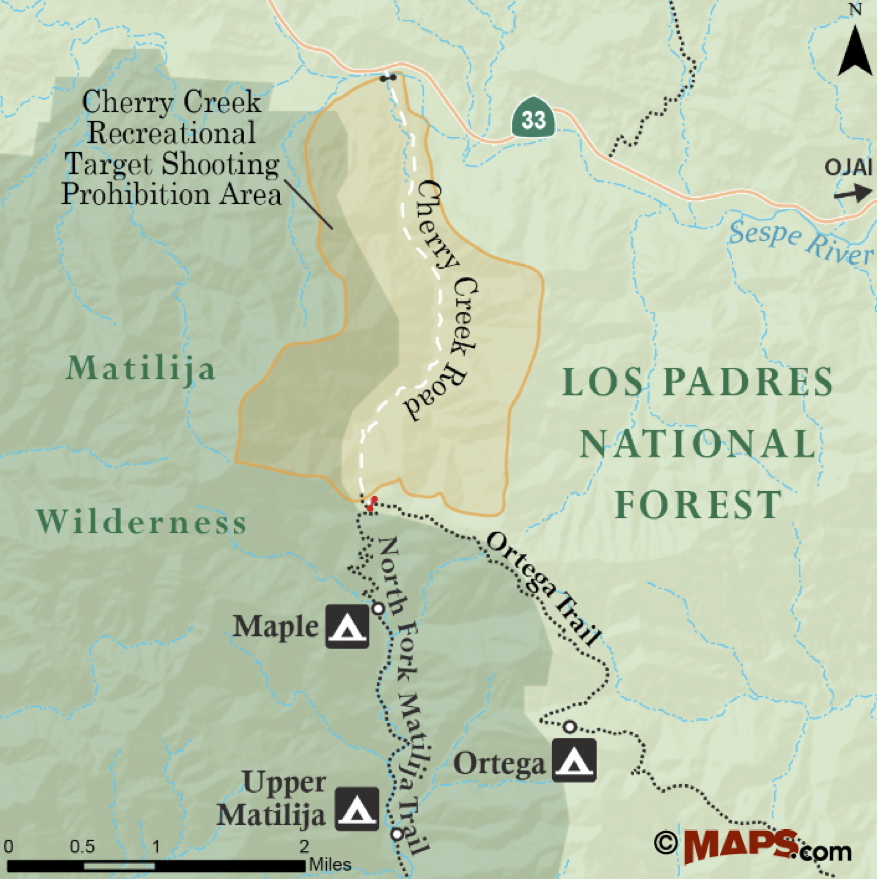
Located along the upper reaches of the Sespe River, Cherry Creek Road follows part of what was once the main route between Ojai and the Cuyama Valley. The unpaved road follows Cherry Creek much of the way and provides access to Upper North Fork Matilija Canyon and Matilija Wilderness. During the winter Cherry Creek Road is closed giving the area a more remote feeling.

A hike to the top of the road is about 6-miles roundtrip and includes some great views of the surrounding area. An enjoyable backpacking trip can be made by continuing along North Fork Matilija Trail down to Maple Camp in Matilija Wilderness. The hike to Maple Camp, from the trailhead, is about 9.25-miles roundtrip.

To get to the trailhead from Ojai, take State Route 33 north, past the turnoff for Rose Valley and continue towards Pine Mountain Summit. Cherry Creek Road, which is on the left, is about 1.5 miles past the Chorro Grande Trailhead, which is on the right. You’ll know if you’ve gone too far if you arrive at Pine Mountain Summit. Parking is found alongside the road at the trailhead. The road is closed to vehicles from December 15 through May 15. When the road is open a high-clearance vehicle is recommended.

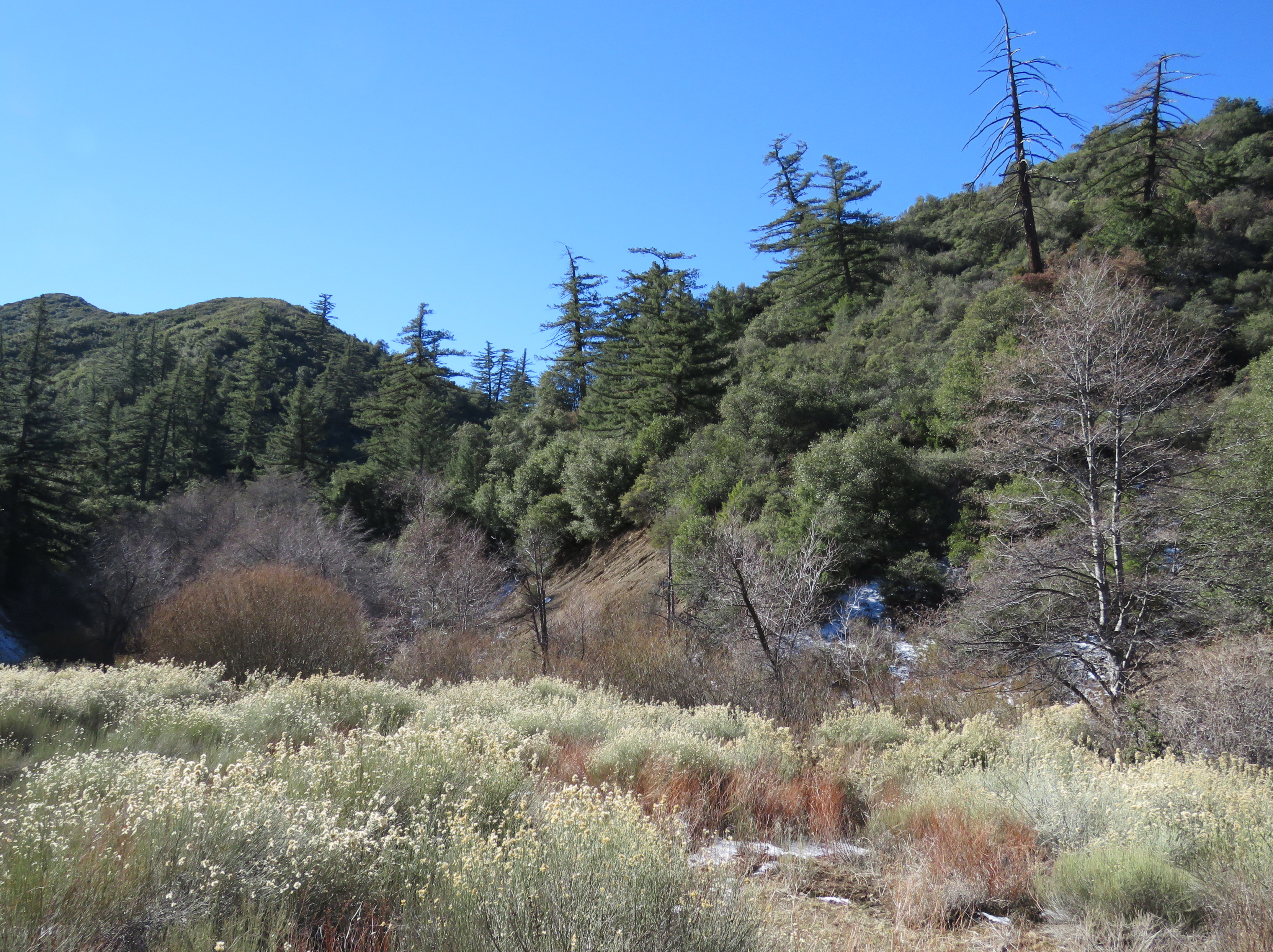
Cherry Canyon Creek Road hike trail backpacking Los Padres National Forest Matilija

Cherry Canyon

Prior to the construction of State Route 33, one of the main routes from Ojai to the Cuyama Valley followed what is now North Fork Matilija Trail and Cherry Creek Road.

The route from Ojai followed the Ventura River to Matilija Creek, and continued up Matilija and Upper North Fork Matilija Creeks, before then descending down along Cherry Creek to the Sespe River, and continuing over Pine Mountain.

The route through Cherry Canyon remained more or less the same, until the 1960s when the Ohio Oil Company built a dirt road through the canyon along the trail, re-routing parts of the trail. The well site came up dry, but that road is now Cherry Creek Road.

Cherry Creek Map recreation shooting prohibition area Matilija upper north fork maple road hike trail camp wilderness Los Padres National Forest Ojai

Map courtesy Maps.com

From the trailhead, Cherry Creek Road crosses the Sespe River, often dry through this section, and enters Cherry Canyon. The road follows the creek upstream, and as the canyon narrows one starts to see big cone spruce and interior live oak lining the canyon. The creek is currently flowing intermittently, and can make for a scenic hike.

Unfortunately the canyon still sees its share of abuse. Years of target shooting has left a legacy that the canyon is still recovering from. For more than 20 years Cherry Creek was one of the main destinations for people who wanted to fire their weapons in an unsupervised environment.

In its heyday one could find, abandoned at the site, shot up water heaters, television sets, household appliances, road signs, oil cans, and whatever else people thought they needed to shoot at in order to practice using their weapons.

Cherry Creek Road hike trail Ojai Los Padres National Forest

Scenery along Cherry Creek Road

In July 2011, following an order by a federal judge to increase protections for wildlife habitat, the Forest Service issued a closure order for the canyon. The Cherry Creek Recreational Target Shooting Prohibition Area covers the entire drainage basin of Cherry Creek and makes all forms of recreational target shooting in the area illegal. The closure does not pertain to hunting.

In October 2011, Los Padres ForestWatch organized a volunteer clean up of the area with over 80 participants. The volunteers removed more than 2.5 tons of garbage that had been left there over the years.

Today, the site is in better condition. Nevertheless, it is disappointing to see that the site is being used illegally for target practice. Along the road one can easily find evidence of recent target shooting activity, including spent cartridges, clay pigeons, and even stand-up targets, as well as empty cans and other litter that has been left behind.

At about the 2.5-mile mark, the road starts its climb out of the canyon as it makes its way towards the saddle that divides the drainages of Upper North Fork Matilija and Cherry Creeks.

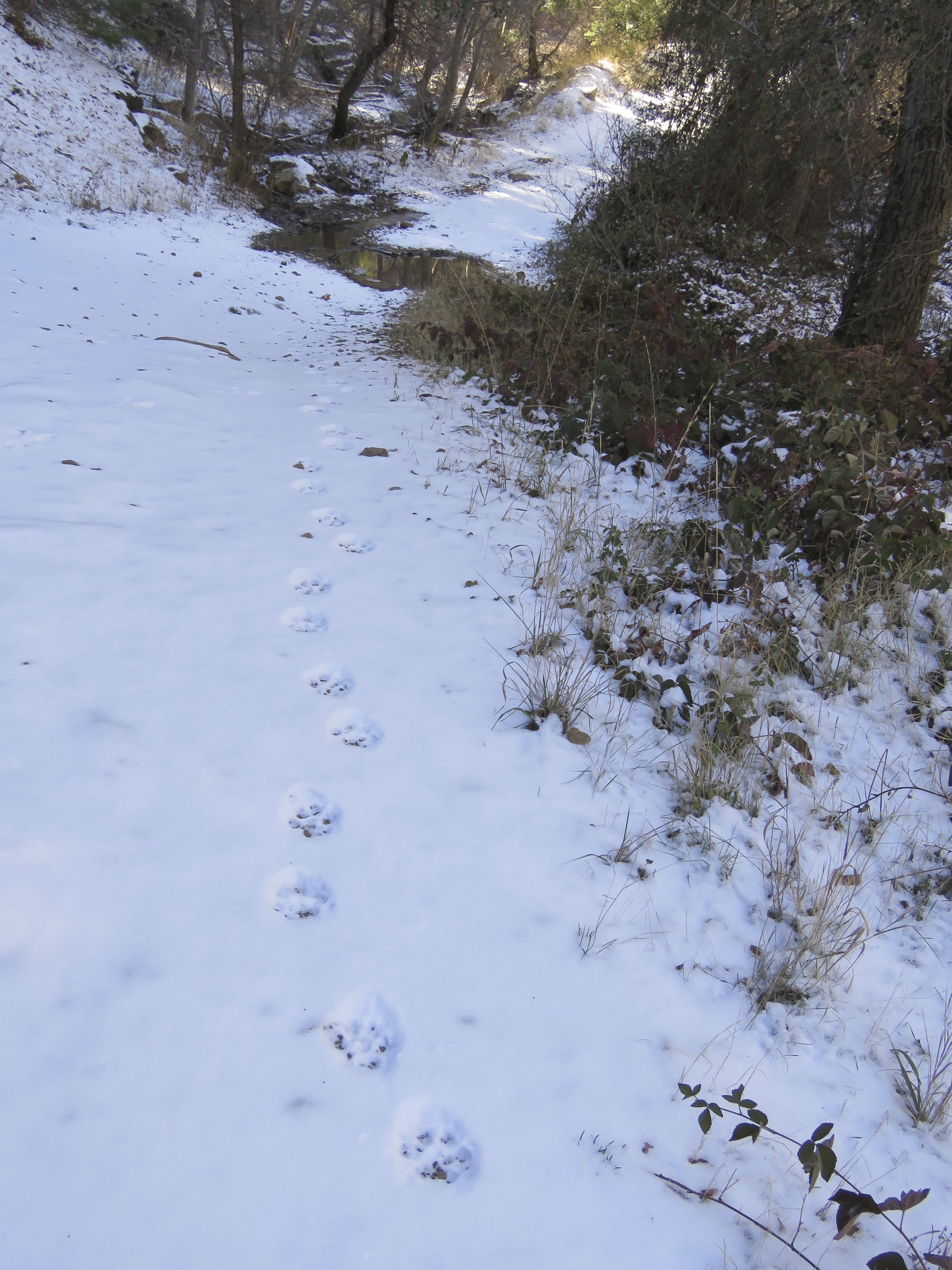
Mountain Lion Tracks cherry creek canyon road trail hike Los Padres National Forest

Mountain Lion tracks in the snow along Cherry Creek Road

At the saddle, one is treated to views out across Upper North Fork Matilija Canyon and out towards the Pacific Ocean. On a clear day one can see Anacapa, Pt. Mugu and the Oxnard Plain. From here, it’s about 1.75 miles down to Maple Camp along North Fork Matilija Trail.

To the left of the North Fork Matilija Trailhead, Cherry Creek Road continues a short way further to the beginning of Ortega Trail. The 9-mile trail is open to motorcycles, and leads back down State Route 33, arriving at State Route 33 about a mile north of Wheeler Gorge Campground.

Ortega Trail follows an old jeep road that served as the “winter route” allowing travelers to bypass Upper North Fork Matilija Creek during the rainy season. The trail features a trail camp about 2.5 miles from the top, which has a picnic table and fire ring, but no water or shade. Both the trail and the camp take their name from Ramon Ortega, who ranched nearby at Potrero Seco in the 1860s.

Continuing along North Fork Matilija Trail, the trail drops down into Upper North Fork Matilija Canyon and enters Matilija Wilderness. The trail offers views out across the headwaters of Upper North Fork Matilija Creek, and passes through a mix of chaparral, including chamise, ceanothus, holly-leaf cherry and scrub oak, before arriving at the canyon floor. From here, it’s less than a quarter-mile downstream to Maple Camp.

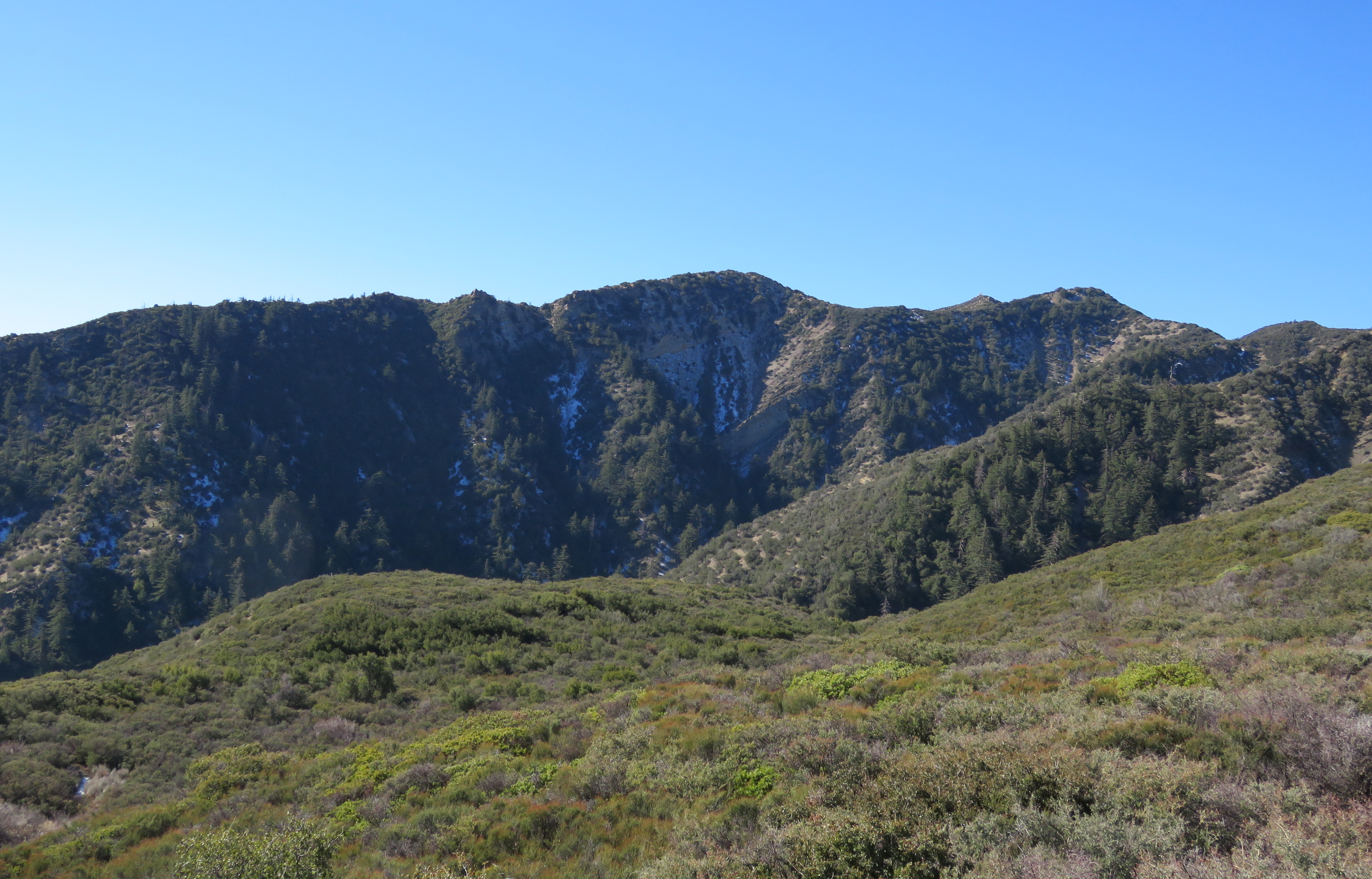
North Fork Matilija Trail Canyon wilderness hike Cherry Creek Road Los Padres National Forest

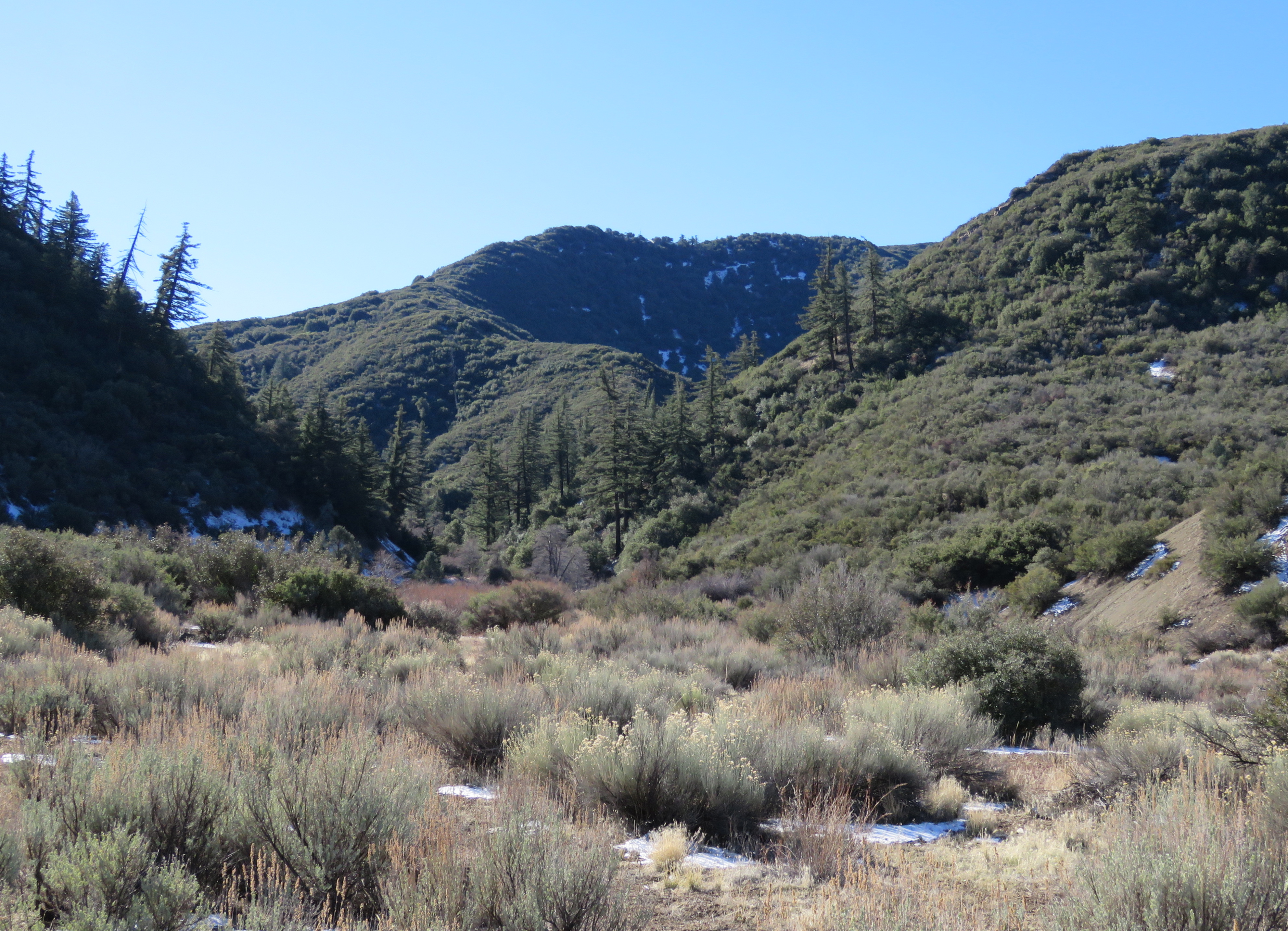
Upper North Fork Matilija Canyon is seen from Cherry Creek Road

Maple Camp is one of the nicer camps in Matilija Wilderness. The site is located in a clearing with a half dozen good size maple trees surrounded by California bay laurel and other riparian plants. Upper North Fork Matilija Creek generally has water in it year round at Maple Camp. The camp has a grated stove and fire ring, as well as two nearby ice can stoves.

From Maple Camp one can explore further downstream towards Upper Matilija Camp, about 3.5 miles round trip. In fact, one way to visit the area is by making a shuttle trip. That is, starting from either the trailhead for North Fork Matilija Trail and coming out at Cherry Creek Road or reversing the route. The total length of that hike is about 12 miles, and there are a number of trail camps along North Fork Matilija Trail that can make for good overnight destinations.

Regardless of how far you hike you will get to see some of the historic route that was once used by travelers between Ojai and the Cuyama Valley.

This article originally appeared in section A of the February 2nd, 2015 edition of Santa Barbara News-Press.

Lagniappe

I did this hike with my sister and a friend as a leisurely 3-day trip. We hiked in via Cherry Creek Road and camped at Maple Camp two nights. On the middle day, I hiked the Ortega Ridge Trail down to the junction with the Dry Lakes Ridge Trail and back to scout out the trail, since I hadn’t hiked it before.

Because this was December and the sun was low in the sky, I could not get a good photo looking south up Cherry Canyon on the hike in or out, both times much of the mountains were in shadow. Nevertheless, I felt like I needed one good shot of the canyon since the article was called Cherry Canyon, and so I went back the next weekend for a day hike. I deliberately got an early start so I could be midway up the canyon a little before noon, figuring my best chance would be when the sun was at its highest in the sky.

Hiking up the canyon, I quickly discovered that the rain I’d gotten the night before in Santa Barbara, produced snow on this side of the mountains, which was a treat, but the real bonus was when I started to see mountain lion tracks along the route.

When I got to the spot for my photo (the first photo in this post), I was surprised, and a little disappointed, that even with the sun at its highest, parts of the mountain were still in shadow, but felt satisfied that this was the best photo that could be taken and let it go at that. It was also a great reminder of just how low the sun is in the sky during the winter.

Another highlight for me when visiting Maple, in addition to all the epic maple trees, is the majestic stand of Big Cone Douglas Fir hiding out just around the corner, upstream from Maple. This last photo is from the top of the trail looking down North Fork Matilija Canyon towards the grove.

North Fork Matilija Trail peak hike backpacking wilderness Los Padres National Forest

Upper North Fork Matilija Canyon

Posted by: James Wapotich | January 26, 2015

Trail Quest: Ventura River Preserve

The Ventura River is one of the four main rivers in our area. The other three are the Santa Ynez, Santa Maria, and Santa Clara Rivers. The 16.5-mile long river originates in the mountains north of Ojai, and begins at the confluence of Matilija and North Fork Matilija Creeks. From there, the Ventura River flows south, entering the Pacific Ocean just west of Ventura.

One way to explore the habitats and scenery along the river is with a visit to Ventura River Preserve. The 1,591-acre preserve covers a three-mile section of the river and offers more than 20 miles of trails, most of which are also open to equestrians and mountain bike users. The preserve is located west of Ojai and has three different trailheads that one can start from.

To get to the preserve from Santa Barbara, head south on Highway 101. One can either take State Route 150 over Casitas Pass, or continue down towards Ventura and take State Route 33 towards Ojai. The southern part of the preserve is located near the intersection of State Routes 150 and 33. In fact, if coming from Carpinteria, State Route 150 crosses the Ventura River just before arriving at State Route 33.

El Nido Meadow Ventura River Preserve hike trail Ojai Valley Land Trust

El Nido Meadow

The southern trailhead is located at the end of Old Baldwin Road, which is the first road on your left just past the river, and before State Route 33, if traveling along State Route 150 from Carpinteria. The Old Baldwin Road Trailhead has space for parking and horse trailers, and also includes an ADA accessible trail.

Between the turnoff for Old Baldwin Road and State Route 33, along State Route 150, is Rice Road, which leads to the Riverview Trailhead.

To reach the northern trailhead, continue north along Rice Road past the Riverview Trailhead, to Myers Road. Turn left onto Myers Road, which ends at the Oso Trailhead. The Oso Trailhead can also be reached more directly from State Route 33, just north of Ojai, by taking Fairview Road west to Rice Road.

Each of the trailheads have slightly different hours, but in general, the preserve is open during daylight hours only. A map of the preserve and the different trails can be found here on the Ojai Valley Lands Conservancy’s website, www.ovlc.org, which manages the preserve. All of the designated trails within the preserve are in generally good shape, and most of the trail intersections are well-marked with trail signs. Parking can be found at each of the trailheads.

Ventura River Preserve map trail hike Ojai Meiners Oak El Nido Meadow Rice Canyon Willis

Map courtesy Maps.com

One of the more scenic trails in the preserve is Willis Canyon Trail, which can be incorporated into a longer loop hike. A hike along Willis Canyon Trail to El Nido Meadow, and returning along Rice Canyon and Orange Grove Trails, is about 6.5 miles. The closest trailhead for Willis Canyon Trail is the Riverview Trailhead.

The Riverhead Trail overlooks the broad flood plain of the Ventura River and offers some great views of the area. From the parking area, the trail quickly descends down to the floodplain and continues west. The trail leads past trellises that were once used to raise kiwis.

The trail then veers south before continuing west and crossing the river. During much of the year the river is dry through this section, bringing to mind Mark Twain, who quipped that he once fell into a California river and “came out all dusty”.

The trail then crosses a Casitas Municipal Water District access road, please stay on the trail. Here, the trail turns north and continues along the western edge of the floodplain. The hills along this side of the floodplain are composed of mostly Sespe Formation material noticeable by its reddish color.

El Nido Meadow Ventura River Preserve hiking trail Ojai

El Nido Meadow framed by the Santa Ynez Mountains

The trail starts to follow what at first appears to be a side channel of the Ventura River but is, in fact, Willis Creek. It’s also here that the trail starts to become more shaded.

At about the 1-mile mark, the trail enters Willis Canyon. Here, the trail branches, with one trail continuing up the shaded canyon and another following an old ranch road overlooking the canyon. The two trails converge a short ways further into the canyon, where they continue as a single-track trail. It’s also at this intersection that one can find Orange Grove Trail, which can be used for the return loop.

Willis Canyon Trail is one of the nicer trails within the preserve, passing through oak woodland before arriving at the scenic El Nido Meadow. The canyon is named for Alexander Willis who homesteaded the canyon near El Nido Meadow in the early 1900s.

About a mile from the beginning of the canyon, Willis Canyon Trail arrives at the intersection with Fern Grotto Trail, which climbs out of the canyon and connects with Chaparral Crest Trail. From here, it’s another half mile to El Nido Meadow along Willis Canyon Trail.

Willis Canyon Trail Ventura River Preserve ojai hiking

Hummingbird sage and coast live oaks are seen along Willis Canyon Trail

Fern Grotto and Chaparral Crest Trails can be used to extend the hike an additional two miles. Fern Grotto Trail leads up to Chaparral Crest Trail, and takes its name from the ferns growing in a small side canyon along the trail. Continue west along Chaparral Crest Trail, which essentially traces the top of Willis Canyon, and offers views out across the Ojai Valley, El Nido Meadow and out towards the Santa Ynez Mountains. Chaparral Crest Trail then returns back down the canyon and rejoins Willis Canyon Trail at El Nido Meadow.

The tucked-away meadow, with its open, grassy field, can also make a good return point for a shorter hike.

Originally part of the much larger 21,522-acre Rancho Santa Ana Mexican land grant, the area that is now Ventura River Preserve was purchased in the late 1880s by D. W. Rice. Rice named his property El Nido Ranch, which is Spanish for nest.

In 1927, the ranch was purchased by the Baldwin Family and became known as Rancho Matilija. The Baldwin Family sold the ranch in the mid-1960s. The property then passed through the hands of several different owners and corporations, each with a vision of developing the land into a housing community and golf course.

In 2003, Ojai Valley Land Conservancy was able to purchase the bulk of the property for $3 million dollars, and obtained an additional $3.1 million from the State Coastal Conservancy to purchase the remainder of the property. A successful fundraising campaign by the land conservancy provided additional funds to manage the preserve.

Ventura River Preserve Ojai hiking trail

The Santa Ynez Mountains frame a view along the Ventura River floodplain

For the return loop from El Nido Meadow, continue northwest along Rice Canyon Trail. The trail soon leaves the preserve by way of a gate and continues through Los Padres National Forest. About a mile later, the trail returns to the preserve and continues heading east.

At about the 2-mile mark from El Nido Meadow, Rice Canyon Trail passes Kennedy Ridge Trail, which leads up towards the Santa Ynez Mountains.

Past Kennedy Ridge Trail, Rice Canyon Trail continues towards the Ventura River, crossing the Robles-Casitas Diversion Canal by way of a bridge. The canal was built in 1959 to divert water from the Ventura River into Lake Casitas.

The trail then passes the plant nursery used for restoration work at the preserve at arrives at Orange Grove Trail. Turn right, and continue south along Orange Grove Trail back to Willis Canyon Trail to complete the loop portion of the hike.

Orange Grove Trail, takes its name from 44-acre orange grove planted there in the mid-1920s. The trees are slowly being replaced with native plants as part of the restoration of the site.

For more information about Ventura River Preserve, as well as the other preserves managed by Ojai Valley Land Conservancy, go to www.ovlc.org.

This article originally appeared in section A of the January 26th, 2015 edition of Santa Barbara News-Press.

« Newer Posts - Older Posts »

Categories