Posted by: James Wapotich | January 26, 2019

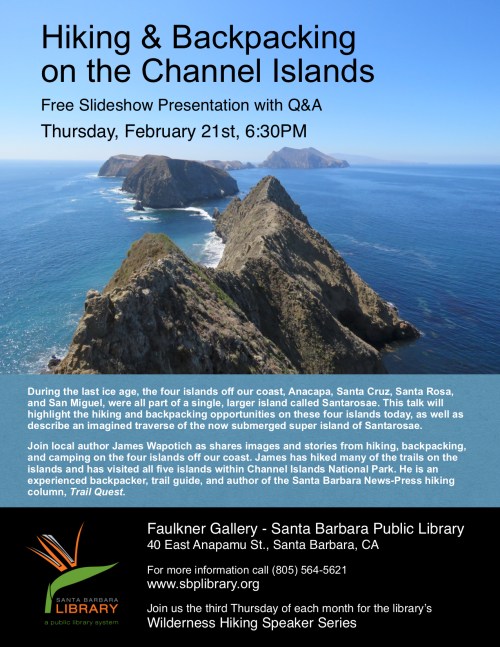
Hiking & Backpacking on the Channel Islands

Hiking & Backpacking Channel Islands National Park Anacapa Santa Cruz Santa Rosa San Miguel

*

Hiking & Backpacking on the Channel Islands

Free Slideshow Presentation with Q&A

Thursday, February 21st, 6:30PM
Faulkner Gallery – Santa Barbara Public Library
40 East Anapamu St., Santa Barbara, CA

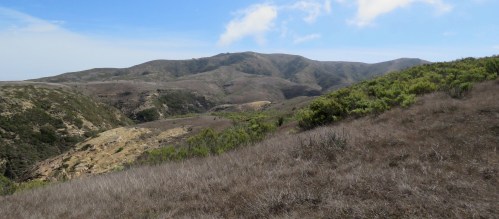
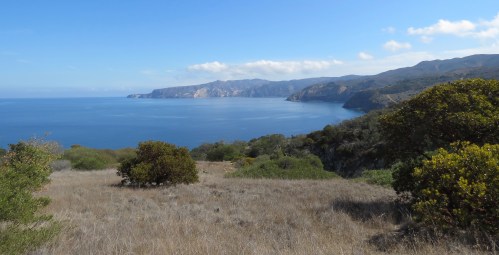
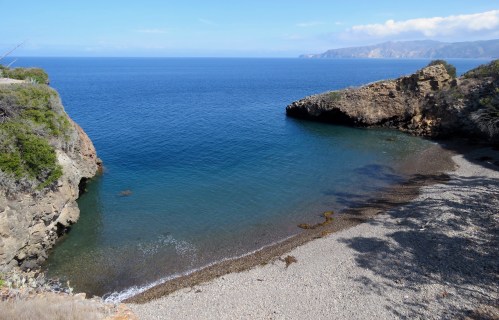
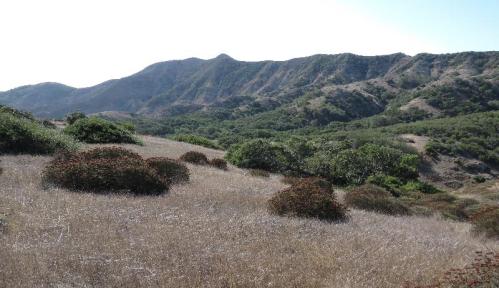
During the last ice age, the four islands off our coast, Anacapa, Santa Cruz, Santa Rosa, and San Miguel, were all part of a single, larger island called Santarosae. This talk will highlight the hiking and backpacking opportunities on these four islands today, as well as describe an imagined traverse of the now submerged super island of Santarosae.

Join local author James Wapotich as he shares images and stories from hiking, backpacking, and camping on the four islands off our coast. James has hiked many of the trails on the islands and has visited all five islands within Channel Islands National Park. He is an experienced backpacker, trail guide, and author of the Santa Barbara News-Press hiking column, Trail Quest.

For more information call (805) 729-4250 or email jwapotich@yahoo.com

This talk is part of the ongoing Wilderness Hiking Speaker Series hosted by the Santa Barbara Public Library. The talks are the third Thursday of the month and feature topics related to hiking, backpacking, and our local natural history.

The next talk in the series is Thursday, March 21st, Ultralight Backpacking and Gear with Lite Hikers Rik Christensen and Paul Cronshaw.

Posted by: James Wapotich | January 26, 2019

5 Favorite hikes from 2018

I don’t normally do Top 10 lists, but felt inspired to name my five favorite hikes from 2018.

#5 Lion Canyon Trail [post Thomas Fire] – On Memorial Day, I hiked Lion Canyon Trail, behind Ojai in Rose Valley. The area was burned during the Thomas Fire and wasn’t reopened to public access until May 24. It was definitely a hot hike due to the lack of shade and time of year, but there was still water in the pools at East & West Fork Lion Falls to cool off in. 

While seeing the burn area and its impact, combined with the subsequent rains on the landscape was interesting, the real highlight of the hike was all the wildflowers, both fire-followers and the regular spring bloom all benefiting from the ash-enriched soil and lack of competition for sunlight and other resources. It was also cool to see all the bear tracks and other evidence of wildlife activity, including an in person encounter with a rattlesnake that had 11 rattles on its tail. See Trail Quest: East and West Fork Lion Falls.

East and West Fork Lion Canyon Falls trail hike backpacking Thomas Fire burn area regrowth Sespe Wilderness Ojai Los Padres National Forest

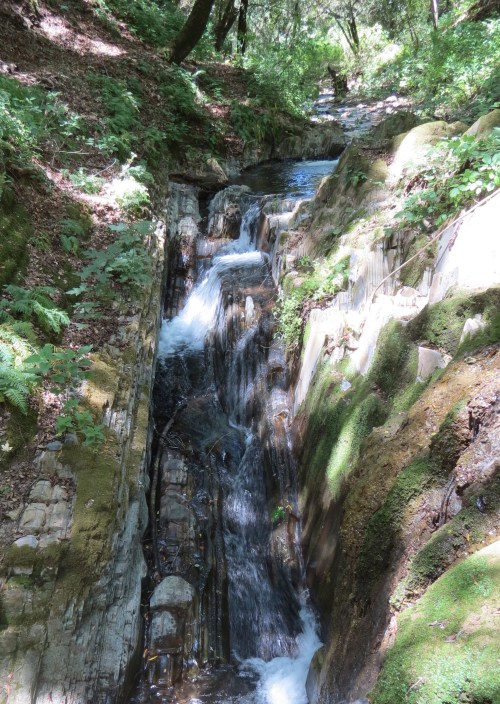
Lion Canyon

#4 Lopez Canyon Trail – Earlier in the year, with many of the trails in the Thomas Fire burn area still closed, I ventured north into San Luis Obispo County for two articles on the Santa Lucia Wilderness. In May, I made a loop hike visiting both Big and Little Falls for the first article, and then two weeks later, returned to hike Lopez Canyon Trail with my friend Casey for the second article.

Lopez Canyon is an amazingly lush canyon. Located just behind the mountains along the coast, it features a rich riparian corridor. The year round creek is lined with mostly dogwood, and growing along the canyon floor is lots of madrone, sycamore, willow, and maple. Higher up in the canyon, in addition to madrone, is sword fern and tanbark oak. And still higher up along the trail is Bishop pine.

In Santa Barbara County, dogwood, madrone, sword fern, tanbark oak, and bishop pine are all considered relic plants from a time when southern California was wetter and cooler and so it was great to see them all here as part of the landscape in San Luis Obispo Country.

In addition to all the great plants, the canyon features two trail camps and several picturesque cascades, and doesn’t seem to see that many visitors. See Trail Quest: Santa Lucia Wilderness, Part 2

Lopez Canyon Trail cascade Potrero Creek Santa Lucia Wilderness hike backpacking San Luis Obispo

Lopez Canyon Cascade near the confluence with Potrero Creek

#3 Fir Canyon – I never thought this would become one of my favorite hikes, but the first mile of Davy Brown Trail down from Figueroa Mountain Road is a rich, diverse world unto itself.

The canyon features a year round, intermittently flowing creek, lined with alder and maple, and shaded by big cone Douglas fir. In the autumn, the maple and alder leaves turn gold and orange adding to the scenery. The canyon also supports a rich array of wildlife, including bear, mountain lion, fox, and bobcat.

On one particular hike in the fall, after it had rained, I counted more than two dozen banana slugs along the trail, including a group of four at one of the creek crossings. It was also on that same visit that I first noticed dogwood growing in the canyon. During the Thomas Fire, we made a hike there to escape all the smoke in Santa Barbara, and found a dead band-tail pigeon along the trail that became part of the inspiration for an article I later wrote about my own reflections on the fire. See Trail Quest: Through smoke and fire.

This past year I’ve made close to a dozen hikes there for various reasons including a two-part article on Ranger Edgar Davison. Part 1 covers the hike through Fir Canyon, see Trail Quest: The Trails of Edgar Davison, Part 1, and Part 2 covers the trails through Munch and White Rock Canyons. Davison was one of the first forest rangers in our local mountains and built the trail down through Fir Canyon, along with several other nearby trails.

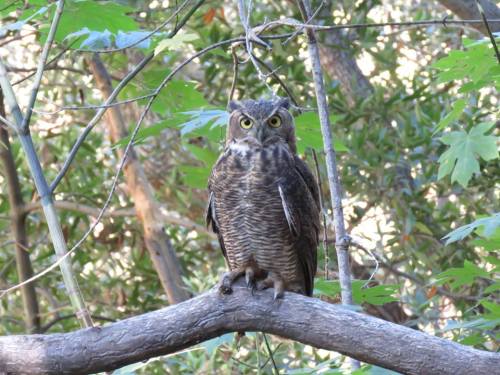
great horned owl fir canyon hike davy brown trail figueroa mountain los padres national forest

Great horned owl in Fir Canyon

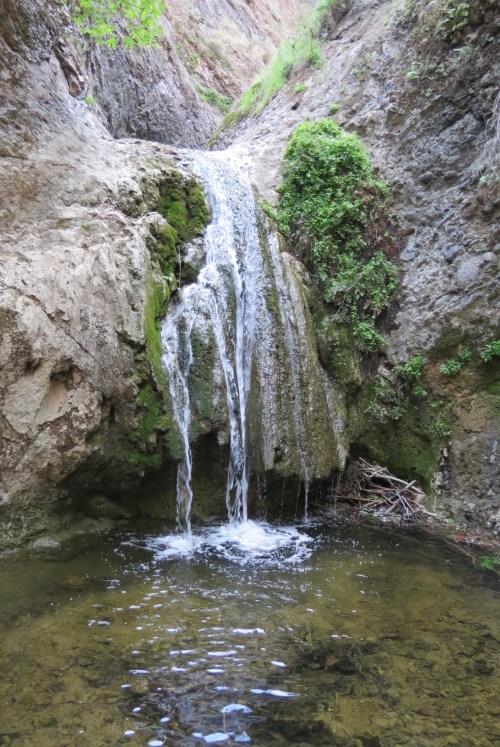
Cascade pool Fir Canyon Davy Brown Trail Los Padres National Forest

Cascade and pool along Davy Brown Creek

#2 Backcountry Beach Camping on Santa Rosa Island – In October, I did a 4-day solo trip on Santa Rosa Island as part of a series of articles on the islands. During the last Ice Age, the four islands off our coast, Anacapa, Santa Cruz, Santa Rosa, and San Miguel, were all part of one single, larger island called Santarosae. The series highlights the hiking and backpacking opportunities on the islands as part of an imagined traverse across Santarosae. 

What impressed me the most about this particular hike was all the subtle ways it reminded me of backpacking in the backcountry, but on the islands. I’ve backpacked on both Santa Rosa and Santa Cruz Islands before, but this time it had even more of that wilderness feel.

The first day I backpacked to Cow Canyon on the north shore, the second day I made a traverse across the island to La Jolla Vieja Canyon on the south shore, and the third day I backpacked from there to Water Canyon Campground. The second day was the toughest of the three and included a section following a largely non-existent trail and another section that was overgrown with wild grasses. Originally I was worried about hiking all day in the exposed sun, but instead mid-afternoon fog and wind had me soaked and leaning into the wind so as not to get knocked over. By the time I arrived at La Jolla Vieja Canyon it was after dark, and when I got there I discovered that elephants seals were hauled out on the beach where I’d intended to camp and had to improvise an alternative.

The combined experience of route finding, cross-country hiking, dealing with the elements, hiking in the dark, scrambling to find a place to camp, and hiking up different creeks to find water to filter was just a great adventure and reminiscent of the challenges of hiking in our local wilderness, all combined with the rich scenery of the islands. See Trail Quest: Black Mountain, Santa Rosa Island

Lobo Canyon Santa Rosa Island hike trail Channel Islands National Park

Lobo Canyon

#1 Birabent Canyon to Manzana Creek – The middle section of La Jolla Trail had been on my mind for some time and eventually grew into a great idea for a shuttle backpacking trip. In fact, I would count Birabent Canyon up there with Fir Canyon as one of my favorite places in the western San Rafael Mountains.

In 2012, I tried to find the middle section of La Jolla Trail between the canyon floor and the upper meadow, about a mile below the top of the mountains. I hiked the trail from both the bottom and the top, but couldn’t connect the two pieces and had to let it go at that. The trail was damaged in the 1993 Marre Fire and it seemed like the middle section was now lost to regrowth. See Trail Quest: The Search for the La Jolla Trail.

Then in 2016, on one of my subsequent visits, I noticed someone had worked a short segment of the first section coming up out of the canyon, which was enough to get me started. From there I was able to piece together and route-find the rest of the damaged trail and reach the upper meadow. See the description at the bottom of Trail Quest: Ballard Camp.

While I was out there I was struck by the inspiration to come back later and hike the trail as part of a backpacking trip. The idea was to follow the trail to the top of the mountains and then come down Zaca Springs Trail, which I hadn’t hiked since 2011; tie into Cedros Saddle Trail, a mile-long trail I’d yet to hike; and then take Sulphur Springs Trail and hike out along Manzana Creek.

In 2018, the idea solidified while I was reading Ranger Edgar Davison’s journal. In it he references what he called “Cascade Canyon”, a feature that isn’t shown on any map I could find. However, based on his description of it as “the narrow and precipitous outlet of two large canyons through the south wall of the Manzana” I was able to determine that it was likely just upstream from Coldwater Camp, and so with that last piece I felt called to head out and connect up these various destinations.

Curt Cragg proved to be the perfect partner in crime for the hike, not only was he interested in seeing the somewhat fabled middle section of La Jolla Trail, but as the founder of Santa Barbara County Outdoor Foundation he had also installed most of the trail signs in the Zaca Ridge/Zaca Lake area, including along Zaca Springs and Cedros Saddle Trails, and was curious to see how they were holding up.

In April, we hit the trail for the overnight trek that turned into a two-part article. See Trail Quest: La Jolla Trail to Manzana Creek, Part 1 for a description of the hike along La Jolla Trail, and Trail Quest: La Jolla Trail to Manzana Creek, Part 2 for Cascade Canyon and the hike along Manzana Creek.

La Jolla Springs Trail Birabent Canyon Zaca Ridge hike backpacking Los Padres National Forest

Curt hiking along the middle section of La Jolla Trail

waterfall cascade canyon San Rafael Wilderness Los Padres national forest Manzana Creek

Small waterfall in “Cascade Canyon”

Posted by: James Wapotich | January 25, 2019

Trail Quest: Ford Point, Santa Rosa Island

Backcountry beach camping on Santa Rosa Island is one of the rare treats afforded in Channel Islands National Park. While Santa Cruz Island is the largest island off the coast of Southern California, only one-quarter of it is open to the public. Coming in second at 83 square miles, Santa Rosa Island offers the most amount of land on any of the islands to explore.

Backcountry beach camping is not for everyone, there are no designated sites outside of Water Canyon Campground, no picnic tables or restrooms. Shade is limited and reliable water can only be found in nine canyons. No campfires are allowed, only cookstoves. Nevertheless, for experienced backpackers, backpacking on the island can be just as rewarding as backpacking in the local backcountry.

Camping is permitted on the beaches above the high tide line. From August 15 to September 15 the beaches between East and South Points along the south shore are open to dispersed camping, and from September 16 to December 31 all the beaches are open except those along the eastern shore between Carrington and East Points, and around Sandy Point. For a complete list of rules and regulations go to www.nps.gov/chis.

The closest beach for camping on the north shore is Cow Canyon, about 10 miles roundtrip; and the closest recommended beaches along the south shore are at San Augustin Canyon, Ford Point, and La Jolla Vieja Canyon, 16, 18, and 22, miles round trip respectively.

The easiest way to reach the island is through Island Packers, www.islandpackers.com, which offers boat rides to all five of the islands within Channel Islands National Park. Santa Rosa Island can also be reached by air through Channel Islands Aviation, www.flycia.com.

For my own traverse of the island, I hiked to Cow Canyon the first day, and then crossed over the island to the south shore via Black Mountain and Soledad Peak, camping the second night near La Jolla Vieja Canyon.

In the morning, I make my way up La Jolla Vieja Canyon to look for a suitable place to filter enough water for the day. The meandering canyon is lined with cattails but there are several pools with flowing water. As with Cow Canyon from the day before, recent rains have improved both the flow and flavor of the water. Intermittent year-round water can also be found in Lobo, Soledad, Arlington, Wreck, San Augustin, Old Ranch House, and Water Canyons.

From La Jolla Vieja Canyon, I day hike west along the south shore towards Johnson’s Lee, where a U.S. Air Force station was once located. The hike is about 4.5 miles roundtrip along an unpaved access road that follows the coast.

About a mile from La Jolla Vieja Canyon, a short side road leads down to Officer’s Beach; the beach is completely empty. However, as I continue over the next rise, I hear elephant seals. They are hauled out on the next beach over sunning themselves, napping, sparring, and everything else elephants seals enjoy doing when not swimming and hunting in the ocean.

The road then meets the only paved road on the island, and arrives where Santa Rosa Island Air Force Station P-15 was once located. In 1950, the Air Force leased land from Vail & Vickers Ranch. The Air Force built radar, receiving, and transmitting facilities on the highest point of the island. A base was built along the coast with more than a dozen different buildings. A paved road led from the landing pier to the base and up to the summit of Radar Mountain.

At one time there were more 300 personnel at the station. The base however proved too costly to maintain due to its island location. It was closed in 1963, and operations were relocated to a facility near Point Conception. The abandoned buildings and material left behind were utilized and repurposed by the ranch over the years. National Parks Service later utilized several remaining buildings. Today, just the auto maintenance building from the station remains.

From the maintenance building it’s less than a quarter of a mile down the road to where the landing pier was located.

Returning to La Jolla Vieja Canyon, I gather my gear. From here, the unpaved road continues eastward, moving away from the coast and wrapping its way into an unnamed canyon before working its way over to Wreck Canyon.

On a previous visit five years ago, the creek crossing in Wreck Canyon was the best source of water on the south shore I found close to Ford Point, now however it is choked with cattails. A good reminder to check with the rangers beforehand to learn about current conditions.

The road then climbs out of the canyon and arrives at the signed turnoff to Ford Point, about two miles from La Jolla Vieja Canyon.

The trail down to Ford Point follows an old jeep road. Near the point, the views extend east out along the coast towards East Point and western Santa Cruz Island. From here, a single-track trail turns inland, before following a small ravine down to the beach.

The long, pristine beach at Ford Point is broken into two halves by a large rock outcropping; a route along the bluff connects the two segments. Both sections can sometimes have places to camp above the high tide line.

From the easternmost beach, an off-trail route continues up along the bluff, tracing the top of essentially a giant sand dune and leading over towards San Augustin Canyon.

As the trail arrives overlooking what could be called San Augustin Point, the trail branches. The trail to the right leads down to the cobblestone beach, where there can sometimes be a level place to camp above the high tide line.

The trail to the right, continues along the western side of San Augustin Canyon, passing through grassy hillsides dotted with lupine, black sage, coastal sagebrush, and coyote brush.

The trail then crosses the creek. Just downstream from the crossing is a trickle of water flowing into a sandstone pool.

From the crossing, the trail becomes more serious about climbing out of the canyon, tracing now the eastern side of the canyon and making its way along the ridge that separates San Augustin from the next canyon over.

The ridgeline then levels out briefly, passing the wreck of a small airplane. According to Islapedia.com, the plane was flown by two hunters intent on poaching non-native elk found on the island at the time. Their plane crashed as they tried to land and they hiked out to the main ranch building claiming engine failure. When they returned to recover the plane, they discovered that cattle from the ranch had eaten the fabric covering much of the plane’s frame, leaving it unusable.

The trail then makes the final push up the ridge, veering west around what could be described as San Augustin Peak, and arriving at San Pablo Road. Here, the views open up to the north across the channel towards the Santa Ynez and San Rafael Mountains.

Essentially a single-track trail, San Pablo Road traces the top of the summits overlooking the south shore. About a mile from the top of San Augustin Trail, the road arrives at a large cement trough fed with water from Clapp Spring. Water from the spring but must be filtered.

From here, it’s less than a mile to Wreck Road, which leads toward Water Canyon Campground. The road traces the edge of Water Canyon and as it reaches the coast offers views out across Bechers Bay towards Santa Cruz Island.

Wreck Road arrives at the coast just south of Water Canyon and joins Coastal Road. To reach the campground turn left; Coastal Road crosses Water Canyon Cree and then meets the side road that leads up to the campground.

The campground has 15 sites available through Recreation.gov. Each site has a two-sided, covered windbreak, a picnic table, and a metal food storage box to keep items safe from inquisitive foxes, mice, and ravens. The campground features potable water and restrooms, and can make a nice base camp for exploring the island. The campground is about 1.5 miles from the landing pier.

A satisfying day hike from the campground is to visit the Torrey pines, about 4.5 miles roundtrip. To reach the grove, follow Coastal Road south towards Skunk Point, and look for Torrey Pines Trail on your right, which leads up into the grove.

During the last ice age when the climate was cooler and wetter, Torrey pines could be found along coast of California. Today, they are the rarest pines in the United States, found in just two locations, near San Diego at Torrey Pine State Natural Reserve and here on Santa Rosa Island, where island fog helps keeps temperatures cooler and provides additional moisture for the trees.

The grove also provides a chance to sit back in the shade and experience the timelessness of the islands. To hear the sound of the wind through the trees and watch birds flit amongst the branches, framed by views of western Santa Cruz Island.

This article originally appeared in section A of the January 21st, 2019 edition of Santa Barbara News-Press. The next article will cover the hike out to Point Bennett on San Miguel Island.

Ford Point San Augustin Canyon Backcountry beach camping hiking backpacking Santa Rosa Island Channel Islands National Park

Ford Point

Torrey pines grove hike Santa Rosa Island Channel Island National Park rarest pine relic plant

Torrey Pines

Bechers Bay Water Canyon Beach hike Santa Rosa Island Channel Islands National Park

The beach near the mouth of Water Canyon

Posted by: James Wapotich | January 25, 2019

Trail Quest: Black Mountain, Santa Rosa Island

It was after dark when the trail finally arrived at the coast, near the mouth of La Jolla Vieja Canyon. As I near the beach, I can hear the sound of elephants seals, and suddenly realize they are hauled out near where I’d planned to sleep. No worry, I would simply cross to the other side of the creek and camp there. However, on the other side my headlamp catches the glowing eyes of more elephant seals, who are just quietly resting there.

Rather than trekking in the dark to another beach, I find a small patch a safe distance from both groups, careful to make sure there is no evidence of elephant seals using the spot. With the wind now nearly constant and blowing uncharacteristically from the east, I gather four large boulders and put them inside my tent, placing one in each corner and settle in for the night, it had been a long day.

On previous visits to Santa Rosa Island I had backpacked to Ford Point on the south shore and day hiked to Lobo and Cow Canyons on the north shore, but was curious what it would be like to traverse the island north to south and visit its highest peak, Radar Mountain.

Originally I had thought of following Smith Highway arcing over to Soledad Road. However, in talking with one of the rangers prior to my trip, I learned of an old jeep road that traces the ridgeline between Lobo and Cow Canyons and leads to the top of Black Mountain. From there it was a simple matter to tie into Soledad Road. This alternate route would save me a welcome mile and a half, and have the added bonus of visiting the cloud forest on Black Mountain.

Backcountry beach camping on Santa Rosa Island is available to experienced, well-conditioned backpackers during the later part of the year, and provides a unique way to explore the island. For a complete list of all the rules and regulations, seasonal closures, and other helpful information go to www.nps.gov/chis.

After spending my first night camped at Cow Canyon, I retrace my route through Lobo Canyon back up to Smith Highway. With no water and little shade along my intended route, I’ve loaded up on water in Cow Canyon, carrying enough for the entire 14.5-mile day.

Continuing west along Smith Highway, I soon pass on the uphill side something that looks vaguely like an old jeep road before arriving at a more evident track coming up along the ridgeline from the coast. I double back to the faint track I saw. The route is not as obvious as I’d hoped, but as I continue I find pieces of the old jeep road, which starts to become more evident as it climbs up the ridgeline between Lobo and Cow Canyons. As I continue, it becomes apparent that the foxes are the ones that use the trail the most and are keeping it alive. In the distance I can see the forested summit of Black Mountain.

The route then rounds the top of Lobo Canyon, joining the ridgeline that defines the backbone of the island. Here, the old jeep road turns east and continues along the top of the ridge towards Black Mountain.

As I continue, I pass the small forest of island oaks that draw part of their water from the fog and hug the north side of the ridge.

From the top of Black Mountain, the views extend out across Cherry Canyon, Bechers Bay, and Skunk Point towards Santa Cruz Island.

During the last ice age, roughly 20,000 years ago, the sea level was 300-400 feet lower. The four islands of our coast, Anacapa, Santa Cruz, Santa Rosa, and San Miguel were all part of a single, larger island called Santarosae. As the sea level began to rise, it covered the lower portions of Santarosae. Around 10,500 years ago Anacapa Island became separate, followed by Santa Cruz Island roughly 1,000 years later, with Santa Rosa and San Miguel Islands separating several hundred years after that.

From Black Mountain, a half-mile trail leads down to Soledad Road. Black Mountain can also be reached from the landing pier or Water Canyon Campground as part of an eight-mile roundtrip day hike following an old jeep road, referred to as Telephone Road.

Continuing west along Soledad Road, about a mile and a half further, the remnants of an old army camp can be seen from the road in the canyon below. A side road leads down to the site, with the most distinctive feature being a large cement star where the flagpole was located. The camp was built in 1943, and turned over to the ranching operation after the war.

About a mile later, Soledad Road arrives at the signed turnoff for Quinn Knobs Trail. The trail does not appear on the National Geographic Trails Illustrated Map of Channel Islands National Park, but is a useful connector trail. The 1.25-mile trail follows a ridgeline and leads over to Wreck Road, providing an alternate, shorter way to reach the south shore.

As I continue along Soledad Road towards Soledad Peak it starts to fog up along the top of the island and a steady wind starts to blow, until I eventually have to start leaning slightly into the wind to offset its force. My concerns of hiking most of the day in exposed sunlight and not having enough water are starting to fade.


Soledad Road then intersects Signal Road; just west of the intersection is Soledad Peak, 1,574 feet of elevation. From there the road continues another half-mile before arriving at a surprisingly paved road. The road connects from Johnsons Lee, where there used to be an Air Force base to the top of Radar Mountain, the highest point on the island, at 1,589 feet.

Both Soledad Peak and Radar Mountain overlook Arlington Canyon, where in 1959, the oldest human remains found so far in North America were discovered. The remains date back 13,000 years. At that time, Santarosae was still a single island, and roughly four to five miles from the mainland at its closet point.

Santarosae was most likely reached with a boat made from tule reeds. Tule is readily available on the mainland, and such a boat is relatively easy to make in as little as three days. Tule can also be found on the islands.

The Chumash would harvest tule, allow it to partially dry, and then tie the material together into cigar-shaped bundles with a willow pole in the middle to help strengthen the boat’s structure. Several bundles were tied together, with the largest one serving as the bottom of the 10-15 foot canoe. The boat was then coated with melted asphaltum to make it more water resistant. While these boats were more commonly used in estuaries and nearshore along the coast, given calm conditions in the channel they could be used to cross to the islands. Tule boats could carry two to three people or a total of several hundred pounds.

The Chumash also made dugout canoes, which were used primarily in estuaries and were not seaworthy enough to cross the channel.

Around 500 A.D., the Chumash began developing wooden plank canoes or tomols. The tomol was a dramatic improvement over both the tule boat and dugout.

Tomols were primarily made from redwood driftwood that had washed ashore along the coast and on the islands.

Using nothing more than tools made from chert, bones, and large clam shells, the Chumash were able to hew and shape the redwood planks and drill holes in them. The planks were then sewn together with string made from red milkweed. In between the planks, the pithy core of tule was used for caulk. A mixture of melted asphaltum and pine pitch was then used to seal the seams, drill holes, and lashings. The entire project would take from two to six months.

Tomols ranged in size from 12 to 24 feet in length, and could carry up to 20 people or 4,000 pounds in cargo. The tomol not only facilitated increased trade amongst the Chumash, but helped deepen social connections by making travel between the islands and mainland, and along the coast easier.

From Radar Mountain, I follow the paved road down to the turnoff to the trail that traces the ridgeline between La Jolla Vieja Canyon and the coast. The trail is essentially an overgrown jeep road, and I was fortunate to have day-hiked the route during the daytime on a previous trip, especially now that I was hiking it in the dark through a thick, wet fog.

The trail ends at the ranch road along the south shore, arriving just west of La Vieja Canyon, where I make camp for the night, a safe distance from the elephants seals.

In the morning, after breakfast, I filter water from La Jolla Vieja Canyon, and then day hike west along the south shore to Johnsons Lee, before backpacking out via Ford Point and San Augustine Canyon, and camping the last night in Water Canyon Campground.

This article originally appeared in section A of the January 7th, 2019 edition of Santa Barbara News-Press

Off-trail route between Lobo and Cow Canyons Black Mountain hiking backpacking Santa Rosa Island Channel Islands National Park

Black Mountain is seen from the off-trail route between Lobo and Cow Canyons

Posted by: James Wapotich | December 28, 2018

Trail Quest: Cow Canyon, Santa Rosa Island

Lobo Canyon Santa Rosa Island hike trail Channel Islands National Park

Lobo Canyon

Santa Rosa is the second largest of the four islands off our coast. The island covers 83 square miles, and unlike Santa Cruz Island, is entirely within Channel Island National Park, providing the largest area overall within the park to explore.

In addition to the campground in Water Canyon, Santa Rosa Island also offers backcountry beach camping. From August 15 to September 15, the beaches along the south shore between East Point and South Point are open to dispersed camping. From September 16 to December 31, all beaches are open except those along the eastern shore between Carrington Point and East Point, Lobo Canyon, and around Sandy Point.

Backcountry beach camping is not for everyone, there are no designated campsites, no restrooms or picnic tables, and no campfires allowed on the island, only portable cook stoves. There is little shade on the island and reliable water is found in only nine of the creeks; conditions along the coast can also be windy.

Camping is permitted on the beach above the high tide line, and so it’s important to check the tides before going, as well as check in the with the rangers beforehand to learn about current conditions.

Reservations are required and available through Recreation.gov. Backpackers will also need to familiarize themselves with the rules and regulations regarding backcountry beach camping, which can be found at, www.nps.gov/chis, along with other information about the islands. A helpful map to carry is National Geographic’s Trails Illustrated map of Channel Islands National Park.

In spite of the challenges, experienced backpackers in good shape often find the rewards of exploring the island’s remote beaches and traversing its expansive landscape worth the effort.

The nearest destination for backpacking on the north shore is Cow Canyon, which is about five miles from the landing pier. The route leads through scenic Lobo Canyon.

The easiest way to reach the island is through Islands Packers, www.islandpackers.com , which offers trips to all five of the islands within the national park. The boat ride is about 2.5 hours.

From the landing pier, continue to the top of the access road, and take the road immediately on the right. The unpaved ranch road leads past some of the old ranch buildings and the research station, arriving at the signed beginning of Smith Highway.

From here, Smith Highway crosses Windmill Creek, before than climbing away from the coast passing through mostly non-native grassland dotted with coyote brush, lemonade berry, and patches of island poppy. As the road continues it offers views back towards the landing pier, Bechers Bay, and out towards western Santa Cruz Island.

At the 1.25-mile mark, the trail arrives at the turnoff to Carrington Point. The hike out to the point and back is about six miles roundtrip. The trail follows a ranch road for the first three-quarters of a mile where it meets another ranch road that leads back down towards the landing pier.

From this intersection, the road out to the point passes through a gate, becoming more of a single-track trail. As it continues the diversity of plants increases; along the route are lupine, goldenbush, island poppy, morning glory, and the rare, endangered island paintbrush.

The trail ends overlooking the point. From here, an off-trail route leads steeply down to the ocean.

In 1994, a nearly complete pygmy mammoth skeleton was found in an ancient dune near Carrington Point. During the last ice age, when the sea level was 300-400 feet lower, the four islands off our coast were part of a larger, single island called Santarosae. This super island covered roughly four times the land area of the islands today.

20,000 years ago the climate of southern California was cooler and wetter and the islands were more forested. It’s believed that Columbian mammoths on the mainland were drawn to Santarosae by the smell of vegetation.

Excellent swimmers, mammoths with their buoyant mass and snorkel-like trunk, could easily cross the four to five-mile distance from the mainland to Santarosae. Modern elephants, descendants of mammoths, have been known to swim as much as 23 miles across open water.

Once on the island, as their numbers increased and resources grew more scarce, natural selection favored smaller-sized mammoths that required less food and water. The lack of mainland predators, unable to make the swim, also made being large less advantageous. In comparison to their fore-bearers, pygmy mammoths shrank over time from 14 feet tall to 6 feet tall, and from 20,000 pounds down to 2,000 pounds.

It’s still not clear why pygmy mammoths went extinct, but their die off coincides with the mass extinction of much of North America’s megafauna, including the saber-toothed tiger, horse, sloth, and short-faced bear, along with the mammoth and mastodon on the mainland.

The oldest human remains on the islands date back to 13,000 years ago at Arlington Springs on Santa Rosa Island and roughly coincides with youngest mammoth remains; however, there is currently no direct evidence that humans hunted mammoths on the islands.

Pygmy mammoths remains have been found on Santa Rosa, San Miguel, and western Santa Cruz Islands.

Other animals that once lived on the islands include flightless ducks, a species of puffin, ornate shrews, and giant island deer mice.

Today, aside from a handful of horses from the ranching era allowed to roam free, the land mammals still living on the island are Santa Rosa Island fox, spotted skunk, and deer mouse.

From the turnoff to Carrington Point, Smith Highway continues west another 1.75 miles towards Lobo Canyon. The transition at the edge of the canyon is striking, 150 years of ranching history has reduced much of the island to non-native grassland dotted with chaparral plants, but here, in Lobo Canyon is a glimpse of what more of the island used to look like.

The road descends into the canyon arriving at the signed beginning of the trail down to the ocean. Across the road, under the oaks, are two picnic tables.

A number of the plants found in Lobo Canyon and on the island were used by the Chumash. Near the picnic tables are several elderberry bushes. Wood from elderberry can be used to make flutes and clapper sticks, as well as hand drills and hearth boards for making fire by friction.

As the trail continues down the canyon, it passes through toyon, island oak, and coast live oak. Berries from toyon can be toasted on a hot rock or dried in the sun, and later eaten. Wood from toyon can be used to make a variety of tools, including arrows, harpoons, and digging sticks.

Acorns from the oaks, can be shelled, with the inner kernel ground up and leached to remove the bitter tannin. The acorn meal can be made into a mush that was a staple of the Chumash, who would mix in seeds and berries to enhance the flavor.

Fruit from coastal prickly pear can be eaten and its red juice used as a paint pigment.

Flowing through the canyon is an intermittent year-round creek, one of nine on the island. The other canyons with fairly reliable water are Cow, Soledad, Arlington, La Jolla Vieja, Wreck, San Augustin, Old Ranch House, and Water Canyons.

The creek in Lobo Canyon supports a number of riparian plants including cattail, horsetail, willow, and cottonwood; and in contrast to other parts of the island feels almost forested. Other plants growing in the canyon include wild blackberry, poison oak, and mugwort, as well as, island buckwheat, giant coreopsis, and dudleya.

The canyon itself is carved from tuffaceous sandstone and siltstone, and the wind and water-sculptured rocks add to the sense of being in another world.

The trail then arrives at the mouth of the canyon and a scenic pocket beach. From here, continue west along the bluffs another half-mile to reach Cow Canyon.

Where Cow Canyon meets the ocean it flows over the bluff forming a small waterfall and pocket beach. The beach can be accessed from the western side. If the route down to the beach is unsafe then camping in an open area above the beach is an option.

Water can be found in the creek, and on my visit, recent rain helped improve both the flow and flavor of the water. A fairy reliable sandstone pool of water can be found in the main canyon about a quarter of a mile up the canyon, just past the confluence with a side creek. Water from the island should be filtered.

An alternate route from Cow Canyon back to Smith Highway is to follow the ridgeline between Cow and Lobo Canyons. An old jeep route at one time followed the ridgeline all the way to the top of Black Mountain.

This article originally appeared in section A of the December 24th, 2018 edition of Santa Barbara News-Press
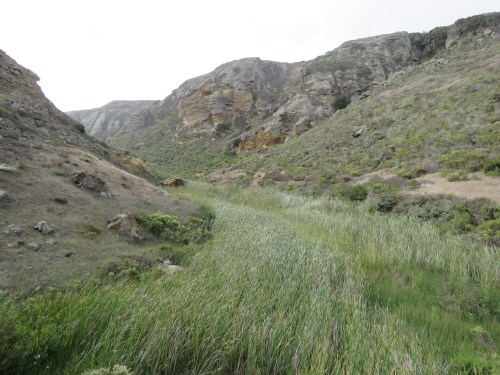
Lobo Canyon trail hike Santa Rosa Island Channel Islands National Park
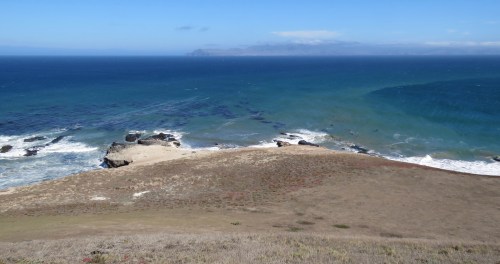
Lobo Canyon

Carrington Point trail hike Santa Rosa Island Channel Islands National Park

Carrington Point

Posted by: James Wapotich | December 13, 2018

Trail Quest: Pelican Bay, Santa Cruz Island

Pelican Bay Trail Western Santa Cruz Island hiking Nature Conservancy

Scenery along the trail to Pelican Bay

During the last ice age, southern California was wetter and cooler, with a climate more akin to what northern California is like today. The Channel Islands were more forested and featured a diverse understory. As the climate became warmer, oaks and chaparral became more dominant, however relict plants from those cooler and wetter times can still be found on the islands.

The hike to Pelican Bay on western Santa Cruz Island leads through one of the more forested areas on the island and includes some of these relict plants. The route traces the island’s northern coast and also offers a chance to see both the Santa Cruz Island fox and island scrub jay.

The docent led hike starts from Prisoners Harbor and is about 4.5 miles roundtrip. The hike can be done during a day trip to the island, or included as part of a backpacking trip to Del Norte Camp. No water is available on this part of the island, and so visitors must bring what they’ll need.

The easiest way to reach the island is through Island Packers, www.islandpackers.com, which offers boat rides to all five of the islands within Channel Islands National Park. The boat ride is about an hour and a half, and typically stops at Scorpion Anchorage before continuing west to Prisoners Harbor.

The eastern quarter of Santa Cruz Island is part of Channel Islands National Park and is open to the public. The western three-quarters of the island is owned by The Nature Conservancy.

Pelican Bay, which is west of Prisoners Harbor, is on Nature Conservancy land. Island Packers through an agreement with The Nature Conservancy is able to offer hikes to Pelican Bay, provided an Island Packers docent accompanies the visitors. The docents are knowledgable about the island and accommodating to the interests and pace of the group, and visitors can turn back at anytime.

From the landing pier, the hike follows the unpaved access road that leads past the estuary of Cañada del Puerto and the Magazine or warehouse used during the ranching era, before then branching. The road to the left leads out towards the eastern part of the island, while the road to the right quickly arrives at a gate leading into The Nature Conservancy’s land. Just before the gate is the beginning of the single-track trail to Pelican Bay.

From here, the trail makes its way up to the bluff overlooking the harbor, and then continues west, tracing the coastline. The trail traverses no less than five separate side canyons and offers a variety of scenery at each turn in the landscape.

The trail passes through a mix of chaparral and coast live oak, including familiar backcountry plants such as toyon, manzanita, chamise, and lemonade berry, with giant coreopsis mixed in.

The diversity of plants and trees also provides cover and habitat for a variety of animals including the Santa Cruz Island fox.

Descended from grey foxes, it’s believed the foxes were either swept out to sea during different storms and rafted to the northern Channel Islands on debris, or were brought there by the Chumash. Archeological evidence suggests the Chumash later brought the foxes with them to the southern Channel Islands to trade with the Tongva, their neighbors to the south.

Today, the island fox can be found on Santa Cruz, Santa Rosa, San Miguel, Santa Catalina, San Nicholas, and San Clemente Islands, with each island population representing its own subspecies.

With less available space and resources, the island foxes became smaller, about the size of a house cat; and without mainland predators competing with or preying on them, the fox became the top predator on the islands.

This continued until the late 1990s, when their population saw an alarming decline, precipitated by an unfortunate set of circumstances.

By the early 1960s, bald eagles had disappeared from the islands due to reproductive failure similar to the California brown pelican. DDT pollution in the water and their food chain, caused thinning of the birds eggshells, which lead to the eggs being crushed during incubation.

The absence of bald eagles, which are highly territorial and eat mostly fish, allowed golden eagles from the mainland to venture out to the islands more freely.

What the golden eagles discovered was a rich food source created by the ranching era. As early as the 1850s, feral pigs began roaming Santa Cruz Island. With an abundant amount of piglets to dine on, golden eagles began nesting and breeding on the islands.

Unfortunately for the island fox, they are about the same size as piglets and just as edible. With less cover on the islands from years of grazing, and having forgotten what it’s like to be the prey, the foxes became an easy target and their population declined by more than 95 percent.

In 1999, with roughly 100 foxes left on the northern islands, a captive breeding program was started. The next year, a similar program was started on Santa Catalina Island, which lost 90 percent of its fox population to canine distemper, introduced to the island by a stowaway raccoon.

In 2004, four of the six subspecies of foxes were listed as endangered; not listed were the foxes on San Nicholas and San Clemente Islands.

To support the foxes’ recovery on the northern islands, from 2002-2006, 44 golden eagles were captured and relocated to the eastern Sierra Nevada, while 61 bald eagles were reintroduced to Santa Cruz Island. From 2005-2006, over 5,000 feral pigs were eradicated on Santa Cruz Island.

Captive breeding was phased out in 2007. In 2016, the foxes on the northern islands were delisted, with a total population of over 4,000 foxes, marking one of the fastest recoveries of an endangered species.

At about the one-mile mark, the trail arrives at a large canyon where a stand of Santa Cruz Island ironwood trees can be found. Part of the rose family, ironwood with its fernlike leaves and tiny white flowers, once covered a much wider range.

23 million years ago, ironwood could be found along the Pacific Coast up to what is now Oregon and inland as far as western Nevada, until about six million years ago when the climate became drier overall and ironwood became extinct on the mainland. Around this same time, roughly 7-4 million years ago, the modern California current became established. The current is one of the main drivers of our Mediterranean climate, which is marked by predominantly dry summers.

Today, ironwood is found just on the Channel Islands, in the cooler, north-facing slopes and canyons of Santa Cruz, Santa Rosa, Santa Catalina, and San Clemente Islands.

Island Bishop pine is another relict plant found on the island. During previous ice ages, when California was wetter and cooler, Bishop pines likely covered a wider area along the coast, but are now found in only a handful of locations.

Another rare species on Santa Cruz Island, is the Island scrub jay, which is found nowhere else in the world. The jay is descended from the scrub jay found on the mainland, but with fewer competitors on the island has grown to be a third larger than its mainland counterpart, as well as brighter in color.

Fossil remains of the bird have been found on both Santa Rosa and San Miguel Islands, suggesting that it was present during the last ice age when the four northern islands were connected together; and likely died out on those islands as the ensuing warmer and drier conditions reduced the amount of available woodland habitat.

The trail then rounds a corner in the landscape and Pelican Bay comes into view. As the trail makes its way towards the bay, it passes through one last canyon. At the mouth of the canyon is Tinker’s Cove, which features a small cobblestone beach. The cove was named after Tinker Bell, when Peter Pan was filmed there during the silent movie era.

From here, the trail clambers over one last rise dotted with non-native century plants, and arrives at Pelican Bay. The curved bay is a popular boating destination and makes for a satisfying turnaround point for the hike.

Private boaters can anchor off western Santa Cruz Island, and with a landing permit from The Nature Conservancy come ashore during the day and explore the beaches and coastal canyons. No camping is allowed. An annual permit is $70 and a 30-day permit is $30. Proceeds support the work of The Nature Conservancy, for more information go to www.nature.org.

Island Packers, through an arrangement with The Nature Conservancy, occasionally offers day trips to a handful of other destinations on western Santa Cruz Island, including Cueva Valdez on the north shore and Willows Anchorage on the south shore.

Their trips to the outer islands of Santa Rosa and San Miguel generally follow the south shore of Santa Cruz Island on the ride out and the north shore of the island on the ride back, which when combined is almost like circumnavigating the island. The ride along the north shore, often includes a visit to Painted Cave, which is one of the largest sea caves in the world.

Article originally appeared in section A of the December 10th, 2018 edition of Santa Barbara News-Press

Tinker's Cove Pelican Bay hike trail western Santa Cruz Island Nature Conservancy

Tinker’s Cove

Island scrub jay Santa Cruz island

Island scrub jay

Posted by: James Wapotich | November 19, 2018

Trail Quest: Del Norte Camp, Santa Cruz Island

Eastern Santa Cruz Island Red Mountain Diablo Peak hiking backpacking Channel Islands national park

Looking west, Red Mountain and Diablo Peak are seen in the distance from the trail

During the last ice age, when the sea level was 300-400 feet lower, the four islands off our coast – Anacapa, Santa Cruz, Santa Rosa, and San Miguel, were all part of a single, larger island called Santarosae. 20,000 years ago, this super island covered 790 square miles and at its closest point was just four to five miles from the mainland.

Southern California was also wetter and cooler with a climate more akin to Northern California today, with the islands more forested than they are now.

It would’ve been interesting to visit this relatively massive island off our coast, and traverse it to east to west, starting from its closest point to the mainland, east of modern Anacapa Island, to its other end, west of modern San Miguel Island.

However, it is still possible to visit all four of the islands today, and traverse the portions of Santarosae that remain above the water, which together cover roughly 195 square miles, about a fourth of the size of Santarosae.

Santa Cruz Island is the largest of these islands, accounting for almost half of that area, covering 96 square miles. The western three-quarters of the island is owned and managed by The Nature Conservancy, while the eastern quarter is part of Channel Islands National Park and is open to the public.

A traverse of eastern Santa Cruz Island can be made as part of a 15-mile backpacking trip.

The more common approach is to start from Prisoners Harbor and hike to Scorpion Anchorage, camping at Del Norte Camp the first night and Scorpion Campground the second night as part of a three-day trip. However, in the spirit of an east to west traverse, I decided to hike it in reverse.

The easiest way to reach the island is through Island Packers, www.Islandpackers.com, which offers boats rides to all four of the islands, as well as Santa Barbara Island, which together comprise Channel Islands National Park.

From the landing pier, I follow the unpaved access road that leads past the Visitor Center and historic ranch buildings to Scorpion Campground for the first night. The campground has 25 campsites, each with a picnic table and food storage box; reservations are made through Recreation.gov. No fires are allowed on the island, only cook stoves.

The campground, which is broken into an upper and lower section, each with a restroom, has two particularly compelling features, eucalyptus trees, which provide much needed shade, and potable water.

There is no easy to locate, drinkable water on eastern Santa Cruz Island for backpacking and so all water for the trip needs to be carried. Hiking west to east has the benefit of only needing enough water to make it to Scorpion Campground. Hiking east to west, means carrying enough water for the entire trip. To overcome this, I persuaded my girlfriend to meet me at Prisoners Harbor on the last day with extra water and join me for a day hike to Pelican Bay.

After a leisurely first day exploring the nearby trails, I get an early start for the full day of hiking that awaits me. I make my way to the upper end of Scorpion Campground, and continue along Scorpion Canyon Trail. The trail follows an old ranch road up the canyon for another quarter of a mile before climbing out of the canyon.

At about the two-mile mark, the trail arrives at the beginning of Montañon Trail, which leads to the top of Montañon Ridge. I am already feeling the heat of the day as there is little shade along the hike.

Montañon Trail follows the ridgeline between Scorpion and Smugglers Canyons, and offers some great views of Montañon Ridge. In the canyons and on the northeast face of the ridge I can see a mix of trees and chaparral, remnants of what the island looked like before the ranching era, which brought with it more than 100 years of grazing activity.

At about the 3.5-mile mark, the trail crests the ridge, offering views across the western part of the island towards Mount Diablo, the highest point on the island. To the east, the views extend towards Anacapa Island. From this vantage, I can easily imagine that a traverse across Santarosae might’ve either followed the now inundated lowlands or the ridgeline connecting the highest summits.

Anacapa Island was the first to separate from Santarosae between 10,900 and 10,300 years ago, while the other three islands remained connected together. Today, the sea between Anacapa and Santa Cruz Islands is just 4.5 miles across, with its deepest point roughly 180 feet.

From Montañon Ridge, a side hike of 1.5 miles roundtrip can be made to Montañon Peak, the highest point on eastern Santa Cruz Island. At the turnoff, Montañon Trail continues down the backside of the ridge.

Between 1991 and 1996, various portions of Santa Cruz Island east of Montañon Ridge became part of Channel Islands National Park. In 2000, the Nature Conservancy generously donated the land west of Montañon Ridge out to Prisoners Harbor, referred to as the Isthmus, for inclusion in the national park.

Continuing west, the trail levels out and arrives at the beginning of East End Road. The unpaved access road follows the main ridgeline west along the isthmus. The road passes through several stands of Bishop pines mixed with manzanita, scrub oak, and chamise, and offers views of the ocean both to the north and south.

At about the eight-mile mark, the trail arrives at the intersection with Navy Road, which continues along the ridgeline. From here, East End Road descends down the north side of the ridge passing through coastal sage scrub. The road ends at the beginning of Del Norte Trail, which leads to Del Norte Camp.

At this intersection is also the beginning of the trail that leads down to Chinese Harbor. The hike to Chinese Harbor is about 3.5 miles round trip and involves a fair amount of uphill on the hike back out. The harbor was named for the Chinese fishing industry that flourished on the islands during the later half of the 19th century. The harbor features a long cobblestone beach.

Continuing along Del Norte Trail, the trail traverses a long coastal bluff, crossing down through several side canyons, before rounding a corner in the landscape at which point Mount Diablo returns into view.

The trail then arrives at the signed turnoff for Del Norte Camp; from here, it’s a short distance to the campground. Del Norte Camp features fours sites, each with a picnic table and food storage box, as well as sand pads for tents. Two of the sites are shaded by island oaks, while the other two are more exposed and offer views out towards Prisoners Harbor and Red Mountain. Just up the road is the outhouse.

From Del Norte Camp it’s roughly four miles to Prisoners Harbor. Del Norte Trail continues west and narrows to essentially a single-track trail. The trail wraps its way down into Cañada del Muro, which features coastal sage scrub mixed with island oak and toyon, as well as willow in the creek corridor.

The trail then climbs out of the canyon and wraps over the next little ridge and descends down into Cañada del Agua. True to its name, the creek does a have a trickle of water in its rust-stained watercourse, however it is not recommended for drinking. Here, too the creek is lined with willow.

The trail then climbs out of Cañada del Agua, and continues west arriving at a picnic table along the trail, likely intended for day hikers. However, from the table, the views east include Montañon Ridge, providing a perspective on the ground covered so far, or yet to be covered depending on one’s direction of travel.

Del Norte Trail then arrives at Navy Road, and continues towards Prisoners Harbor. The road passes through Eagle Canyon and rounds a corner at which point Prisoners Harbor comes into view.

The harbor is near the mouth of Cañada del Puerto, which is one of the larger creek drainages on the island. In the canyon are coast live oak, and along the creek are willow, mule fat, and other riparian plants.

Across the creek, continuing towards the landing pier, a short side trail leads to a shaded bench tucked in under the willows. Past the side trail, the road arrives at the magazine or warehouse building used as part of the former ranching operations. Next to the building are restrooms, but no potable water.

With the distance from Del Norte Camp to Prisoners Harbor just four miles, and the timing of the arrival and departure of the Island Packers boat, it is relatively easy to include the docent led hike that leads west to Pelican Bay as part of the three-day backpacking trip.

This article originally appeared in section A of the November 19th, 2018 edition of Santa Barbara News-Press

Posted by: James Wapotich | November 5, 2018

Trail Quest: Montañon Peak, Santa Cruz Island

Montañon Ridge Peak hike eastern Santa Cruz Island trail Channel Islands National Park

Montañon Ridge is seen from the trail

Santa Cruz Island is the largest of the four islands seen right off our coast. The island covers 96 square miles, and contains the highest point on the islands, Mount Diablo which rises 2,450 feet above the sea.

The western three-quarters of Santa Cruz Island is managed by Nature Conservancy, and the eastern quarter is managed by National Parks Service as part of Channel Islands National Park, which is open to the public.

Montañon Peak, at 1,808’, is the highest point on eastern Santa Cruz Island and offers exceptional views of the island, as well as out towards Anacapa Island. The hike to the peak from the pier at Scorpion Anchorage is about eight miles roundtrip.

The easiest way to reach the island is through Island Packers www.islandpackers.com, which offers transportation to all four of the islands, plus Santa Barbara Island, which together comprise Channel Islands National Park.

The boat ride is roughly an hour and can include sightings of dolphins and whales depending on the season.

As the boat nears the island, Montañon Ridge dominates the view, its reddish-orange coloring seeming almost out of place for southern California. Rising above the eastern end of the island and dotted with trees, the ridgeline forms a mountainous wall that separates eastern Santa Cruz from the rest of the island.

While Montañon Peak can be reached during a day visit, overnight camping provides the best of both worlds, allowing for a more relaxed pace and additional time to explore more of the island. Scorpion Campground has 25 campsites, each with a picnic table and food storage box. The campground is shaded by eucalyptus trees and broken into an upper and lower section, each with a restroom and potable water. Six group sites are also available in the upper campground. Reservations are made through Recreation.gov.

There are several ways to reach the peak, but perhaps the most scenic is by starting through Scorpion Canyon. From the landing pier, follow the main access road that leads up the canyon. The unpaved road follows the relatively broad flood plain of Scorpion Creek, passing the Visitor Center and old ranch buildings, before continuing through the upper and lower campgrounds.

Scorpion Canyon Trail starts just past the uppermost campsite. The trail continues up the canyon, and leads through a mix of non-native grasses and chaparral, passing through toyon, coyote brush, ceanothus, and island cherry.

The trail then climbs out of the canyon, following an old road cut, transitioning from Monterey shale into volcanic rock, and becoming steeper as it leaves the canyon. From the trail, the views extend out across Scorpion Canyon.

As the trail crests out of the canyon, it arrives at the intersection with Montañon Trail and the ranch road that connects over to Smugglers Road, which leads back to the landing pier and represents an alternate way to reach the peak.

Just south of the intersection are the remains of an old oil well. The exploratory well was drilled in 1966, by Atlantic Richfield, and yielded water instead of oil.

From here, Montañon Trail heads westward, making its way towards the top of the ridge. The trail passes through a sea of island buckwheat and offers some great views of the ridgeline. Wandering off-trail towards the south, the remains of an airplane wreck can be found scattered amongst the brush and wild grasses.

Montañon Trail follows the spur ridge separating the watersheds of Scorpion and Smugglers Creeks. Prior to the ranching era, 80-90 percent of the island was covered with trees and shrubs. With the last sheep removed in 1999, the island has steadily recovered from overgrazing, with native plants expanding out from the more inaccessible canyons. From the trail, oak, ironwood, and denser chaparral can be seen in the canyons and along the northeastern face of Montañon Ridge.

The trail then crests the top of Montañon Ridge and offers views out across western Santa Cruz Island. The trail joins the southeast-trending ridgeline and arrives at an informal trail juncture, marked with a sign that says “Prisoner’s Harbor 10 miles”. From here, Montañon Trial continues down the backside of the ridge towards Prisoner’s Harbor, while a spur trail leads southeast towards the peak.

The spur trail is in generally good condition, leading out to a radio tower, and follows the ridgeline over several rises and saddles before arriving at the tower. From the tower, the trail is less distinct leading down to the next saddle and up to the top of Montañon Peak.

From the peak, the views extend east towards Anacapa Island and, beyond that, the western end of the Santa Monica Mountains.

The four islands off our coast represent the western extension of the Santa Monica Mountains and were formed underwater, roughly 20 million years ago, through the interplay of tectonic plates. About 165 million years ago, the eastward moving Farallon Plate ran into the North American plate, with the denser Farallon Plate subducting under the North American Plate.

About 30 million years ago, the Farallon Plate ran out of material, bringing in behind it the Pacific Plate. However, instead of running directly into the North American Plate and subducting under it, the Pacific Plate met it at an angle and begin moving against it laterally, along what is now known as the San Andres Fault

As the Pacific Plate traveled northward, it grabbed pieces of the North American Plate, bringing them along with it. 20 million years ago the area that would become the Western Transverse Ranges was oriented north-south and located near where San Diego is now. As it was dragged northward, it was rotated clockwise 90 to 100 degrees arriving at the east-west orientation it has today.

As this block of land was dragged and rotated, it caused the sea floor to thin; the reduced pressure allowed molten magma to form and rise from the earth’s mantle, erupting as undersea lava. As the lava cooled it formed many of the features we see today, combined with the sedimentary layers of sand and silt that were deposited offshore which also make up parts of the islands.

Five million years ago, when the Pacific Plate captured what is now Baja California and jammed it into Southern California, the resulting compressional forces uplifted the islands, as well as the other mountains in our area.

From the peak, looking west, the views extend out across the Isthmus towards North Ridge, which includes Mount Diablo and Red Peak. Much of the isthmus is comprised of Monterey shale, a sedimentary rock, while North Ridge is made of volcanic rocks.

Ethnographic and archeological data suggests that Montañon Ridge was used by the Chumash during the winter solstice to call in and ask for a bountiful year. The Chumash would erect on the ridge, spirit poles made from toyon, redwood, or pine that were decorated with feathers, and make offerings of seeds, small incised stones, or other gifts representing their requests. Similar ceremonies were likely held on Mount Diablo, as well as on the mainland.

The earliest evidence of the Chumash on the Channel Islands dates back 13,000 years ago, on Santa Rosa Island, with sites on Santa Cruz Island stretching back at least 9,000 years.

There are 10 recorded village sites on Santa Cruz Island, including Swaxil, in Scorpion Valley, and Nanawani, near Smugglers Cove, both of which are east of Montañon Ridge. Routes from both Swaxil and Nanawani would’ve likely made their way from the coast, following spur ridges to reach the main Montañon Ridge, the highest point on the eastern end of the island.

In Chumash cosmology, there are three worlds. The middle world where we live, an upper world where supernatural beings exist, and a lower world where dangerous entities reside. It’s said that when death first arrived to the middle world, some of the animals moved to the upper world.

Every night, in the upper world, the Sun and Great Eagle play peon against Sky Coyote and the Morning Star, with the Moon as referee. In peon each member of one team has hidden in their hands one white and one black bone or stick, while the other team tries to guess which hand holds the white one. In the upper world, at the winter solstice, a tally is made for the year of the contest. If Sky Coyote wins, there will be good rain, plants will grow bountiful, and more game will be available. If the Sun wins, it will be a hard year, food will be more scarce, and more people will die because of the drought.

The outcome of the game and rooting for Sky Coyote, as well as asking for a good year, still seems relevant today, since the amount of rain we receive each year influences the well-being of the land and, by extension, our communities.

This article originally appeared in section A of the November 5th, 2018 edition of Santa Barbara News-Press

This article also represents the 300th Trail Quest article, since I first started writing the column, eight years ago. If you’d like to see that very first article, go to Trail Quest: Aliso Canyon.

Posted by: James Wapotich | October 31, 2018

Trail Quest: Anacapa Island

Anacapa Island Santarosae ice age Channel Island National Park

The eastern end of Anacapa Island is seen from offshore

During the last ice age, when the sea level was 300-400 feet lower, the four islands off our coast were connected and part of a larger, single island called Santarosae. 20,000 years ago, when the sea level was at its lowest point, Santarosae covered roughly 790 square miles and was just four to five miles from the mainland, which extended further out from today’s coastline.

It would’ve been a tempting sight off the coast, and I’ve often wondered what it would’ve been like to traverse this super island from end to end. However, lacking a time machine, it is still possible to hike on all four of the islands and imagine what it was like and how it’s changed over the millennia.

20,000 years ago, California was also wetter and cooler. Santarosae and southern California had a climate more akin to Northern California today. Redwood trees could be found along our coast, and Santarosae was more forested with conifers such as Bishop pine, Douglas fir, and Gowen cypress, that supported a diverse understory. As southern California became drier and warmer, oak woodland and chaparral became more dominant, with conifers on the mainland retreating to higher elevations where the environment was still relatively cooler and wetter.

As the sea level rose, Santarosae’s coastal plains and lowlands became inundated, separating the higher portions of the island. Between 11,000 and 9,000 years ago, Santarosae was gradually broken into the four smaller islands we know today – Anacapa, Santa Cruz, Santa Rosa, and San Miguel. These four islands combined cover roughly 195 square miles, about a fourth of their original size, with Anacapa Island, the smallest, covering just over one square mile.

The oldest record of humans on the Channel Islands dates back 13,000 years ago, with the discovery of Arlington Springs Man on what is now Santa Rosa Island, and so the first Chumash people did visit and likely live on Santarosae when it was a single island.

Today, Anacapa Island remains the closest island to the mainland, just 11 miles from the shore. The easiest way to reach the island is through Island Packers, www.islandpackers.com, which offers boats rides to all four of the islands, as well as Santa Barbara Island, which together comprise Channel Islands National Park.

While the boat ride is not the same as paddling out to the islands, watching Anacapa Island come into view is still striking. Off the eastern end of the island is the Arch Rock. The iconic arch and nearby spires are composed of weathered volcanic material, as is most of Anacapa Island.

The islands were formed underwater, roughly 15-20 million years ago, and literally rose up from the sea about five million years ago. The block of land that comprises the Transverse Ranges was originally oriented north-south and located where San Diego is now. Through the movement of tectonic plates, as the Pacific Plate moved northward against the North American Plate, this block of land was dragged north and rotated 90-100 degrees over the past 20 million years, arriving where it is now, and assuming the east-west orientation it has today.

As this block of land was dragged and rotated, it caused the sea floor to thin; the reduced pressure allowed molten magma to form and rise from the earth’s mantle, erupting as undersea lava. As the lava met the cold waters of the Pacific Ocean it cooled rapidly creating many of the features that can still be seen today. In some places this volcanic material is as much as 10,000 feet thick.

Five million years ago, when the Pacific Plate captured what is now Baja California and drove it into Southern California, the resulting compressional forces uplifted the islands, as well as the other mountains in our area.

As the sea level continued to rise, breaking up Santarosae, Anacapa Island was further weathered and eroded into three separate islands connected by a thin strip of land that’s visible during low tide, forming what is now Eastern, Middle, and Western Anacapa Islands.

Today, just Eastern Anacapa Island is open to visitors. From the landing harbor, a set of stairs leads up to the top of the island.

From April to June, visitors are immediately greeted by Western gulls, which are busy nesting on the ground all over the island. Free from mainland predators, the gulls and their chicks can dominate the island with their activity. Anacapa Island is one of the largest breeding areas for Western gulls.

A trail from the top of the stairs leads towards the Visitor Center, which is located amongst several other buildings associated with the lighthouse and National Parks Service. Restrooms can be found near the Visitor Center, as well as at the campground towards the middle of the island.

From the Visitor Center, a figure-eight loop hike can be made that provides a tour of the island, a total of about two miles. A short trail also leads out towards the lighthouse adding less than a half-mile roundtrip. All of the trails can be hiked during the time allotted on a typical day visit though Island Packers.

I opt for the trail that traces the northern side of the island. Years of sheep grazing on Anacapa Island from the late 1800s until the 1930s, have reduced most of the larger chaparral plants to a few isolated patches, mostly at the western end of the island. However, there is still a reasonable amount of plant cover with a mix of non-native iceplant and native plants such as island tarweed, goldenbrush, and island morning glory.

Other birds on the island include rufous-crowned sparrow, orange-crowned warbler, and Allen’s hummingbird. There’s also one species of land mammals, the Anacapa Island deer mouse, as well as side-blotched and alligator lizards.

The trail quickly arrives at Cathedral Cove. From the overlook, there are often harbor seals and California sea lions that can be seen sunning themselves on the rocky beach below.

From here, the trail turns inland, arriving at the campground, and joining the northern half of the loop. The campground has seven sites, each with a picnic table and food storage box. There is no shade and visitors must bring their own water. Reservations are made through Recreation.gov.

Continuing west from the campground, the trail quickly branches. I take the southern route this time, which climbs up a rise and leads past a Chumash midden. Although, there were no permanent Chumash settlements on Anacapa Island due to the lack of available water, it was an important stopover between the mainland and the other islands. The island also provided places to gather shellfish, hunt sea mammals, and fish offshore, similar to the other islands.

The Chumash call the island Anyapakh, which means ever-changing, perhaps a reference to the island’s appearance from a distance which can sometimes alternate between a single island and three separate islands.

Past the midden site, the trail continues through a large stand of giant coreopsis. Coreopsis are part of the sunflower family and can also be found along the coast on the mainland. The plant blooms from March to April with lush green foliage and bright yellow flowers, the plant appears more or less lifeless when dormant.

The trail then arrives at Inspiration Point, which offers sweeping views westward across Middle and Western Anacapa Islands, and beyond them, the eastern end of Santa Cruz Island and its Montañon Ridge.

Taking in the view, I watch as two hawks fly over and land on Middle Anacapa Island, making it appear tantalizingly close. Both Eastern and Middle Anacapa Islands are essentially flat plateaus rising above the sea. However, Western Anacapa Island retains more of its mountain ridge character and includes the highest point of the three islands, Summit Peak, at 936 feet above sea level. Chaparral and small oak woodlands can still be found in two of the island’s larger and deeper north-facing canyons.

Western Anacapa Island also represents one of the largest California brown pelican rookeries or colonies along the coast. California brown pelican was listed as endangered in 1970, due to reproductive failure from DDT pollution entering its food chain, which caused the birds to produce eggshells too thin to support the embryos in reaching maturity. DDT was banned in 1972, since then the pelicans have rebounded dramatically.

On the return loop, along the north shore, the trail passes Pinniped Point, which can also provide views of harbor seals and California sea lions on the rocky beach below.

From the Visitor’s Center a short hike can be made towards the lighthouse.

The first light on the island was a tower with an acetylene beacon built in 1912. The structure was replaced in 1932 with the current lighthouse, which was later automated in 1966.

In 1938, Anacapa and Santa Barbara Islands became a National Monument. They were later combined with San Miguel, Santa Rosa, and the eastern portion of Santa Cruz Islands in 1980, to create Channel Islands National Park.

An interpretive brochure for the island, along with information about visiting and exploring Channel Islands National Park, can be found online at www.nps.gov/chis

This article originally appeared in section A of the October 22nd, 2018 edition of Santa Barbara News-Press

Posted by: James Wapotich | October 31, 2018

Trail Quest: Lizard’s Mouth and the Goddard sites

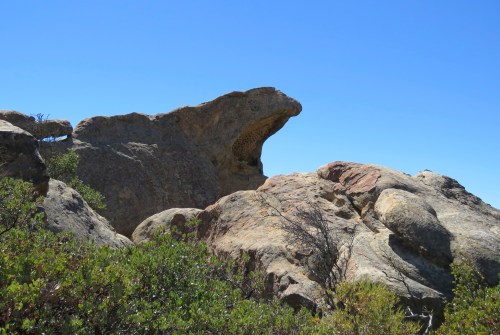
Lizard's Mouth hike climb trail West Camino Cielo Los Padres National Forest

Lizard’s Mouth

The Santa Ynez Mountains, with its sweeping views of the coast, can lend itself well to quiet reflection, and the great sandstone outcrops and boulders along West Camino Cielo can balance that nicely with plenty of surfaces to scramble over and explore.

The hike to Lizard’s Mouth is less than a mile roundtrip, but can easily be extended with additional exploring of the area. The hike is short enough and manageable enough that it can be a great hike to take kids on.

The off-trial routes to the nearly forgotten Goddard sites are probably less interesting to kids, but are rewarding discoveries in themselves and offer a unique historical connection to the Beatniks.

To get to the trailhead for Lizard’s Mouth from Santa Barbara, take State Route 154 towards San Marcos Pass. Turn left onto West Camino Cielo Road, which is before the top of the pass. Continue west on West Camino Cielo Road as it winds its way towards the top of the mountains.

The road passes the Goddard sites first. Past the turnoff for Windermere Ranch, start to look for the first metal barricade on the left, followed by another further up on the right.

For the Lizard’s Mouth hike, continue further on West Camino Cielo Road until just before Winchester Canyon Gun Club. Just past the gun club, West Camino Cielo Road continues unpaved along the top of the Santa Ynez Mountains.

Parking for Lizard’s Mouth is in the pullouts along the road. There is a sign for Lizard’s Mouth, set back from the road; the sign is more obvious once parked and on foot than while driving by it.

There is no maintained trail, but rather a maze of off-trail routes that people have created through their own explorations of the area. For the most direct route towards Lizard’s Mouth, head southwest from the trailhead. The route threads its way through chaparral, roughly paralleling and, at times, walking on an exposed outcrop of sandstone. The route quickly crests the edge of the mountain ridge and the views open out towards the coast.

From here, veer to the right, and traverse the large, sloped outcrop of sandstone, which ends at the top of Lizard’s Mouth. The feature is so-named because of its resemblance to a lizard with its mouth gaping open. The affect cannot easily be seen from the top, but with some rock scrambling to the north it’s possible to get below the feature, and capture the iconic view.

From the top of Lizard’s Mouth, the views extend south out across the coast towards the Channel Islands, with crisp views of More Mesa, Goleta Slough, UCSB, the airport, Devereux Slough, and Elwood Bluffs. To the west, is Broadcast and Santa Ynez Peaks. And to the northeast, the views extend towards the San Rafael Mountains and beyond them Mount Pinos.

After visiting Lizard’s Mouth, I drive back along West Camino Cielo Road to find the Goddard sites. Along the way, I pass a number of pullouts on the road, each with informal off-trail routes that lead to places people must’ve have found interesting. It’s tempting to explore each and every one of them.

I park at the pullout across the road from the metal barricade on the north side of the road and walk down West Camino Cielo Road to the metal barricade on the south side of the road. The barricade, which is marked with a metal sign that reads “No Motor Vehicles”, effectively blocks the unpaved road that once led down into Goddard picnic area.

There is not much to see at the site. An informal trail leads through the barricade and quickly arrives a flat area under the oaks. Nearby is a large sandstone boulder with an oak growing right against it. Carved in the boulder are names and initials, as well as handholds leading to the top of the boulder. Stretching west from the boulder, is a long, relatively flat area underneath the oaks that would’ve been a nice place for a shaded picnic area overlooking the coast.

In his 1963 edition of a Camper’s Guide to the Tri-County Area, Bob Burtness notes the picnic area had five picnic tables, three klamath stoves, a barbecue pit, and an outhouse. Today, nothing remains at the site.

After the hike, I reached out to Burtness, as well as local historian Jim Blakley. They both confirmed the picnic area was on the south side of West Camino Cielo Road, in spite of appearing on the north side of the road on topographic maps. The site on the north side of the road is where the old Goddard residence was located.

Goddard picnic area appears on the 1938 Forest Service recreation map and offered great views out across the coast. However, as some would say, the site was loved to death, becoming a popular destination for partying, until things got out of hand and the Forest Service removed the picnic area completely in the 1970s.

Hiking back up the road, I arrive at the metal barricade on the north side of the road. Here, too an informal trail leads past a metal sign that reads, “No Motor Vehicles”. The trail veers right, and makes its way east, up a rise, where I can see some conifers.

The somewhat overgrown trail leads through chaparral before arriving at the top. Here, I pass under an oak, before spotting a rusting water tank; next to the tank on one side are some cement foundations to a structure. The trail becomes a little less distinct, but pressing eastward from the water tank, I pass through another cement foundation and arrive at three cedar trees. Although cedars grow in our backcountry, these were likely planted. Past the cedars, in a small clearing, I see belladonna lilies, or naked ladies, in bloom with their bright pink flowers, adding to the variety of non-native plants growing at the site.

As my eyes adjust to mix of native and non-native plants, and the different segments of low rock walls, I spot some olive branches. Upon closer examination, I can see the main trunk was burned, and that these are its offshoots. Nearby a rock wall drops down several feet below me, suggesting that this might’ve been the main structure.

Continuing down the hill I find several other low rock walls, suggesting the site may have had a terraced garden.

Returning back up to the cedar trees, I spot a road cut I hadn’t seen before that leads down the backside of the rise. The road quickly joins another unpaved road cut. I follow it east, as it wraps around the rise southward and becomes impassable. I then double back along the road and follow it westward passing parts of an old stove. Continuing along the road, I can see native madrone and tan bark oak amongst the coast live oak and chaparral.

The road then arrives at a small creek and follows it briefly before ending at a large hole in the ground with wood and metal pieces that might’ve served as some kind of water catchment for the Goddard residence.

Dwight Goddard was originally educated as an industrial engineer and made his fortune during World War I. After his first wife’s death, he became a Congregational missionary and went to China. His interest in non-Christian religions led him to discover Buddhism, which he began studying. In 1928, he was introduced to Zen Buddhism, and lived and studied in a Zen monastery in Japan for eight months.

Inspired by his experience, in 1934, he decided to establish a male-only monastic movement called the Followers of Buddha. The participants spent their winters at his 40-acre site on West Camino Cielo and their summers on his property in Thetford Hill, Vermont, traveling between the two by van.

The monastery was short-lived, due to lack of participants, and Goddard later deeded the land along West Camino Cielo to the Forest Service sometime during the 1930s.

It was his writings, however, that would have a more lasting impact and eventually help bring Buddhism into the mainstream culture. In 1932, he wrote A Buddhist Bible, which was a rich collection of writings from the different schools of Buddhist thought that he found compelling.

Goddard died in 1939, but his book would make its way into the hands of Jack Kerouac, the Beat Generation writer made famous by his now classic book On the Road.

In 1953, Kerouac was living with fellow Beat Poets Neal and Carolyn Cassady, and it was Neal Cassady who suggested Kerouac read A Buddhist Bible. The story goes that Kerouac promptly stole a copy of the book from the local library, and through the book became introduced to Buddhism. That influence came through in Kerouac’s second book, Dharma Bums, which helped to popularize Buddhism and bring it into mainstream western culture.

This article originally appeared in section A of the October 1st, 2018 edition of Santa Barbara News-Press

Cedar growing at the old Goddard site

« Newer Posts - Older Posts »

Categories