Posted by: James Wapotich | September 28, 2018

Navigating Wilderness

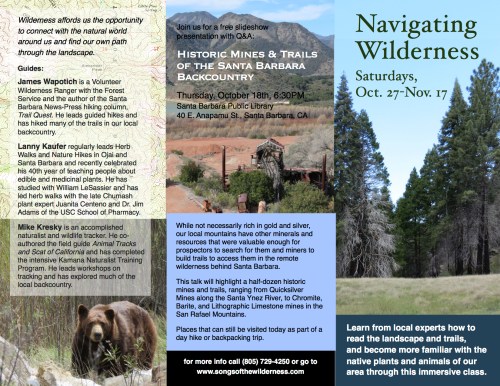
Navigating Wilderness skills class map reading route finding edible and medicinal plants tracks tracking hiking backpacking Mike Kresky Lanny Kaufer

*

Navigating Wilderness skills class map reading route finding edible and medicinal plants tracks tracking hiking backpacking Mike Kresky Lanny Kaufer

*

Navigating Wilderness
Saturdays, Oct. 27-Nov. 17

Learn from local experts how to read the landscape and trails, and become more familiar with the native plants and animals of our area through this immersive class.

The Santa Barbara and Ojai backcountry offers more than 500,000 acres of designated wilderness and hundreds of miles of trails to explore, and yet often the biggest obstacle to venturing out on the land or going deeper into nature is simply having the skills and confidence to get started.

Through this immersive four Saturday workshop, you will learn how to read the landscape and trails; become more familiar with the edible and medical plants of our region; learn about the animals of our area and how to recognize their tracks; and build skills and awareness that allow you to feel more at home in the woods.

Each class takes place outside, on one of our local trails, and provides a mix of hands on instruction, immersive exercises, and council sharing circles that allows for learning on many levels.

Reading the Landscape
October 27th, 9AM-2PM

Learn how to orient yourself to the local landscape, read the topography, and create your own mental maps. Discover how to navigate the backcountry without the use of a compass or GPS; and learn to remove the word lost from your vocabulary.

Edible and Medicinal Plants
November 3rd, 9AM-2PM

Venturing out onto the land is even more rewarding when we take time to develop a meaningful connection with nature.

Join local plant expert Lanny Kaufer as we learn about the edible and medicinal plants in our area. Many of these plants were first used by the Chumash and have a rich ethnobotanical history.

Plants are great teachers of how to adapt to a particular place and move with the seasons. Learn how to recognize a number of our native plants; where to find them; and their different uses.

Animal Tracks and Tracking
November 10th, 9AM-2PM

Our backcountry is home to a rich variety of animals that often goes unseen by us. Join local tracker and naturalist Mike Kresky as we learn about these animals and their relationship to the land. Learn how to recognize some of the common tracks of our local mammals, birds, and even reptiles.

Tuning into the wildlife around us can deepen our awareness of place and through our senses connect us to the aliveness of the natural world.

Routefinding
November 17th, 9AM-2PM

Many of our local trails are overgrown, particularly those off the beaten path.

Learn how to read the trails, practice route-finding, and develop your own sense of “body radar” to help you navigate in the wilderness. We will work with how to create a trail narrative and interpret the landscape, and begin to see nature as an ally and how to hone and trust your senses.

Guides:

James Wapotich is a Volunteer Wilderness Ranger with the Forest Service and the author of the Santa Barbara News-Press hiking column, Trail Quest. He leads guided hikes and has hiked many of the trails in our local backcountry.

Lanny Kaufer regularly leads Herb Walks and Nature Hikes in Ojai and Santa Barbara and recently celebrated his 40th year of teaching people about edible and medicinal plants. He has studied with William LeSassier and has led herb walks with the late Chumash plant expert Juanita Centeno and Dr. Jim Adams of the USC School of Pharmacy. www.herbwalks.com

Mike Kresky is an accomplished naturalist and wildlife tracker. He co-authored the field guide Animal Tracks and Scat of California and has completed the intensive Kamana Naturalist Training Program. He leads workshops on tracking and has explored much of the local backcountry.

All four Saturday classes take place on our local trails.

To sign up or for more information, please contact:
James (805) 729-4250 jwapotich@yahoo.com

Workshop is $175 per person, or bring a friend and both $150 each.
Must be able to comfortably hike 2-3 miles

Posted by: James Wapotich | September 26, 2018

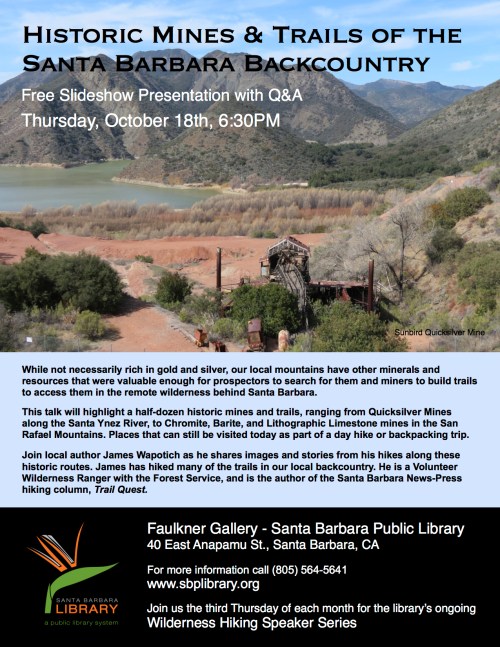
Historic Mines & Trails of the Santa Barbara Backcountry

Historic Mines and trails of the Santa Barbara backcountry quicksilver sunbird chromite white rock barite white elephant mine moraga limestone lithographic los padres national forest

*

Historic Mines & Trails of the Santa Barbara Backcountry

Free Slideshow Presentation with Q&A

Thursday, October 18th, 6:30PM
Faulkner Gallery – Santa Barbara Public Library
40 East Anapamu St., Santa Barbara, CA

While not necessarily rich in gold and silver, our local mountains have other minerals and resources that were valuable enough for prospectors to search for them and miners to build trails to access them in the remote wilderness behind Santa Barbara.

This talk will highlight a half-dozen historic mines and trails, ranging from Quicksilver Mines along the Santa Ynez River, to Chromite, Barite, and Lithographic Limestone mines in the San Rafael Mountains. Places that can still be visited today as part of a day hike or backpacking trip.

Join local author James Wapotich as he shares images and stories from his hikes along these historic routes. James has hiked many of the trails in our local backcountry. He is a Volunteer Wilderness Ranger with the Forest Service, and is the author of the Santa Barbara News-Press hiking column, Trail Quest.

For more information call (805) 729-4250 or email jwapotich@yahoo.com

This talk is part of the ongoing Wilderness Hiking Speaker Series hosted by the Santa Barbara Public Library. The talks are the third Thursday of the month and feature topics related to hiking, backpacking, and our local natural history.

The next talk in the series is Thursday, November 15th, When the Animals Were People – storytelling with Chumash elder Julie Tumamait.

Posted by: James Wapotich | September 21, 2018

Trail Quest: Antimony and Eagle Rest Peaks

Part of the Transverse Range, the San Emigdio Mountains frame the southern end of California’s great Central Valley, and link the Tehachapi and Temblor Mountains.

Both Antimony and Eagle Rest Peaks offer great views of the surrounding area, and provide a chance to explore the mountains north of Mount Pinos.

The hike to Antimony Peak is about five miles round trip, and from there it’s another six miles round trip to Eagle Rest Peak, for a total of 11 miles to visit both. The trail starts at roughly 6,660 feet of elevation, with Antimony and Eagle Rest Peaks at 6,848’ and 6,005’ respectively.

The longer trek to both peaks is a somewhat strenuous roller-coaster of a hike, involving 2,900 feet of combined elevation loss and 2,400 feet of combined elevation gain on the hike out; the numbers are then reversed on the return hike. The hike can take most of the day to complete. There is no water along the trail.

To get to the trailhead from Santa Barbara, take Highway 101 south towards Ventura. From Ventura, take State Route 126 east towards Santa Clarita where it meets Interstate 5. Continue north on Interstate 5 and exit at Frazier Mountain Park Road.

Follow Frazier Mountain Park Road to Cuddy Valley Road. Continue on Cuddy Valley Road and look for the signed turnoff for Tecuya Ridge Road on the right. The road is before the turnoff to Mount Pinos and the nearby campgrounds.

Tecuya Ridge Road is unpaved, and a high-clearance vehicle is recommended. At each of the intersections along the road, stay to the left. The road improves as it continues, and ends in a small loop at the trailhead for Antimony Peak, about 4.5 miles from Cuddy Valley Road.

From the parking area, the trail follows an old jeep road towards Antimony Peak. The trail quickly descends through a mix of pinyon pine and white fir, with an understory of scrub oak.

The jeep road was built in the 1940s, to access the mining area, and is now more of a wide single-track trail. The grade becomes more moderate as the road wraps itself west around the summit north of the trailhead.

At the lower elevation, chaparral plants assert themselves in the mix, with ceanothus and yucca appearing. Along the trail I can see where deer have grazed on the yucca stalks.

The trail then rounds a corner, and Antimony Peak comes into view with is stark, exposed southern face. The mountain is composed of granitic rock, appearing white in the early morning light. Here, the trail passes through a gate, before descending down to a saddle.

From here, the trail follows a series of switchbacks that zigzag towards the peak, gaining 900 feet in less than a half-mile. It’s an impressive feat that not only was the road built, but was also used to carry ore and supplies.

At about the two-mile mark, the trail crests the top of the mountain and enters an open area dotted with Kennedy’s buckwheat. Here, at the saddle, the trail branches, although at first glance the routes to the different peaks are more subtle in comparison to the jeep road. To the left is the off-trail route to Antimony Peak. To the right is the off-trail route towards Eagle Rest Peak. And straight ahead, the old jeep road continues down the mountain another quarter of a mile to where the miners’ cabins were located.

The off-trail route to Antimony Peak heads east, uphill towards the summit. The route is marked with occasional cairns and is relatively easy to follow.

The trail quickly arrives at the summit, a small level area amongst the pines. At the summit is a USGS survey marker and, next to it, the peak register where one can add their name.

From the summit, the views through the trees extend east towards the Tehachapi Mountains; to the south towards Frazier Mountain and Mount Pinos; and to the north, towards Eagle Rest Peak, the San Joaquin Valley, and the southernmost Sierra Nevada.

Returning to the old jeep road, from the saddle, the jeep road continues down the mountain another quarter of a mile and arrives at an open clearing amongst the trees that is also dotted with Kennedy’s buckwheat. Scattered about the clearing is wood from the cabins, as well as rusting tin cans. At the edge of the clearing, under the trees, is an old stove.

The first mining claims on the north side of Antimony Peak were made in 1872, by Stephen Boushey and his partners. In those days, ore was carried down the mountain by mule into San Emigdio Canyon where it was smelted. From there it was hauled by wagon to Bakersfield.

The two-mile trail from the mine down into the canyon was supposedly called Tail Hold, or Tailholt Trail because it was so steep it required holding onto the tail of one of the mules when climbing it. The trail led down the west side of Antimony Peak, into San Emigdio Canyon, where the smelters can still be found today.

In the early 1940s, the U.S. Bureau of Mines surveyed the area, digging trenches and exploratory drill sites to determine its potential as an emergency antimony reserve.

The brittle, silvery metal expands when solidifying and is used as an alloy of lead and tin in the manufacture of machine bearings, ammunition, batteries, and metal casings.

For the hike to Eagle Rest Peak, return back up to the saddle. The peak is visible from the saddle and can make for a compelling destination.

From the saddle, the trail traverses the north side of mountain westward staying below the summit that’s just west of Antimony Peak. The trail passes through a small stand of Jeffrey pines, before then joining the ridgeline that leads down towards Eagle Rest Peak, and from there, passes through mostly pinyon pine mixed with interior live oak. Much of the route is marked with cairns.

On the ridgeline, the grade starts off reasonable, but then rapidly starts descending as the trail loses over 1,100 feet of elevation in just over a half-mile. After its relentless descent the trail arrives at a low saddle. I try not to think about the hike back out.

From here, the off-trail route begins an equally vigorous ascent of the unnamed summit between Antimony and Eagle Rest Peaks. The trail gains roughly 500 feet of elevation over the next quarter of a mile.

Along the more exposed southern side of the unnamed summit, chaparral plants such as manzanita, silk tassel, and yerba santa assert themselves. On the ground I can see fresh bear tracks. Other animal sign along the trail include fox, bobcat, coyote, and mountain lion.

The trail then crests the unnamed summit, traversing across the top of it. Here, the trail becomes a little less distinct with wild grasses growing amongst the trees. With less available rocks to create cairns, hikers have tied plastic ribbons or flags to some of the trees to mark the route.

After crossing the almost mesa-like summit, the trail continues with more relentless descending. Then, at last, it becomes more forgiving as it continues over a mini-summit on its way down. Here, the route is a little more brushy. On the ground, I can now see fresh bear tracks coming and going, and know that at least the bear made it back out.

The trail then arrives at an open grassy saddle. In spite of its low elevation, the saddle offers nearly panoramic views of the area with San Emigdio Canyon to the west, Eagle Rest Peak to the north, Lost Canyon to the east, and the slopes of Antimony Peak to the south.

From here, the trail begins its final ascent to reach Eagle Rest Peak. The trail gently climbs to a rise, before then starting up the hillside for another steep ascent, passing through a mix of grassland, pinyon pine, and juniper.

At one point, I mistakenly turn off the trail, traversing westward, perhaps trying to spread out the ascent, but quickly realize my error. The off-trail route is remarkably uniform in its wear pattern and fairly well-marked with cairns, making it somewhat easy to differentiate it from game trails.

As the trail continues its ascent to the peak, it starts to require some rock scrambling, and becomes more challenging to follow as it makes its way up through the sandstone, with the final push along an outcrop of sandstone, just before it reaches the summit.

At the summit, are several massive sandstone boulders. Here, the steepness of the climb is immediately offset by the sheer drop off on the other side. The views are equally impressive, stretching north out across the wide expanse of the southern San Joaquin Valley.

After a brief rest, I retrace my route, making it back to my car just after sunset.

This article originally appeared in section A of the September 17th, 2018 edition of Santa Barbara News-Press

Antimony Peak San Emigdio Mountains jeep road trail hike los padres national forest

Antimony Peak in the early morning light

Eagle Rest Peak hike trail San Emigdio Mountain San Joaquin Valley Los Padres National Forest

Eagle Rest Peak with the southern San Joaquin Valley in the distance
Eagle Rest Peak trail hike San Emigdio Mountains Los Padres National Forest

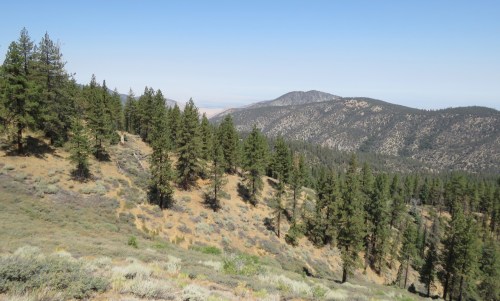
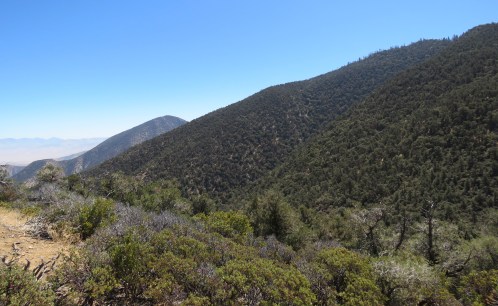
Scenery along the trail to Eagle Rest Peak looking east

Eagle Rest Peak hike trail san emigdio mountains los padres national forest

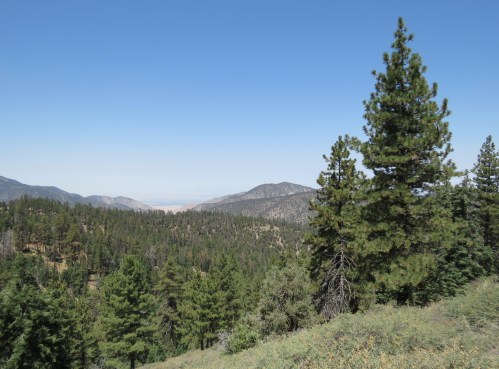
Scenery along the trail to Eagle Rest Peak looking west

Eagle Rest Peak trail hike san emigdio mountains los padres national forest

*
Posted by: James Wapotich | September 4, 2018

Trail Quest: McGill Trail and the Perseids

Mount Pinos is the tallest mountain in our local area, with an elevation of 8,831 feet. During the summer, the higher elevation can offer some relief from the heat with cooler evenings and somewhat lower daytime temperatures.

But perhaps the real attraction of Mount Pinos is the pines and potential for stargazing. The higher elevation and cooler overall temperatures allow conifers to thrive; and the often clear skies at night, combined with low light pollution, makes Mount Pinos one of the best stargazing destinations in southern California.

There are three campgrounds near Mount Pinos for overnight camping and a couple of nearby trails to explore.

McGill Trail starts from McGill Campground and is about seven miles roundtrip. The trail leads from the eastern slope of Mount Pinos down to the edge of Cuddy Valley and offers some great views of the surrounding area.

To get to Mount Pinos from Santa Barbara, take Highway 101 south towards Ventura. From Ventura, take State Route 126 east towards Santa Clarita where it meets Interstate 5. Continue north on Interstate 5 and exit at Frazier Mountain Park Road.

Follow Frazier Mountain Park Road to Cuddy Valley Road and continue to Mount Pinos Highway, which leads towards the top of Mount Pinos. The road passes the lower trailhead for McGill Trail, and, as it climbs up the mountain, passes both McGill and Mount Pinos Campgrounds. The road ends at the parking area for the Mount Pinos trailhead and the nearby walk-in campground of Chula Vista.

McGill Campground has 73 sites, of which 75 percent are reservable. Mount Pinos Campground has 19 sites, of which 79 percent are reservable. The balance of the sites, including all 12 at Chula Vista Campground are on a first come, first-served basis.

Campsites can be reserved by going to www.recreation.gov. McGill and Mount Pinos Campgrounds are $20 per night while Chula Vista Campground is free. All of the campsites have picnic tables and fire rings. All three campgrounds have restrooms. There is no water available at any of the campgrounds.

McGill Trail starts from McGill Campground. There is a $10 day use fee if not camping there, which can be avoided by starting from the lower trailhead.

From the signed trailhead, the trail heads north, tracing the western edge of the campground before intersecting a cross-country skiing trail coming in from the west. McGill Trail is a popular mountain biking route and so some alertness is required when hiking it. Mountain bikers can extend the route by starting at the parking area for the Mount Pinos trailhead and utilizing cross-country skiing trails to connect over to McGill Trail, doubling the length of the ride.

McGill Trail is relatively easy to follow. The well-worn path leads through mostly pines, with not a lot of brush.

At about the half-mile mark from the trailhead, McGill Trail meets Whitethorn Nature Trail. The quarter of a mile long interpretive trail starts near Group Site 1 in McGill Campground and leads to an overlook visible from McGill Trail. The trail is paved and wheelchair accessible.

At the beginning of the trail are brochures for the interpretive hike that describe the natural history of Jeffrey pines over the course of six numbered stops.

Jeffrey pines are named for botanist John Jeffrey, who first identified and described the tree in 1852, while traveling through Shasta Valley. The conifer is closely related to ponderosa pine and was originally listed as a subspecies.

In fact, it is often hard to tell the two apart, both have three needles per fascicle and similar looking bark and cones. Fortunately, the texture of the cones provides a reliable means of differentiation. Both types of cones have barbs on the end on their scales, however, the barbs on Jeffrey pine point inward, while those on ponderosa pine point outward. The difference is noticeable to the touch when handling the cones, giving rise to the phrases “gentle Jeffrey” and “prickly ponderosa” as a way to remember which is which.

Growing sporadically amongst the pines along McGill Trail is a mixed understory of snowberry and whitethorn ceanothus. Also along the trail is elderberry, gooseberry, and Great Basin sagebrush.

There’s also a fair amount of bird activity with Steller’s jays being the most vocal, followed by ravens. Other birds that can be seen along the trail include mountain bluebirds, nuthatches, flickers, and Clark’s nutrcracker.

As the trail continues, the views open up east, out across Cuddy Valley towards Frazier Mountain. Cuddy Valley is named after John Cuddy, who homesteaded there in the mid-1800s. His son, Joseph “Don” Cuddy served as the area’s first forest ranger.

The trail then starts to wrap westward around the mountain offering some great views of Tecuya Ridge and the San Emigdio Mountains, and beyond them the San Joaquin Valley and southernmost Sierra Nevada.

Here, the trail starts to descend, although with a reasonable enough grade to make the return hike generally bearable. At the lower elevation, black oak starts to appear in the mix, with a good example of the tree right next to the sign at the lower trailhead.

From here, the trail continues an additional half-mile to another, lower trailhead near the old San Emigdio Pines Plantation.

Another nearby hike is to the top of Mount Pinos. From the parking area at the end of Mount Pinos Highway, it’s roughly three miles round trip the summit. The trail follows an unpaved access road through a mix of Jeffrey pine and white fir that alternates with several open meadows covered largely in rabbitbrush.

From the overlook at the end of the access road, the views extend south out across the Ventura and Santa Barbara backcountry. Nearby, is the beginning of Tumamait Trail, which traverses the top of the mountains, through the Chumash Wilderness, towards Cerro Noroeste for a longer hike.

At night, in the clear mountain air, one of the main attractions is stargazing. The parking area for the Mount Pinos trailhead is a popular destination for amateur astronomers and is often filled with cars.

There are a dozen different meteor showers that happen annually throughout the year, with one of the best being the Perseids in August.

Meteors are caused when a piece of rocky or iron debris enters the atmosphere. These fast-moving objects, generally ranging in size from of a grain of sand to a small boulder, can reach speeds between 20-45 miles per second. Moving through the atmosphere, they compress and heat the air in front of them, creating a glowing streak in the sky.

Meteor showers, such as the Perseids, often occur when the earth passes through the dust and debris left by a comet on its sojourn around the sun. The comet that provides material for the Perseid shower, is Swift-Tuttle which orbits the sun every 133 years and was last seen in 1992. At its peak, the Perseids can display on a meteor or more per minute.

The point in the sky where the meteor shower appears to originate is called the radiant, and in general meteor showers are named for the constellation where their radiant is located, in this case, the constellation Perseus.

The best time to view a meteor shower is when the debris from its comet is densest and the radiant is high in the sky, typically from midnight to just before dawn on the peak day.

The ideal viewing conditions are away from light pollution, on a moonless night, with a clear view of as much of the evening sky as possible. Having a lawn chair or blanket makes its easy to lay back and watch the show once your eyes adjust; and bringing a sleeping bag or extra layer can help keep you warm.

When viewing the stars at the Mount Pinos parking area, please consider turning off your headlights when you arrive and leave, when it’s safe to do so, as well as back into your parking spot to minimize the amount of light disturbance. Another alternative, is to hike out towards Mount Pinos, where there are no cars and fewer people.

The next promising meteor shower is the Geminids, which can sometimes offer close to a 100 meteors per hour. The shower will peak this year on Friday, December 14, at 4:30 a.m., with good viewing Thursday night starting after midnight when the moon sets.

There are a number of online resources for stargazing. Sky and Telescope Magazine on their website, www.skyandtelescope.com, has a feature called, “This Week’s Sky at a Glance”, which offers a quick summary of any interesting astronomical sights that may be happening, as well as an annual summary of the year’s upcoming meteor showers. Skymaps.com has a free downloadable chart of the evening sky each month that shows the location of the visible stars and any planets for that month.

This article originally appeared in section A of the September 3rd, 2018 edition of Santa Barbara News-Press

McGill Trail hike San Emigdio Mountains Tecuya Ridge Mount Pinos Los Padres National Foreest

The San Emigdio Mountains frame a view from McGill Trail

Jeffrey pines McGill Trail hike San Emigdio Mountains Tecuya Ridge Mount Pinos Los Padres National Foreest

Jeffrey pines are seen along McGill Trail

Posted by: James Wapotich | August 27, 2018

Trail Quest: Hot Springs and Buena Vista Canyons

The Thomas Fire, which started near Santa Paula on Dec. 4 of last year, burned west through the mountains behind Ojai and Ventura. It then crossed State Route 33, and burned along both sides of the Santa Ynez Mountains.

On the coastal side of the Santa Ynez Mountains, the fire burned west until it reached the burn scars of the 2008 Tea Fire and 2009 Jesusita Fire, where it essentially stalled out and was contained.

As a result of the fire, all of the trails within the burn area were closed until further notice. On Jan. 9, winter rains brought debris flows and flooding, further damaging the trails.

The Forest Service lifted the closure on all trails within the National Forest affected by the fire on May 24. However, portions of trails on land owned and managed by both the City and County of Santa Barbara remained closed, including most of the lower trailheads. Since then, the City and County have reopened their sections as well, with the exception of the trails in Cold Spring Canyon, which remain closed, including West Fork Cold Spring Trail from Gibraltar Road.

Between Cold Spring and Romero Canyons is a network of trails, most of which have been reopened. These trails, combined with Edison access roads, provide a great way to craft a variety of loop hikes and explore the front country side of the Santa Ynez Mountains. All of the unpaved Edison access roads have been cleared and are in great shape, and many of the lower trails have also been cleared or worked on as well.

Trails for these different loop hikes can be accessed from Hot Springs, San Ysidro, and Buena Vista trailheads.

To reach Hot Springs trailhead from Santa Barbara, take Highway 101 south and exit at Hot Springs Road. Turn left, and continue though the roundabout and follow Hot Springs Road up to East Mountain Drive. Turn left onto East Mountain Drive, and continue towards the trailhead.

From the trailhead, Hot Springs Trail follows an easement through private property for the first half-mile, passing along the way an information kiosk splattered with mud from the debris flow, which provides a sense of how high the debris flow was.

Although Hot Springs Canyon is not as deeply scoured as San Ysidro or Romero Canyons, the damage from the debris flow is still evident. Further up the trail one can see where a private bridge across the creek was swept away. Please respect private property.

The trail follows the creek upstream, passing one last developed property before joining an unpaved access road and arriving at the first trail juncture, which is still signed. Straight ahead, is the trail that follows the creek up towards the site of the old Hot Springs Hotel. Across the creek, the trail branches. To the left is Hot Springs Trail and to the right is McMenemy Trail, which leads over to San Ysidro Canyon.

Hot Springs Trail follows an unpaved access road that traces the eastern edge of Hot Springs Canyon. The road roughly follows the original road built in 1862, to access the hot springs. From the road, it’s easy to see the burn damage in the canyon. Many of the oaks are scarred, but sprouting back. Covering the hills are morning glory, and growing back on the hillsides are chamise, ceanothus, and laurel sumac.

About a mile from the trailhead, Hot Springs Trail crosses the east-west running Edison access road. From here it’s a short way to the old Hot Springs Hotel site.

The first 3-story hotel was built here during the 1880s. In 1921, it burned to the ground during a forest fire and was rebuilt. In 1964, the Coyote Fire burned through the canyon, again destroying all the buildings, which this time were not rebuilt.

What remains is the stone foundation, including a set of stairs leading up from the trail to the top of the foundation. Past the hotel site, the trail continues up the canyon to where the hot springs flow out into the creek.

From the hotel site, a return hike can be made along the loop trail that leads back down the creek. The trails favors the west side of the creek and is relatively easy to follow.

An alternate return loop can be made along Saddle Rock Trail, which is reached from the hotel site, by continuing east along the Edison access road or catway.

Edison Catway connects from Hot Springs Canyon over to San Ysidro Canyon. About a half-mile from Hot Springs Trail, the road arrives at the first turnoff for the transmission towers and the unsigned top of Saddle Rock Trail. To the east, roughly a quarter of a mile, are the next towers over and the top of Girard Trail.

Saddle Rock Trail follows the ridgeline between Hot Springs and Oak Canyons. Coming down from Edison Catway, the trail quickly arrives at a flat mesa with a large sandstone outcrop and offers some great views out across Montecito and Santa Barbara.

The half-mile trail is at times rocky and steep, but easy to follow, as it threads along the ridge, passing through outcrops of coldwater sandstone. Growing back along the trail are chamise, manzanita, and laurel sumac. The trail then arrives at the unsigned intersection with McMenemy Trail, which is marked with a lone charred oak tree.

McMenemy Trail connects from Hot Springs Canyon over towards San Ysidro Canyon, and essentially parallels Edison Catway, traversing the lower portions of the Santa Ynez Mountains east to west. McMenemy Trail is in great shape having been recently been worked by volunteers, along with Saddle Rock, Girard, and Old Pueblo Trails.

McMenemy Trail is an enjoyable hike, in spite of the burn damage, as it winds its way across the front of the mountains, crossing Oak Creek before arriving at the intersection with Girard Trail. Near the intersection is a commemorative bench, honoring Colonel Logan T. McMenemy, who deeded the trail to the community in 1962.

Girard Trail is a half-mile connector trail that leads up to Edison Catway. The trail traces the western side of San Ysidro Canyon and offers great views out across the canyon. Halfway up the trail is a short side trail leading down to an overlook. At the overlook is a commemorative plaque honoring Edward “Bud” Girard and his work to help preserve our local trails. Girard was also instrumental, along with other community members, in helping to reopen Franklin Trail behind Carpinteria.

From the intersection with Girard Trail, McMenemy Trail continues east, descending down into San Ysidro Canyon, where it meets San Ysidro Trail. From here, it’s a roughly a half-mile up the canyon to Edison Catway for other loop options.

A short way down San Ysidro Trail is the beginning of Old Pueblo Trail, which leads over towards Buena Vista Canyon.

Buena Vista Canyon can be visited as part of a separate 3.5-mile loop hike that connects with San Ysidro Canyon.

To reach Buena Vista trailhead from Santa Barbara, take Highway 101 south, and exit at San Ysidro Road. Continue north to East Valley Road and turn right, following East Valley Road to Park Lane. Turn left onto Park Lane and continue to the intersection with East Mountain Drive. To the left, East Mountain Drive continues past Wiman trailhead and ends at San Ysidro trailhead. To the right, Park Lane continues to Buena Vista Trailhead.

Buena Vista Trail leads up Buena Vista Canyon, quickly climbing away from the creek and offering views out across the canyon. The canyon was also damaged during the debris flow and flooding, similar to Hot Springs Canyon. The trail is in fair condition and drops back down into the creek. Here, mud splattered on one of the distinctive boulders along the trail gives a sense of how high the debris flow was.

About a half-mile from the trailhead, Buena Vista trail branches. To the right, a connector trail climbs east out of the canyon where it meets the Edison access road coming up from Romero Canyon. To the left, another connector trail climbs west out of the canyon where it meets the Edison access road coming up from San Ysidro Canyon; the trail is overgrown with wild mustard.

From San Ysidro Canyon, continue down San Ysidro Trail to the beginning of Old Pueblo Trail for the loop hike back to Buena Vista Canyon.

Old Pueblo Trail is in good shape. The mile long trail follows an easement above the more developed properties bordering the mountains. Please stay on the trail. The trail meets Wiman Trail before joining Park Lane for the last leg back to Buena Vista trailhead.

Wiman Trail is a short quarter of a mile connector trail from East Mountain Drive that follows a small, shaded side creek up towards Old Pueblo Trail.

Regardless of how far you hike, each of these different trails and connectors provide a way to explore our local mountains.

This article originally appeared in section A of the August 20th, 2018 edition of Santa Barbara News-Press

Buena Vista Canyon Trail Thomas Fire Santa Barbara Montecito hike Los Padres National Forest

Buena Vista Canyon is seen from the trail

Buena Vista Canyon Trail debris flow Thomas Fire Santa Barbara Montecito hike Los Padres National Forest

Familiar rock feature shows the height of the debris flow

Hot Springs Canyon Trail Thomas Fire Santa Barbara Montecito hike Los Padres National Forest

Hot Springs Canyon is seen from the trail

McMenemy Trail Thomas Fire Santa Barbara Montecito hike Los Padres National Forest

The Santa Ynez Mountains frame a view along McMenemy Trail

Saddle Rock Trail Thomas Fire Santa Barbara Montecito hike Los Padres National Forest

Saddle Rock Trail


Posted by: James Wapotich | August 26, 2018

Trail Quest: San Ysidro Canyon

The Thomas Fire started on December 4, 2017, and burned more than 280,000 acres, roughly 440 square miles, before it was contained. And while we all breathed a collective sigh of relief when the fire was stopped behind Montecito, it proved to be just the opening salvo in a two-part disaster.

On January 9, the first winter storm hit, three days before the fire was officially contained. The unusually intense rain triggered a debris flow that devastated Montecito, claiming the lives of 23 people and damaging or destroying more than 450 structures.

Driving to the trailhead for San Ysidro Trail, the damage wrought by the debris flow is inescapable. Where East Valley Road crosses San Ysidro Creek, houses can be seen that have been partially destroyed, while others have been completely removed. Still visible on the buildings and trees is dried mud showing the height of the debris flow; and covering the ground is a layer of mud showing how far out the debris flow spread.

The trails within the burn area were also damaged. While most of the trails have been reopened, many are in need of repair and not necessarily hikeable. Substandard trail conditions and unstable ground require caution in hiking and in some cases are not safe to traverse. For example, there is a washed out section along upper San Ysidro Trail that is not safe to cross.

Cold Springs Canyon remains closed, although the uppermost portion of Cold Spring Trail can be accessed from East Camino Cielo Road.

The trailhead for San Ysidro Trail is reached from Santa Barbara by taking Highway 101 south. Exit at San Ysidro Road and continue north to East Valley Road. Turn right onto East Valley Road and continue to Park Lane. Turn left onto Park Land and follow it to East Mountain Drive, which ends at the trailhead.

The trail follows an easement through private property and where it joins a private access road, the house that was immediately on the left is now completely gone. The parcel of land it stood on also appears partially swept away and is now fenced off. Please respect private property.

The easement continues just west of the access road and rejoins the road past a gate, near the beginning of Old Pueblo Trail, which is also open. Here, the trail follows an unpaved Edison access road up the canyon. All of the Edison access roads in the burn area have been cleared and are in excellent condition.

Continuing up the canyon, the damage from the fire and debris flow is evident. The understory and chaparral have been burned away. The creek channel is much deeper and the floodplain has been largely cleared of plants and trees.

Nonetheless plants are growing back and much of the canopy is still intact. Along the road, large-flowered phacelia, canyon sunflower, and nightshade are in bloom.

The road passes the beginning of McMenemy Trail, marked now with just cairns, as the sign has been washed away. Further up the canyon, the Edison access road branches. The road to the right leads towards Buena Vista Canyon, while the main road continues up the canyon.

The access road then arrives at the beginning of the single-track trail, before crossing the creek and continuing east towards Hot Springs Canyon.

Hiking up the single-track trail, I can see where the debris flow spilled out of the creek, flowing across parts of the trail, and depositing trees and brush, some of which have been cut out and cleared by volunteers.

The canyon then starts to narrow and it’s easy to imagine the debris flow being channeled through here before starting to spread out near the mouth of the canyon. Much of Montecito is built on historic alluvial fans created by similar debris flows thousands of years ago.

Scanning the creek, many of the scenic cascades along the trail are either gone or have become unrecognizable. The familiar pool where the water flowed between two large outcrops of sandstone is gone. Over time, I imagine, new cascades will take shape and the canyon will once again become more picturesque.

The trail then climbs above the creek, returning back down just before it crosses San Ysidro Creek. Here, the trail follows a side creek towards San Ysidro Falls, before making its way to the top of the mountains.

The day is already hotter than I’d like. Recalling from previous hikes that the balance of the trail is uphill and unshaded, I decide to follow San Ysidro Creek and explore off-trail.

I hike upstream to where two side creeks join the main creek. Normally, to travel further would require bushwhacking and weaving through downed trees, but the mixed blessing of the debris flow is that it has cleared the way up each of the creeks.

In one canyon, I find fresh bear tracks and a large patch of Humboldt lilies in bloom that are being visited by swallowtail butterflies. In another canyon, I find a pair of garter snakes and stumble across a Humboldt lily with an impressive 28 flowers.

Before leaving, I pay a quick visit to the falls. The creek below them has also been carved out, but the falls appear largely as before, with the same trickle of water one would expect this time of year.

On my second hike, getting an earlier start, I quickly make my way to the falls. From here, the trail starts its climb up the mountain, making its way up a hillside of loose Cozy Dell shale. The trail is washed out, but passable with care.

As I continue, the task becomes more grueling; loose shale covers large parts of the trail requiring extra care to traverse. Even with trekking poles, the effort is like walking uphill in dry sand.

Further up, trail conditions start to improve as the trail joins the ridge separating the side canyon with San Ysidro Falls and the main canyon of San Ysidro Creek. Here, the devastation wrought by the fire can be seen over a wide area. It’s also easy to see where much of the material from the debris flow originated over the years.

Even with their chaparral covering, these mountains represent an almost endless supply of dirt and rock. Over thousands of years boulders and other loose material has worked its way down into the creek corridors.

During a forest fire, the protective chemicals that plants like chaparral produce to cover their leaves to mitigate water loss is released into the air and settles on the soil forming a water resistant coating. This hydrophobic layer, either at or just below the surface, prevents rainwater from being easily absorbed by the soil, dramatically increasing runoff during a storm. Depending on the intensity of the fire and amount of leaf litter burned, the layer can persist for several years.

Whereas most forest fires occur earlier in the year, allowing the often lighter rains of November and December to help soften the impact, the first storm after this fire was in January.

The storm brought with it several short bursts of high intensity rain, including one that dumped a half-inch of rain in five minutes; an event with a likelihood of happening only once every 200 years.

The intense burst of rain, combined with the effects of the fire on the landscape, triggered a debris flow of loose rocks, downed trees, and other material that was able to reach speeds of around 25 mph.

Because the density of the debris flow is close to the density of the boulders that have been washed down, the debris flow is able to essentially lift the boulders and carry them downstream at the front of the flow, like a floating wall of bulldozers scouring the canyon until it opens enough for the flow to fan out and the material to start to be deposited.

Slowly growing back on the scorched hills in the canyon are chamise, ceanothus, toyon, holly-leaf cherry, laurel sumac, and other chaparral plants, which anchor loose dirt in place and can help break up hydrophobic soils.

Continuing up the trail, roughly four miles from the trailhead, the trail arrives at a steep slide area that will need to bve repaired before it can safely be crossed. Unfortunately, it may be a year or more before it’s fixed. Trail crews will likely wait and see if subsequent rains undermine the trail further before investing resources in repairing it and instead focus on clearing and maintaining the lower trails that see more traffic.

From East Camino Cielo Road, the uppermost portion of San Ysidro Trail can be accessed and is in fair condition down to the slide area.

These mountains now present a challenging contrast between their beauty and the incredible amount of devastation and destruction the fire and subsequent debris flow have wrought on our community.

This article originally appeared in section A of the August 6th, 2018 edition of Santa Barbara News-Press

San Ysidro Canyon Trail debris flow Thomas Fire damage Santa Barbara montecito hike los padres national forest

San Ysidro Canyon looking downstream

Humboldt lily San Ysidro Canyon trail Santa Barbara montecito hike Los Padres National Forest

Humboldt lily with 28 flowers

Papilio rutulus western tiger swallowtail on Humboldt lily Lilium humboldtii san ysidro canyon santa barbara montecito los padres national forest

Swallowtail on Humboldt lily

Papilio rutulus a pair of western tiger swallowtail on Humboldt lily Lilium humboldtii san ysidro canyon santa barbara montecito los padres national forest

*

San Ysidro Canyon Trail debris flow Thomas Fire damage Santa Barbara montecito hike los padres national forest

Off-trail San Ysidro Creek

Posted by: James Wapotich | August 4, 2018

Trail Quest: Remote viewing Parma Park

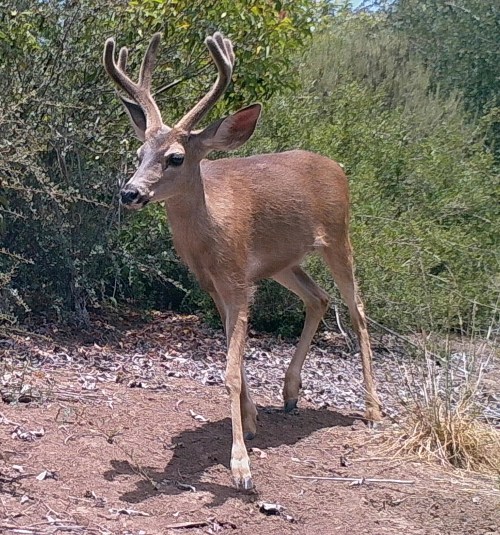
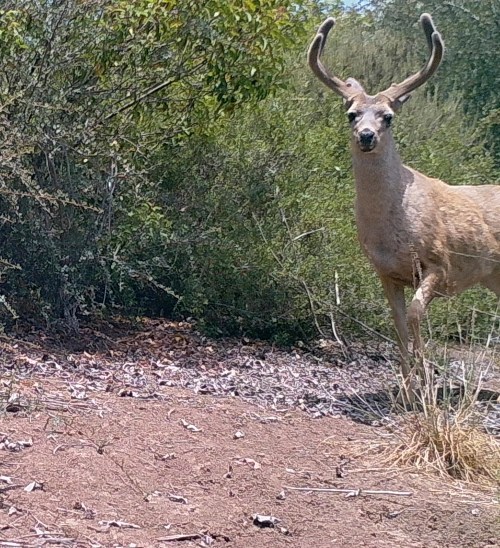
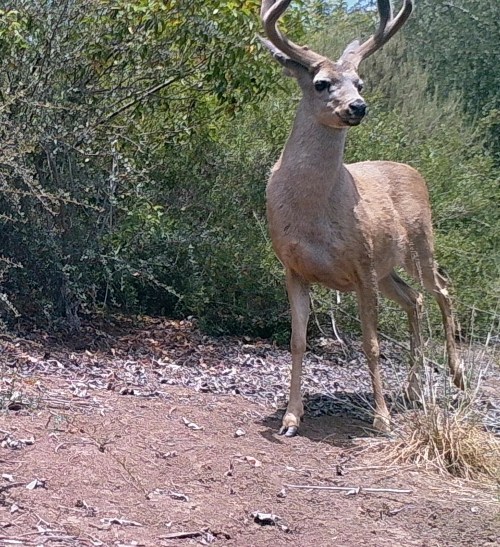
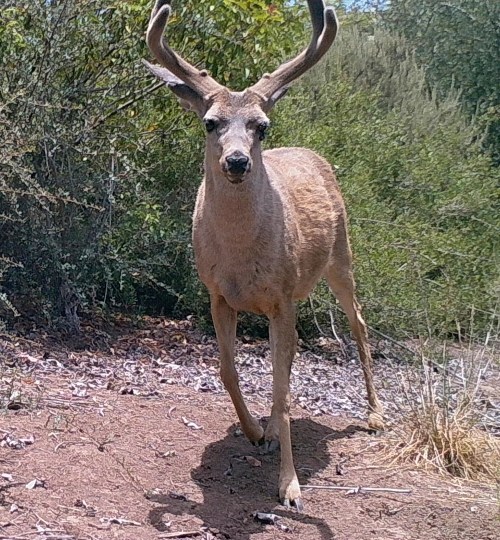
Wildlife cameras are a great way to peak into the hidden lives of the animals around us. They provide a way to view wildlife in their natural state, undisturbed by our presence.

Camera tracking was first pioneered in the late 1890s, and was originally called camera trapping because the camera required the use of a trip-wire for a picture to be taken. In the 1990s, motion detection cameras with infrared sensors became available to the public, opening up a wider range of opportunities to observe and track animals.

Last fall, a friend loaned me one of his wildlife cameras. Recalling the advice of wildlife biologist David Lee, I set the camera up in my backyard. I’d taken a camera tracking class with Mr. Lee earlier in the year, and one of his suggestions was to set the camera up at home to get familiar with it before taking out it into the field.

Where I live in town, there are several oaks and other trees mixed with native and non-native plants. My landlord is a landscaper who appreciates the different animals that frequent the yard and has stashed water dishes around the property, which he fills from time to time.

Outside my window, there’s a dish along a path that leads around the corner of the building. I’ll often hear animals at night scurrying along the path or drinking from the dish, and will occasionally see a skunk or possum when I go outside to investigate.

One of the keys to placing a wildlife camera, is selecting a location with a lot of activity and so I figured this would be a good spot. Nevertheless, I was surprised by just how much traffic passes by my window unnoticed.

Through the images captured by the camera, I learned that there are at least two different skunks and possums in the yard that have a little circuit they follow almost nightly.

This was consistent with what Mr. Lee shared during the class, that smaller animals like skunks and possums have smaller home ranges and one is likely to see them almost nightly, while larger mammals such as bears and mountain lions in the backcountry might only pass a particular spot once a month.

Another surprise was my neighbor’s cat. I might see him once or twice a month in person, but he’s out there 2-3 times a day cruising around the yard, which is clearly part of his territory. Other animals recorded included squirrels and crows who also frequent the water dish.

Encouraged by my results, I purchased several cameras, since they proved relatively easy to set up and use, and started thinking of where else I could place them.

The ideal location would be somewhere with a lot of diverse wildlife activity, that’s also relatively easy to get to in order to check the camera and swap out the memory card and batteries as needed. At the same time, the location would need to be off the beaten path far enough so as to go unnoticed by other people to prevent the camera from being damaged or stolen.

Eventually, Parma Park came to mind, which is close to where I live and doesn’t see as many visitors as the more popular front country trails.

Parma Park is a 200-acre open space park managed by the City of Santa Barbara in Sycamore Canyon. The park features a mix of riparian, oak woodland, chaparral, and grassland. There are roughly five miles of trails within the park, which is open from sunrise to a half-hour after sunset.

The main entrance to the park is along Stanwood Drive. A short way in from the entrance, near the picnic tables, is an interpretive sign with a map of the different trails.

I set up my first camera in March along one of the tributaries of Sycamore Creek, brilliantly located, I thought, at the confluence of two creeks. The site seemed promising, lots of poison oak to discourage visitors, flowing water, and two watercourses for animals to explore. To clinch the deal, I even found where a mountain lion had killed a deer nearby.

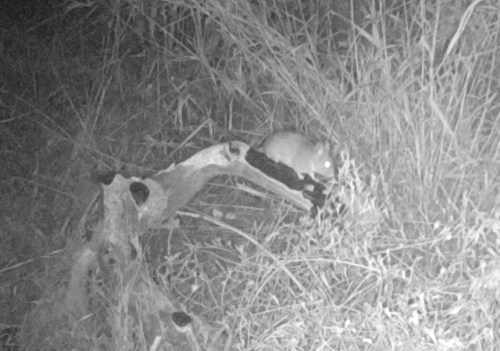
However, when I checked the camera a week later, all I saw was a couple of mice and a very fast squirrel. It seemed the lesson was, just because I thought it was a great place, didn’t mean the animals thought it was a great place. Going over the site in my mind, I had to admit that I hadn’t seen a lot of tracks or scat and decided to find a place with more evidence of wildlife traffic.

On the way back, I spotted a side trail leading away from the creek that looked promising. A short way up the trail, I found relatively fresh deer tracks, as well as older tracks from when the ground was wet during the last rain. But what really caught my attention was a set of mountain lion tracks crossing the deer tracks. The tracks were of different ages, but as I studied the site it looked like it was the intersection of several different animal paths.

I found a nearby tree to strap the camera to and made a series of test shots as I’d done in my backyard, walking through the field of view and fine tuning the height and angle of the camera. Satisfied with the placement, I secured the camera with a lock.

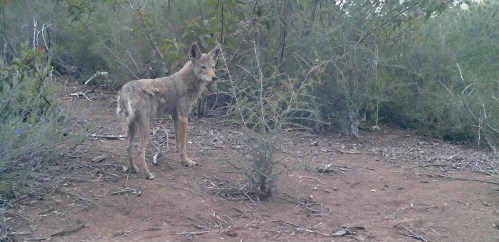
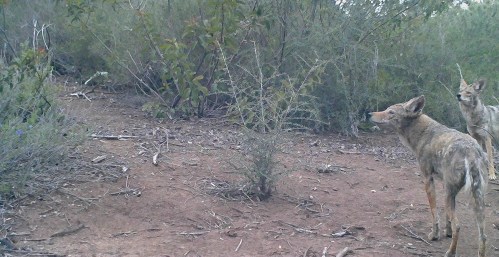
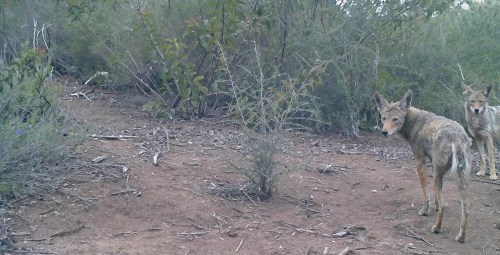
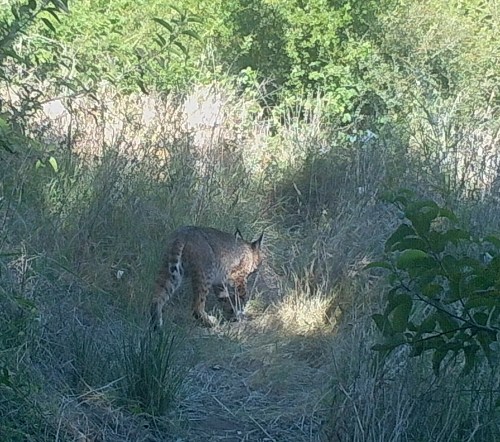
When I went back a week later the results were astounding. According to the time stamp, three days after I set up the camera a pack of five coyotes wandered through around six in the evening one Saturday. Two dashed up the hill, the second one doubled back just as three more arrived. Two of them wandered off, while the other two hung out for a while before disbursing. Other animals recorded by the camera included skunk, rabbit, and deer.

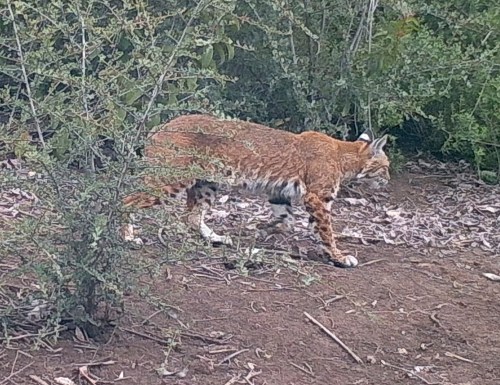
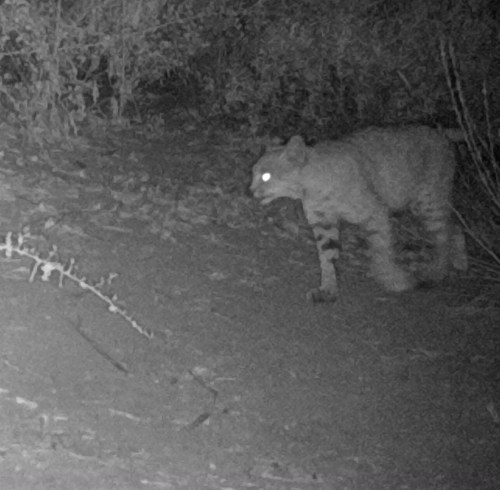
When I went back roughly a week later, the next batch of images contained a couple more coyote, more deer, and this time a bobcat.

Inspired by my success, I set up a second camera further up the hill where I found a trail that went between two bushes. Hoping to capture images of a fox or bobcat, I angled the camera looking out along the trail towards an intersection with another trial that came up the hill. I wasn’t sure how productive the site would be, but it was certainly hidden.

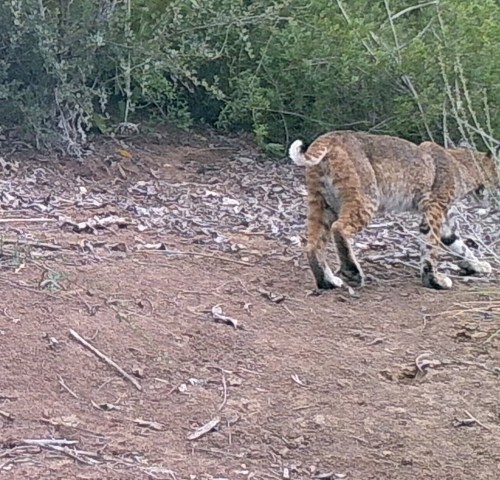
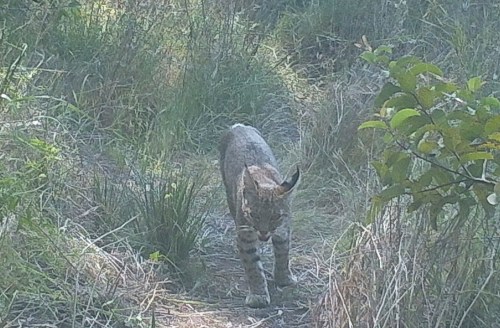
When I returned a week later, according to the time stamp, just an hour and fifteen minutes after I left a deer came through and to my surprise continued past the camera along the trail, which I would’ve thought too small for a deer. Another image showed a buck coming up and sniffing the camera. But the real prize was two different shots of a bobcat coming and going along the trail.

However, when I returned a second time a week later I noticed the results were less dramatic. No bobcat, and although I could see deer at the trail juncture, none of them took the trail leading past the camera. When I checked the first camera, I also noticed a decline in the activity and wondered if I hadn’t “soured” the sites with my regular visits.

In his class, Mr. Lee had cautioned us not to eat food or go the bathroom near where we set up our cameras because it could cause animals to avoid the area. And while I hadn’t done either of those, I had inadvertently sat there reviewing the images on my camera. I resolved to visit the sites less frequently and minimize the amount of time spent there.

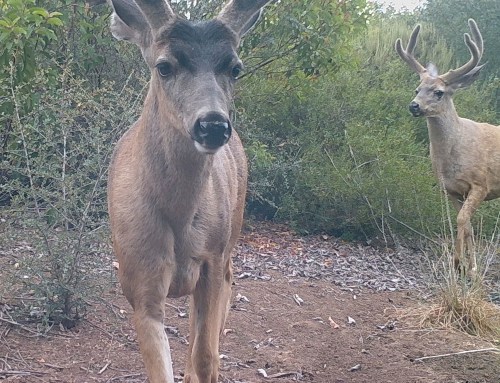
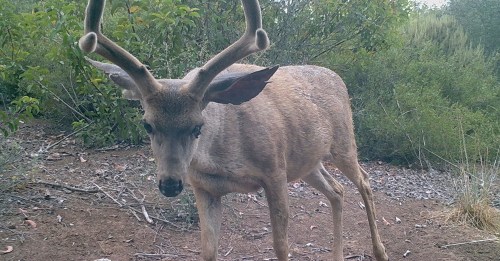
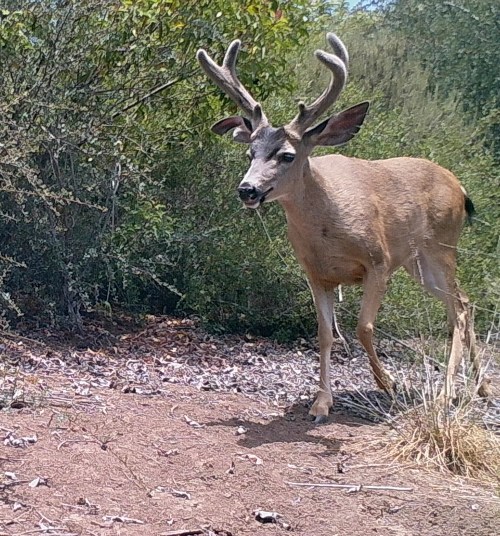
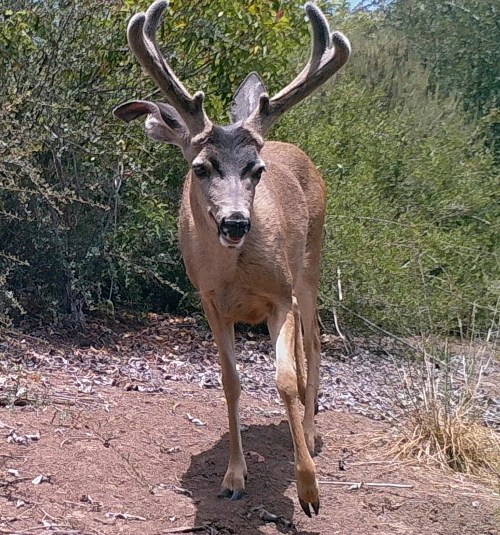
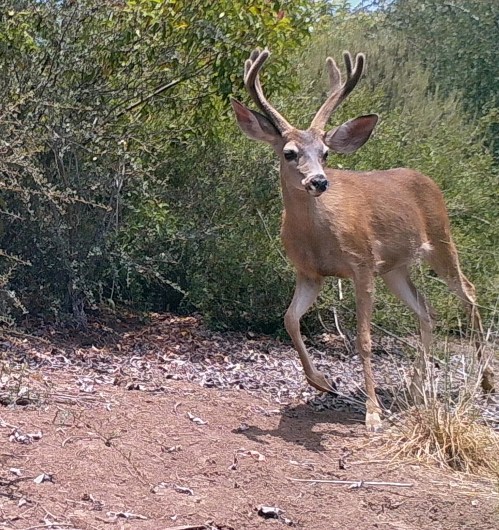
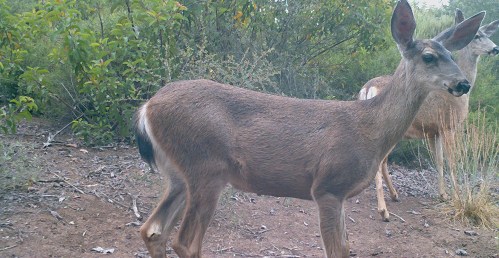
Both sites rebounded. At the second site, deer resumed using the path through the brush. And at the first site, there was veritable parade of deer. In fact, in reviewing the images from both sites for the past several months, I was able to recognize some of the deer as regulars, either by their antlers or the nicks and tears in their ears.

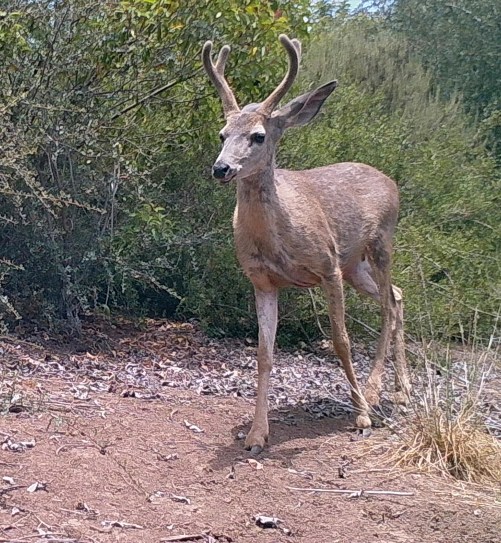
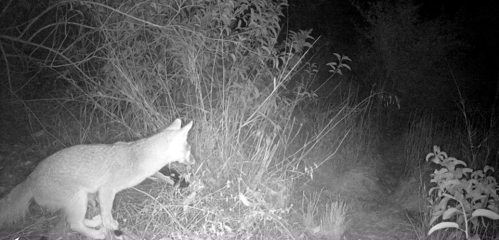
Among the deer, four bucks passed through, one after the other, around noon on a Monday, looking like reindeer with their velvet antlers. In last set of images, a fox wondered through at night adding to the variety of animals using that particular route.

There is something satisfying about seeing animals in their natural state, unaware that they’re being observed. When I encounter animals in the wild, their behavior often changes in response to my presence. They either dash off or cautiously continue what they’re doing. But here, through the camera, their natural rhythm is unbroken, and viewing the images brings with it a sense of being in the backcountry and peering into a world that is usually hidden from view.

This article originally appeared in section A of the July 23rd, 2018 edition of Santa Barbara News-Press.

Odocoileus hemionus californicus California mule deer black-tailed mule deer wildlife camera tracking bucks santa barbara

California mule deer aka black-tailed mule deer

Odocoileus hemionus californicus California mule deer black-tailed mule deer wildlife camera tracking buck santa barbara

*
coyote Canis latrans wildlife camera tracking santa barbara

Coyote

coyote Canis latrans wildlife camera tracking santa barbara

*
coyotes Canis latrans wildlife camera tracking parma park santa barbara

*
bobcat Lynx rufus wildlife camera tracking parma park santa barbara

Bobcat

bobcat Lynx rufus wildlife camera tracking parma park santa barbara

*

bobcat Lynx rufus wildlife camera tracking parma park santa barbara

*

Odocoileus hemionus californicus California mule deer black-tailed mule deer wildlife camera tracking buck

*

Odocoileus hemionus californicus California mule deer black-tailed mule deer wildlife camera tracking buck

*

Odocoileus hemionus californicus California mule deer black-tailed mule deer wildlife camera tracking buck

*

Odocoileus hemionus californicus California mule deer black-tailed mule deer wildlife camera tracking buck

*

Odocoileus hemionus californicus California mule deer black-tailed mule deer wildlife camera tracking buck

*

Odocoileus hemionus californicus California mule deer black-tailed mule deer wildlife camera tracking buck

*

Odocoileus hemionus californicus California mule deer black-tailed mule deer wildlife camera tracking buck

*

Odocoileus hemionus californicus California mule deer black-tailed mule deer wildlife camera tracking buck

*

Odocoileus hemionus californicus California mule deer black-tailed mule deer wildlife camera tracking does

Does

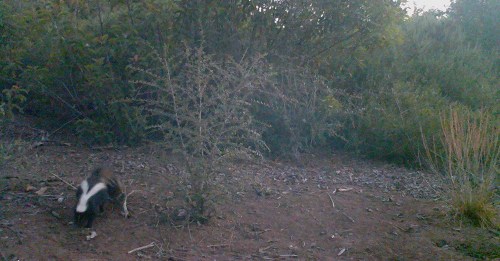
skunk wildlife camera tracking santa barbara

Skunk

grey fox Urocyon cinereoargenteus wildlife camera tracking parma park santa barbara

Grey fox

Below are some images from the nearby second site.

Odocoileus hemionus californicus California mule deer black-tailed mule deer wildlife camera tracking buck santa barbara

*

bobcat Lynx rufus wildlife camera tracking parma park santa barbara

*

bobcat Lynx rufus wildlife camera tracking parma park santa barbara

*

mouse wildlife camera tracking parma park santa barbara

Mouse

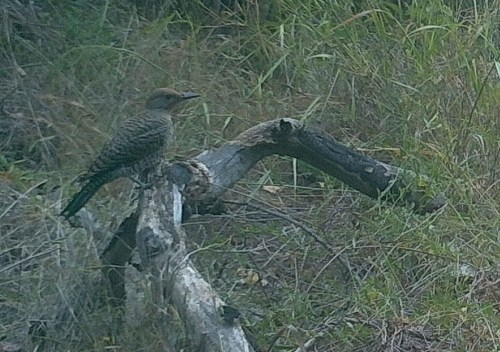
Flicker Colaptes auratus wildlife camera tracking santa barbara

Flicker

grey fox Urocyon cinereoargenteus wildlife camera tracking parma park santa barbara

*

Posted by: James Wapotich | July 9, 2018

Trail Quest: Romero Canyon

With most of the trails now open within the Thomas Fire burn area and volunteer groups actively organizing and leading restoration projects, many of the front country trails devastated by the fire and subsequent flooding are starting to return to life.

Currently only Cold Spring Canyon, including East and West Cold Spring Trails, remains closed to the public. The uppermost portion of East Cold Spring Trail, however, is accessible from East Camino Cielo Road.

In Romero Canyon, both Romero Trail and Old Romero Road have been largely restored. The lower portion of Romero Trail along with all of Old Romero Road have been cleared. The upper portion of Romero Trail still requires some work but can be hiked with caution due to substandard trail conditions.

The hike along Romero Trail to the top of the mountains is seven miles round trip. An extended loop hike of 11.5 miles can be made by returning along Old Romero Road. Both routes provide opportunities to explore the canyon and assess the burn damage and impact of the subsequent flooding and debris flow.

To get to the trailhead from Santa Barbara, take Highway 101 south and exit at Sheffield Drive. Turn right onto Jameson Lane and follow it as it curves north becoming Sheffield Drive. From Sheffield Drive, turn left onto East Valley Road and follow it briefly to the beginning of Romero Canyon Road. Continue on Romero Canyon Road to the end where it meets Bella Vista Drive. Turn right onto Bella Vista Drive and continue to where it crosses Romero Creek and arrives at the trailhead.

At the trailhead, damage from the flooding and debris flow is immediately evident. The flood plain has been cleared of plants and is noticeably wider. The creek channel is much deeper and where the creek crosses the road a new culvert has been installed and the road repaired.

Romero Trail follows an unpaved Edison access road up the canyon for the first half-mile. All of the Edison roads within in the burn area have been cleared and are in good condition.

The access road now crosses through the creek, just downstream from where the bridge was. In one of the more striking examples of how strong the flooding and debris flow were, the bridge is just gone. All that remains are its stone foundations and twisted rebar.

As I take in the scene, the fog and overcast sky adds to the sense of loss and disorientation. The basic topography of the canyon remains, but with the altered creek course and floodplain it’s hard to recall exactly what the canyon used to look like in its finer details. Equally hard to imagine is how it will eventually appear in five to ten years from now.

Past the first creek crossing, the road branches. The road to the left leads over towards Buena Vista Canyon. Staying to the right, Romero Trail continues along the road to the next creek crossing and the beginning of the single-track trail.

The trail sign is gone, likely burned in the fire. From here, the single-track trail follows the east side of the creek upstream, while Old Romero Road continues its long, circuitous journey to the top of the mountains.

The creek is flowing and the canopy of oaks is largely intact. I hear two stellar jays making a lot of noise even for stellar jays and veer off trail to investigate. They are scolding a Cooper’s hawk that’s sitting in one of the trees. My arrival breaks up the party and the birds disperse. Further up the canyon I hear flickers, towhees, and canyon wrens. The level of bird activity is encouraging.

Continuing up the trail, I can see that most of the understory has been burned and the trunks of many of oaks are charred. Growing back beneath the oaks are ferns, canyon sunflower, giant rye grass, and poison oak. As the canyon starts to narrow, Humboldt lilies appear in bloom along the trail and California bay laurel can also be seen growing back.

The trail is good shape thanks to the work of volunteers, as well as the amount of foot and bike traffic the trail is experiencing. The creek crossings are steeper than before but well-marked with cairns. The picturesque pools once seen from the trail are gone, but much of the overall character of the canyon remains or will return.

The trail then heads up a side canyon before following a set of switchbacks up to the intersection with Old Romero Road. Here, Romero Trail continues another mile towards the top of the mountains, while Old Romero Road winds its way there more slowly. From this four-way intersection a shorter return loop of 6.5 miles can made along the road.

As Romero Trail continues it becomes less shaded and the burn damage more evident. Where there was once dense chaparral holding the hillsides in place, loose dirt and ravel have slid across the trail, which volunteers have since cleared.

In some ways, many of our hillsides and mountains are mostly loose dirt and boulders and what helps keep them in place is plants. Growing back from their root burls are toyon, holly-leaf cherry, and ceanothus. On the exposed hillsides are wild cucumber, as well as other plants all taking advantage of the reduced competition, available sunlight, and ash-enriched soil.

Trail conditions in this upper section are currently a mixed bag, with some areas having been worked by volunteers and others in need of repair and requiring care to traverse. There are also sections that are unburned and only partially burned.

Nearing the top of mountains, white sage can be seen sprouting back and yucca is in bloom with its creamy white flowers. Adding to the color are patches of pale orange from bush monkey flower and red from honeysuckle penstemon and crimson larkspur.

The trail then arrives at the signed juncture with Ocean View Trail, the return point for the shorter hike to the top of the mountains.

For the extended loop hike continue north along Romero Trail. The northern section of the trail is unburned and where it passes through a stand of California bay laurel seems almost forested. The trail is overgrown, which in the context of having hiked through the burn area is somehow reassuringly familiar.

The trail then rounds a corner and the views extend out across Blue Canyon and the Santa Barbara backcountry. To the east, I can see the blue waters of Jameson Lake surrounded by the charred mountain landscape that was burned in the Thomas Fire. Scanning west, I can make out where the Thomas Fire meets the burn scar from the 2016 Rey Fire, which also burned a wide swath across the backcountry.

The trail then meets Romero-Camuesa Road. Just down the road, North Romero Trail continues into Blue Canyon.

For the loop hike back, from this juncture, turn left and head west up Romero-Camuesa Road to Romero Saddle. Here, the road arrives at a locked Forest Service gate and meets East Camino Cielo Road. Romero-Camuesa Road is currently closed to vehicles due to winter storm damage, but is open to hikers, mountain bikers, and equestrians.

Continue along East Camino Cielo Road a short way past the cement water tower to the top of Old Romero Road.

Old Romero Road is currently in excellent shape. Over the years, brush and rock debris have effectively narrowed the route down to a single-track trail. However, recent trail work has cleared the trail to almost twice its original width.

The road makes a wide loop passing through the upper reaches of San Ysidro Canyon before returning to Romero Canyon and winding its way down into the canyon.

Lining much of the upper road is large-flowered phacelia with its oversized purple-blue flowers. Where there is pronounced southern exposure the plant can be seen dominating the hillsides. A fire-follower, the seeds of large-flowered phacelia can lie dormant for many years until chemical cues created by fire, followed by rain, cause them to sprout. The plant can also be seen in the lower canyon along the trail.

The last fire to burn through this area was the 1971 Romero Canyon Fire, which burned 15,650 acres before it was contained. In comparison the Thomas Fire burned 281,893 acres.

At about the 7.5-mile mark into the loop, Old Romero Road meets Romero Trail, which can provide a quicker return route.

The road eventually meets the Edison access road and then makes a wide loop around the front of the mountains before returning back into Romero Canyon. Through this section the views extend out along the coast from Carpinteria Salt Marsh to Santa Barbara Harbor.

The road then meets the beginning of the single-track trail to complete the loop.

Both trails have been largely restored. The lower portion of Romero Trail along with all of Old Romero Road have been cleared. The upper portion of Romero Trail still requires some work but can be hiked with caution due to substandard trail conditions.

All of the front country trails have been reopened except for East and West Cold Spring Trails. However, the uppermost portion of East Cold Spring Trail is accessible from East Camino Cielo Road.

This article originally appeared in section A of July 9th, 2018 edition of Santa Barbara News-Press.

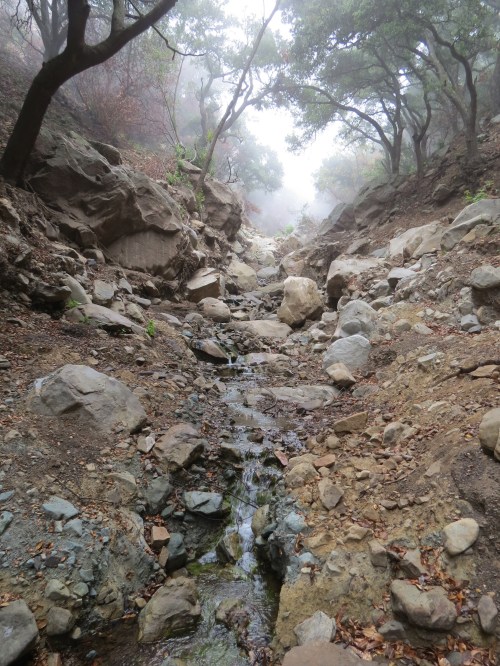
Romero Creek Canyon Trail hike front country thomas fire burn area los padres national forest

Romero Creek

fire follower large-flowered phacelia old romero road canyon trail thomas fire burn area Los Padres national forest front country santa ynez mountinas

Fire follower, large-flowered phacelia can be seen along the trail

Romero Creek bridge flood debris flow damage thomas first canyon trail los padres national forest front country santa ynez mountains

The bridge across Romero Creek is no more.

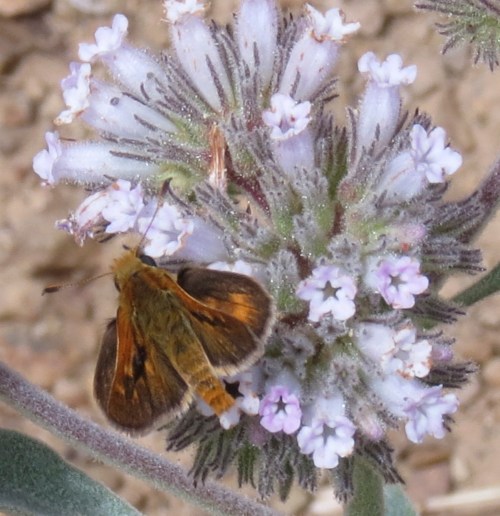
Romero Trail canyon santa ynez mountains los padres national forest

Skipper

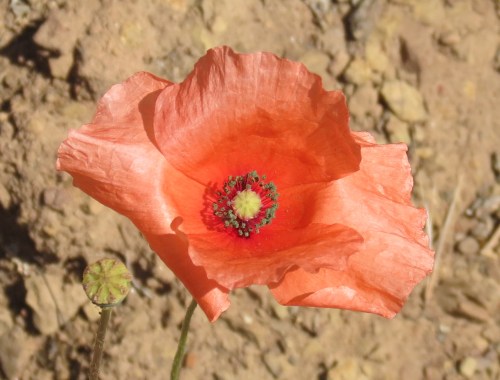
fire poppy Papaver californicum thomas fire burn area romero trail canyon santa ynez mountains los padres nation forest

Fading fire poppy

Posted by: James Wapotich | June 25, 2018

Trail Quest: East & West Fork Lion Falls

On May 24, the Forest Service lifted the closure for all trails in the National Forest within the Thomas Fire burn area. The fire, which started on December 4, near Santa Paula, burned east all the way into the mountains behind Santa Barbara before being contained. The fire burned 281,893 acres and is the largest recorded wildfire in California history.

With access now largely restored it’s possible to visit these trails and see how they’re doing. While summer heat can make hiking in the backcountry less appealing, it occurred to me that a hike along Lion Canyon Trail could include a visit to the swim holes below East and West Fork Lion Falls.

The hike to both East and West Fork Lion Falls is about six miles roundtrip and provides a chance to see the burn area. The trail starts from Middle Lion Campground in Rose Valley behind Ojai.

The trailhead is reached from Ojai, by taking State Route 33 north to Rose Valley Road. Rose Valley Road leads past the turnoff for Rose Valley Campground and Rose Valley Falls, before arriving at the turnoff to Middle Lion Campground.

At the turnoff for Middle Lion, I discover the gate on the road is closed and that I will have to take the connector trail down to the campground to reach the trailhead. A sign on the gate says the campground is scheduled to reopen on June 30. A similar sign is found on the gate before Rose Valley Campground.

The connector trail adds another mile roundtrip, but is easy to follow and about halfway down joins the paved road to the campground.

From the campground, the trail quickly crosses Lion Creek. Here, a stretch of unburned alder trees line the creek, a remnant of the verdant beauty the canyon had before the fire. It isn’t until the end of the hike that I fully appreciate the cooling effect trees provide. A short ways past the crossing, most of the remaining trees along the creek have been burned.

Shade from trees not only provides direct relief from the sun, but through transpiration trees further cool the area around them by taking up water through their roots that evaporates through their leaves, stems, and flowers.

Lion Canyon Trail is easy to follow and where powdery ash and loose soil have settled on the trail, fresh bear tracks can be seen.

While the fire has effectively cleared all the brush in the canyon, spring is still in effect with wildflowers lining the trail. In the mix are annual wildflowers, as well as fire followers that have been activated by the heat, smoke, and other chemical clues from the fire. Both types of plants are benefitting from this year’s rain combined with the ash-enriched soil, more available sunlight, and overall lack of competition.

Covering many of the hillsides is both short-lobed and caterpillar phacelia. Also abundant is farewell to spring and Turkish rugging, which is part of the buckwheat family. Other wildflowers along the trail include goldenstar, chia, blue dicks, larkspur, lupine, and mariposa lilies. Wild roses are also in bloom.

Growing back from root burls is scrub oak, toyon, and chamise. Sycamore and California bay laurel are also sprouting back from their bases.

Taking in the amount of the new growth created by the plants it seems almost average for this time of year. Nature hasn’t been extra hard at work striving to recover from the fire, but rather has just kept growing and moving forward like it always does. It’s a powerful reminder to take one’s time. In my own life when I experience a set back, I feel embarrassed, even ashamed, and push myself to bring things back to the way they were or even ambitiously make them better than before.

But nature just goes at its own steady pace, or in the words of Lao Tzu, “Nature does not hurry, yet everything is accomplished.”

In spite of the burn damage, the trail is in generally good condition, no downed trees to contend with and no major slide damage across the trail.

As the trail climbs above the creek, the lack of brush offers unobstructed views out across the canyon. The same lack of brush also reveals more clearly the raw beauty of the terrain and its topography.

Rounding a corner, as the trail starts back down towards the creek, I spot a rattlesnake stretched out across the trail. It doesn’t coil up or rattle, but looking at its tail I can see that it has roughly 11 rattles.

It is a common misconception that the number of rattles indicates the age of the snake. Although rattlesnakes add a new rattle each time they shed their skin it doesn’t easily translate into years. Young snakes may shed as much as three to four times a year, while older snakes may shed once a year or less. Rattles can also break off over time and so the only thing that can be said for sure about this particular snake is that it shed its skin at least 11 times.

We stare at each other for a moment and then the snake decides to make its way towards me. With plenty of open space around me and not wanting any complicated discussions, I scramble off trail and yield the right a way.

At about the 1.5-mile mark from Middle Lion Campground, the trail arrives at the intersection with Rose-Lion Connector Trail. Here, Lion Canyon Trail continues along the edge of the broad flood plain of Lion Creek, which used to be lined with dense willow that is now growing back.

The trail the crosses Lion Creek before arriving at the four-way intersection that leads to East and West Fork Lion Falls. The crossing is less clear now without fully grown willow defining the trail corridor and silt from this year’s rain that has flowed across parts of the trail. But the lack of brush also makes it’s easier to read the landscape.

From the four-way intersection, I continue to the left towards East Fork Lion Camp. Here too the route is a little more challenging to accurately follow as it crosses East Fork Lion Creek. Past the crossing, the trail stays on the north side of the flood plain all the way to East Fork Lion Camp.

The camp is surprisingly undamaged. While there is little shade, the two large big-cone Douglas fir towering over the camp are still standing and only one of them has burn damage and just on one side. There is currently water flowing at the camp and the two camp sites are both usable.

Past the camp, an off-trail route continues up the canyon to the first cascade. Here, the creek tumbles over huge boulders of conglomerate stone creating a variety of pools and cascades.

Scrambling over the rocks, I quickly reach East Fork Lion Falls, sometimes referred to Spruce Falls. At the base of the waterfall is a chest deep pool of water that is the perfect antidote for the heat.

Retracing my route back to the four-way intersection, I continue over to West Fork Lion Falls.

The trail to West Fork Lion Camp stays on the east side of the flood plain the entire way to the camp.

As the trail rounds a bend in the canyon, it arrives at a surprisingly large patch of Humboldt lilies with more than two dozen in bloom and another 50 to 60 with buds that haven’t opened. The vibrant orange flower with brown spots can be found sporadically on other trails, as well as elsewhere in Lion Canyon, but here, walking through so many in bloom adds to the sense of discovery that exploring the backcountry can offer.

West Fork Lion Camp also has very little shade but is still otherwise usable.

Past the camp an off-trail route crosses the creek and makes its way up towards West Fork Lion Falls.

Although the pool at the base of the waterfall is not as deep as the one in East Fork Lion Canyon, it still provides welcome relief from the heat and lack of shade along most of the hike. For company, I share the pool with two garter snakes actively swimming around, who were there first. After cooling off, I hike back.

Rose Valley Falls is also flowing. The gate just before the campground is also closed, but it’s a short walk from the gate to the campground. From the campground, it’s about a half-mile to the base of the falls. The trail is similarly burned, but at the falls is a largely unburned pocket of California bay laurel and maple, which provide shade and add to the beauty of the scene.

This article originally appeared in section A of the June 25th, 2018 edition of Santa Barbara News-Press

Lion Canyon Trail Thomas Fire Ojai hike Los Padres National Forest

Lion Canyon

Lion Canyon trail pre-Thomas Fire hike Ojai Los Padres National Forest

Lion Canyon, 2015

Rattlesnake lion canyon trail los padres national forest

Rattlesnake with 11 rattles out on the trail

Mariposa lily lion canyon trail los padres national forest

Mariposa lily

Farewell to Spring Lion Canyon Trail los padres national forest

Farewell to Spring

Turkish rug lion canyon trail los padres national forest

Turkish rugging

Humboldt lily lion canyon trail los padres national forest

Humboldt lily

Rose Valley Falls trail ojai los padres nation forest

Rose Valley Falls


Posted by: James Wapotich | June 4, 2018

Trail Quest: Santa Lucia Wilderness, Part 2

The Santa Lucia Mountains extend along the coast from Monterey County south into San Luis Obispo County. The southernmost end of the range is part of Santa Lucia Wilderness within Los Padres National Forest.

Tucked away in these mountains is Upper Lopez Canyon, a hidden world of lush plant life and year-round water. From the trailhead along Upper Lopez Canyon Road, Lopez Canyon Trail follows the creek upstream passing through Sulphur Pot and Upper Lopez Camps before making its way to the top of the Santa Lucia Mountains.

The hike to Sulphur Pot Camp is about four miles and from there it’s another mile to Upper Lopez Camp. Both camps make for great overnight backpacking destinations. Past Upper Lopez Camp, the trail continues another 2.5 miles to top of the mountains.

The trailhead is reached from Santa Barbara by taking Highway 101 north to Arroyo Grande and exiting at Grand Avenue. Continue east on Grand Avenue through old town Arroyo Grande and turn right onto Huasna Road, which more or less turns into Lopez Drive.

Continue on Lopez Drive towards Lake Lopez Recreation Area. The road crosses Lopez Dam and branches just before the entrance to the recreation area. Stay to the right and follow Hi Mountain Road a short way to Upper Lopez Canyon Road.

Upper Lopez Canyon Road traces the eastern edge of the recreation area and makes its way into the national forest. Where the paved road ends, it continues as a private access road with parking allowed only at the trailheads. A high clearance vehicle is recommended to ford the dozen plus creek crossings along the road.

The unpaved road passes Little Falls Trailhead before ending at a locked gate, which is also the trailhead for Big Falls and Lopez Canyon Trails. 

At the trailhead, my friend Casey and I gather up our backpacking gear and continue up Lopez Canyon along the trail. 

The trail continues past the gate, along the private, unpaved road for the first 2.25 miles before entering Santa Lucia Wilderness. There is no sign denoting the beginning of the wilderness and so without a GPS it’s hard to tell where it officially starts. Please respect private property. 

The road follows the creek upstream and over the course of those first three miles fades from a viable jeep road to an overgrown road cut, gradually becoming impassable for vehicles, although there are occasionally sections that are more open.  

The canyon is lush with plant life, well-shaded with a canopy of coast live oak, maple, willow, sycamore, and madrone. Beneath this canopy, in the dabbled sunlight, is a mix of wild blackberry, poison oak, ferns, and other plants.

The dense understory and enclosed feeling from the canopy adds to the sense of being in another world; it’s only when we’re able to glimpse chaparral higher up on the canyon wall is the spell broken.

As I approach one of the many creek crossings, a golden eagle sitting on a rock in the creek takes flight. I pick up my pace, hoping that it might land on a tree upstream, but it has other plans for the day. A little further up the trail, after settling back into the hike, I spot the eagle through a break in the trees, circling high above the canopy.

At about the 3-mile mark, the road reappears one last time through a relatively open area, before finally ending.

Here, the canyon and creek narrow creating a scenic chute-like cascade. Looking around, I half expect to see redwoods in the lush canyon and imagine they probably did grow here during the last ice age when the area was wetter and cooler. Adding to the scenery is Potrero Creek, which creates its own little cascade as it flows into the chute, joining Lopez Creek.

Potrero Creek has a series of built up travertine pools and so we continue up the side canyon to explore them. Each is a variation on a theme with water cascading over mossy rocks into pools shaped by the travertine and in some cases framed with ferns. It is a scene seeming almost tropical.

Curious how far the pools extend up the canyon, I follow what looks like an off-trail route, which turns out to be a well worn bear trail that leads above the pools. Here, the creek is still flowing, but with less travertine built up.

Back at one of the travertine pools, Casey points out where not only have newts laid their eggs, but other newts are now eating them. I watch as a newt takes in its mouth a ball of eggs about the width of a quarter in one gulp.

Continuing past the confluence with Potrero Creek, the trail starts to become more overgrown and the poison oak more challenging to avoid. 

At about the 4-mile mark, we arrive at Sulphur Pot Camp. A short trail leads up to the camp, while the main trail continues on the opposite side of the creek. The camp is under a mixed canopy of coast live oak, maple, and California bay laurel, and features a picnic table and metal fire ring, as well as an outhouse that the bears are slowly tearing down. 

Near camp, an unnamed side creek flows into Lopez Creek. Here too, built up travertine has created a series of shallow pools that have been named Sulphur Pots due to their shape and the sulphur in the creek further upstream.

Past Sulphur Pot Camp, the trail becomes even more overgrown, but still relatively easy to follow. At some of the crossings, dogwood, which grows along much of the creek, has become so overgrown that the route through it requires ducking down, but probably works just fine for the bears. 

About a half-mile from Sulphur Pot Camp, the trail arrives at an old trail juncture on the western side of the creek. Here, a metal sign with an arrow marks the route for Lopez Canyon Trial.

Shown on older topographic maps as a pack trail, the now overgrown trail leads up to the saddle between Lopez and Gay Mountains, which overlook this portion the canyon. 

Continuing along Lopez Canyon Trail, just past the juncture, is an old road cut on the eastern side of the creek that leads a short way up to a gate, before continuing through private property.

Continuing upstream, at about the 5-mile mark, we arrive at Upper Lopez Camp. The camp is situated near the creek, under several tall coast live oaks that stretch up towards the sky. The camp features a picnic table and metal fire ring.

After setting up our tents, we continue up the canyon to explore the rest of the trail.

Lopez Creek continues in its northwesterly direction up the canyon, before turning ninety degrees. The change is almost imperceptible, but about a quarter of a mile later, the trail starts up a side canyon on its way to the top of the mountains. Lopez Creek continues southwest, before making another ninety degree turn and wrapping around Lopez Mountain.

As the trail climbs away from Lopez Creek, the amount of poison oaks starts to diminish, until it’s all but forgotten. The trail follows several sets of switchbacks on its way out of the canyon. Here, tanbark oak starts to become more noticeable, complimenting the madrone and sword fern growing canyon. 

Gaining more elevation, knobcone pines begin to appear in the mix, until the plants along the trail transition into predominantly knobcone pine with an understory of manzanita and chamise. 

Knobcone pines have a closed-cone and one of their striking characteristics is that the cone grows directly on the trunk and branches, instead of hanging from the branches. The cones can remain closed for many years, requiring the heat of a forest fire to open them and disperse the seeds.

As the trail nears the top of the mountains it traverses a ridgeline before meeting East Cuesta Road and the upper trailhead. From the road, the views to the west stretch out across the city of San Luis Obispo towards the ocean and include Oceano Dunes and Morro Rock.

The unpaved access road is an alternate way to reach Upper Lopez Canyon, particularly when the creek is high and the crossings are impassable along Upper Lopez Canyon Road. From this upper trailhead, it’s about 4.75 miles to the beginning of the gated road, which starts near Cuesta Pass along Highway 101.

After enjoying open sky above us we return to camp and hike out the next day.

This article originally appeared in section A of the June 4th, 2018 edition of Santa Barbara News-Press

Lopez Canyon Trail cascade Potrero Creek Santa Lucia Wilderness hike backpacking San Luis Obispo

Lopez Canyon Cascade near the confluence with Potrero Creek

California newt eggs lopez canyon santa lucia wilderness los padres nation forest

California newt and eggs

Lopez Mountain canyon trail hike Santa Lucia wilderness los padres national forest San Luis Obispo East Cuesta Ridge hike

Lopez Mountain is seen from Lopez Canyon Trail

Pacific starflower Trientalis latifolia lopez canyon trail Santa Lucia Mountains wilderness Los Padres National Forest

Pacific starflower


« Newer Posts - Older Posts »

Categories